Places
Archaeologists Discovered 22000 Year Old Tracks That May Be From the World’s First Vehicle.
Archaeologists Discovered 22000 Year Old Tracks That May Be From the World’s First Vehicle. The discovery of 22000 year old tracks at White Sands National Park in New Mexico has shed new light on early human innovation and transportation methods. These tracks as revealed in a recent study published in Quaternary Science Advances suggest that ancient humans used a rudimentary vehicle known as a travois to transport goods or belongings. This finding challenges conventional perspectives on early transportation pushing back the timeline of non wheel based vehicles much further than previously thought. At the heart of this discovery are the linear impressions found alongside human footprints. Unlike ordinary tracks left by people walking these marks suggest the dragging of wooden poles indicating the use of a travois. This is a simple yet effective means of carrying heavy loads by lashing two poles together often in the shape of a triangle and pulling them along the ground. Such a transport method was widely used by Indigenous peoples in North America well into recent history particularly among the Plains tribes who adapted it for use with horses. However, this new discovery suggests that its use dates back much further to a time when humans were still navigating the challenges of Ice Age survival.
By Adnan Rasheed11 months ago in History
I'm Coming Home. Content Warning.
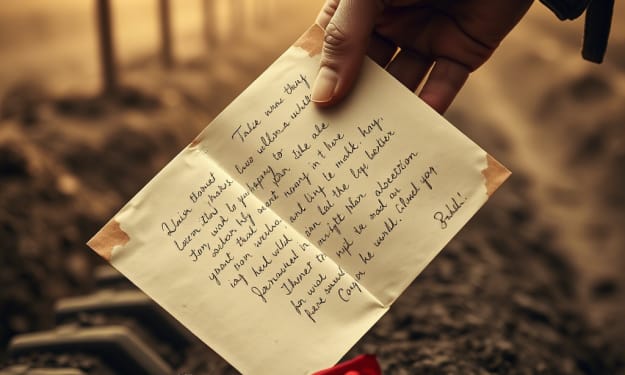
Note: Please read the rather long Author's Note at the end for the origin of this story. Dear Mom and Dad, Home seems a world away as I write this, and I guess, in a way, it is. While I'm writing these words, though, word is going out that we will be stateside within a few days. We have one last task ahead of us and then our tour here in this country is done.
By Dana Crandell11 months ago in History
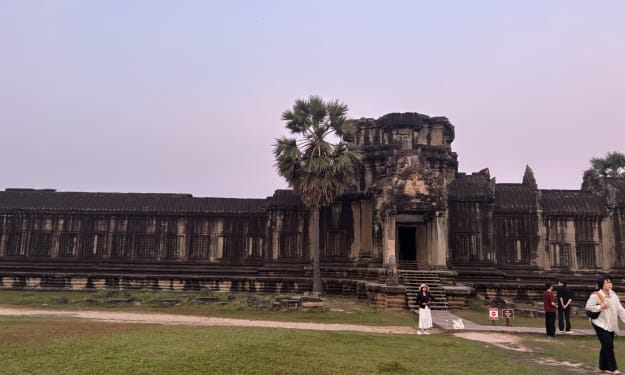
The forgotten history of The Kingdom of Cambodia. . Content Warning.
For those of us in the West who have heard of Cambodia without visiting, it may be seen as just a country in South East Asia that is not too well off. Those of us who have been lucky enough to travel to or simply read about this humble hidden gem, may know the rich yet dark history surrounding the Kingdom itself. I myself have been fortunate enough to travel here recently and spent about 3 weeks travelling throughout the country. From border towns and bustling cities with wild nightlife, to the vast green fields of rice paddies, all the way to the coast with some of the most gorgeous water I have ever seen. In my time spent in the country my eyes have been opened in more than one aspect.
By Jacob Newson11 months ago in History
Tutankhamun: The Greatest Archaeological Discovery of All Time
In the annals of archaeology, few discoveries have captured the world's imagination like the unearthing of Tutankhamun's tomb. Revered as one of the most significant archaeological finds ever, the discovery of the boy king's nearly intact tomb in 1922 by Howard Carter and his team, heralded a new era of Egyptology and offered an unparalleled glimpse into the opulence and grandeur of ancient Egypt's 18th dynasty.
By Francis Dami11 months ago in History
Explore the Spiritual Essence of Kamakshi Amman Temple: A Pilgrimage to Divinity in Kanchipuram
Nestled in the sacred city of Kanchipuram, Tamil Nadu, the Kamakshi Amman Temple stands as a beacon of devotion, history, and spiritual significance. Dedicated to Goddess Kamakshi, a revered incarnation of Parvati, this ancient temple has attracted devotees, historians, and spiritual seekers for centuries. Its rich cultural heritage, breathtaking architecture, and the deep-rooted belief in the power of its rituals make it one of the most prominent pilgrimage sites in India.
By Sri Kamakshi Ambal Temple11 months ago in History
Sati: A Comprehensive Exploration of History, Culture, and Law. Content Warning. AI-Generated.
Sati, or self-immolation, is a historical practice in which a widow sacrifices herself by ascending her deceased husband’s funeral pyre. Though often misrepresented as a religious rite, sati is a cultural tradition rooted in patriarchal norms and feudal honor systems. Banned in India since 1829 under British colonial rule and reinforced by modern legislation, sati remains a contentious symbol of gendered violence and societal control. This essay delves into the origins, evolution, regional variations, socio-cultural context, legal framework, and contemporary implications of sati, dispelling myths and highlighting its complex legacy.
By Nithisha PJ11 months ago in History
Guamanian: Culture, Language & Heritage
The Guamanian Chamorro people have a unique culture deeply rooted in the Mariana Islands. This chain of islands is in the Pacific. Their culture is a mix of old traditions and new influences. It shows a strong community spirit and respect for their heritage.
By The Big Bad 11 months ago in History
A sweet Potato Peel Pie Adventure.
Dear little one, It is a dreary February Saturday, the kind of day when you have to nap and do some task that is delegated for such a day as this. I must clean up a drawer. It contains my random notes and notebooks from times long past.
By Katherine D. Graham11 months ago in History