
Archaeologists Discovered 22000 Year Old Tracks That May Be From the World’s First Vehicle.
The World First Vehicle Found

Archaeologists Discovered 22000 Year Old Tracks That May Be From the World’s First Vehicle.
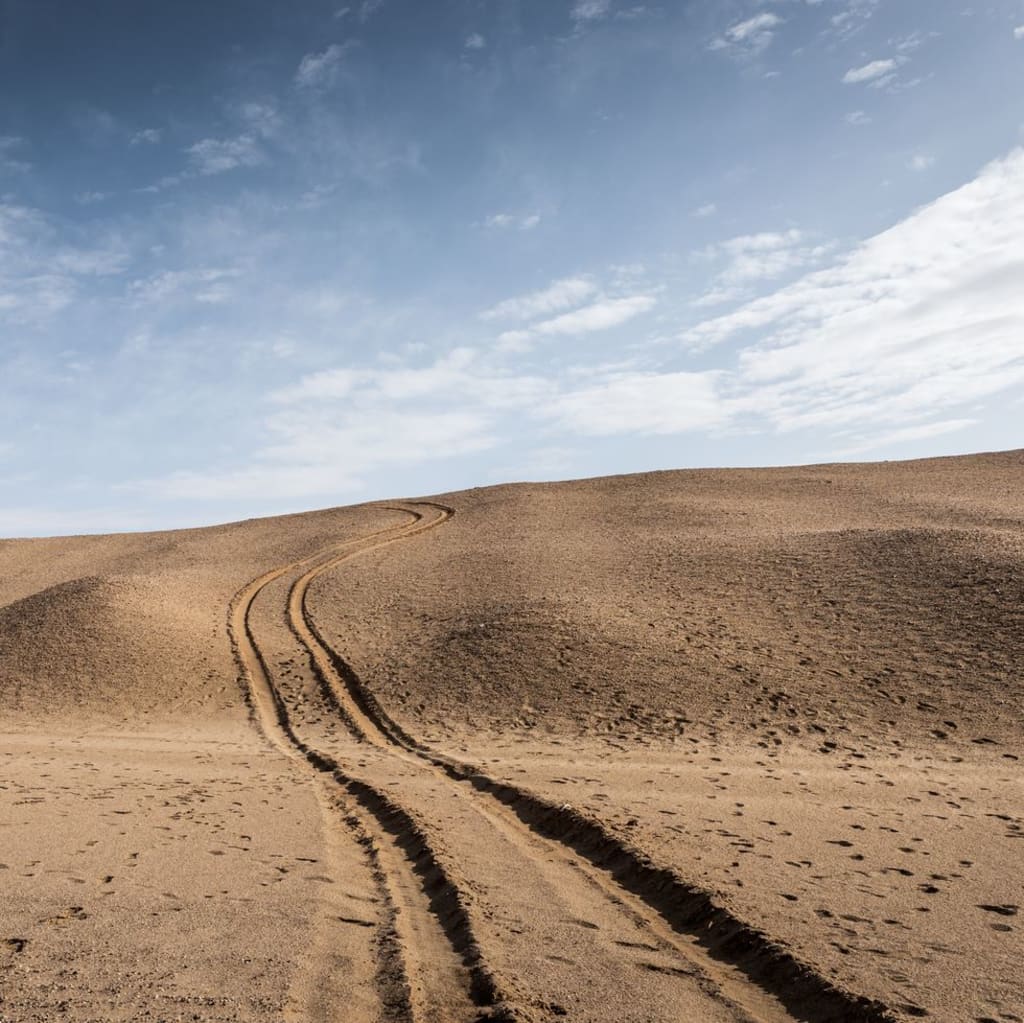
The discovery of 22000 year old tracks at White Sands National Park in New Mexico has shed new light on early human innovation and transportation methods. These tracks as revealed in a recent study published in Quaternary Science Advances suggest that ancient humans used a rudimentary vehicle known as a travois to transport goods or belongings. This finding challenges conventional perspectives on early transportation pushing back the timeline of non wheel based vehicles much further than previously thought. At the heart of this discovery are the linear impressions found alongside human footprints. Unlike ordinary tracks left by people walking these marks suggest the dragging of wooden poles indicating the use of a travois. This is a simple yet effective means of carrying heavy loads by lashing two poles together often in the shape of a triangle and pulling them along the ground. Such a transport method was widely used by Indigenous peoples in North America well into recent history particularly among the Plains tribes who adapted it for use with horses. However, this new discovery suggests that its use dates back much further to a time when humans were still navigating the challenges of Ice Age survival.
The presence of these tracks at White Sands National Park is significant for several reasons. First they provide tangible evidence that prehistoric humans had developed organized and systematic methods for moving goods. While the wheel is often considered the hallmark of transportation innovation the travois represents a much earlier stage in this evolutionary process. The ability to drag heavy objects efficiently would have had profound implications for survival enabling early humans to transport food firewood and even young children across vast distances. Moreover the discovery of multiple sets of tracks some with two parallel lines and others with a single line suggests variations in design and use. The two line tracks indicate that a traditional travois with two poles resting on the ground was employed while the single line tracks may have been caused by a version where the poles were joined at the front forming a point that made contact with the ground. This variability implies that the travois was a common and widespread tool rather than an isolated invention of a single group. It also highlights the adaptability of ancient humans who likely modified their tools based on terrain load and necessity.
Understanding the significance of this discovery requires placing it in the broader context of Ice Age human activity. Around 22000 years ago much of North America was covered by vast ice sheets and the climate was significantly colder than today. Early humans in this region were hunter gatherers reliant on their ability to move efficiently to track game find edible plants and locate safe shelter. The use of a travois would have been a game changer in this harsh environment reducing the physical strain of carrying heavy burdens and allowing for a more efficient distribution of resources within a group. The White Sands tracks are also remarkable because they add to a growing body of evidence that challenges traditional views on when humans first arrived in North America. Previous studies of footprints at this site have suggested human presence as early as 23000 years ago which is significantly earlier than many mainstream archaeological models have suggested. The addition of travois tracks to this archaeological record strengthens the argument that humans were well established in the region long before the end of the Ice Age.
One of the most fascinating aspects of this discovery is its implications for understanding the cognitive abilities of early humans. The invention and use of a travois demonstrate a sophisticated understanding of mechanics and efficiency. It suggests that these people were not merely surviving but actively seeking ways to improve their quality of life. They were problem solvers innovators and engineers in their own right developing technologies that would lay the groundwork for future advancements in transportation. The methodology used to date these tracks is another crucial aspect of the study. Scientists employed radiocarbon dating and other geological techniques to determine the age of the sediment layers in which the tracks were found. The consistency of the findings across multiple tracks confirms that these marks were made thousands of years ago ruling out the possibility of more recent interference. This rigorous scientific approach ensures the credibility of the findings and underscores the importance of White Sands National Park as a key site for understanding early human history.
In addition to the technological and historical insights provided by this discovery there is also an important cultural dimension to consider. The use of a travois is a testament to the ingenuity and resilience of ancient peoples and it connects directly to the traditions of Indigenous communities who continued to use similar transport methods well into recent history. Understanding the deep historical roots of such practices helps to bridge the gap between ancient and modern Indigenous cultures emphasizing the continuity of human adaptation and survival strategies over millennia. While the travois represents one of the earliest known forms of human transportation it also raises questions about what other innovations might have existed in prehistoric times. Were there other forms of load bearing devices that have yet to be discovered. Could the travois have been used in combination with other tools to further ease the burden of transportation. The answers to these questions may lie in future archaeological discoveries but for now the tracks at White Sands provide a fascinating glimpse into a world long past.
Ultimately the discovery of these ancient travois tracks is a groundbreaking contribution to our understanding of early human ingenuity. It highlights the complexity of prehistoric life and challenges us to reconsider the conventional timeline of technological development. Far from being primitive wanderers the people who left these tracks were resourceful and innovative employing clever solutions to the challenges of their environment. As research continues it is likely that more evidence will emerge further illuminating the rich and complex history of human adaptation and survival.
About the Creator
Adnan Rasheed
Author & Creator | Writing News , Science Fiction, and Worldwide Update| Digital Product Designer | Sharing life-changing strategies for success.
Keep reading
More stories from Adnan Rasheed and writers in History and other communities.
Pilot Last Words Before Plane Crash 😔
Pilot Last Words Before Plane Crash Air travel is considered one of the safest modes of transportation but when an aircraft crashes it turns into a massive tragedy. After a crash the most important question is What happened. The answer to this question is often found in the black box a device installed in every aircraft that records the pilots' final conversations and flight data. Many times the recordings in the black box contain words that reflect fear surprise helplessness or even courage. Some words send chills down the spine while others become immortal last messages to the world. Here we take a detailed look at five unfortunate flights their final words and the stories behind them.
By Adnan Rasheed11 months ago in History
Stanislav Kondrashov Oligarch Series: Echoes of Influence in Southern Italy
Oligarchy isn’t always written into the laws of a country. Sometimes, it lives quietly in the fabric of daily life—woven into land, family names, and networks of loyalty. Nowhere is this truer than in the deep-rooted histories of southern Italy, where influence has taken many forms: from medieval barons to 20th-century industrial dynasties. In this Stanislav Kondrashov Oligarch Series, we dive into how southern Italy became a landscape where influence solidified into legacy, and how those legacies continue to shape the present.
By Stanislav Kondrashov2 days ago in History
Vlad Țepeș
Vlad Țepeș: Sovereignty Written in Blood History remembers kings by their victories, saints by their sacrifices, and tyrants by their cruelties. Vlad Țepeș is remembered by all three and understood by none. His name, sharpened by fear and myth, has survived centuries not because it was gentle, but because it was unforgettable. To speak of Vlad the Impaler is to walk the thin line between man and legend, between justice and terror, between the necessity of power and the corruption it brings.
By Pure child2 days ago in History
Ludacris and Nelly draw backlash over bookings at MAGA-coded music festival
Ludacris and Nelly headlining a mostly right-wing event is good for them. It’s also great for the genre of hip hop. The two rap veterans have showcased their talents on other stages. Why can’t they perform for mostly MAGA folks and grab that bag?
By Skyler Saunders3 days ago in Beat




Comments
There are no comments for this story
Be the first to respond and start the conversation.