
"Echoes from the Trenches: A Love and Loss Story of World War I"
"The Role of Letters in Sustaining Hope and Connection Amidst War"

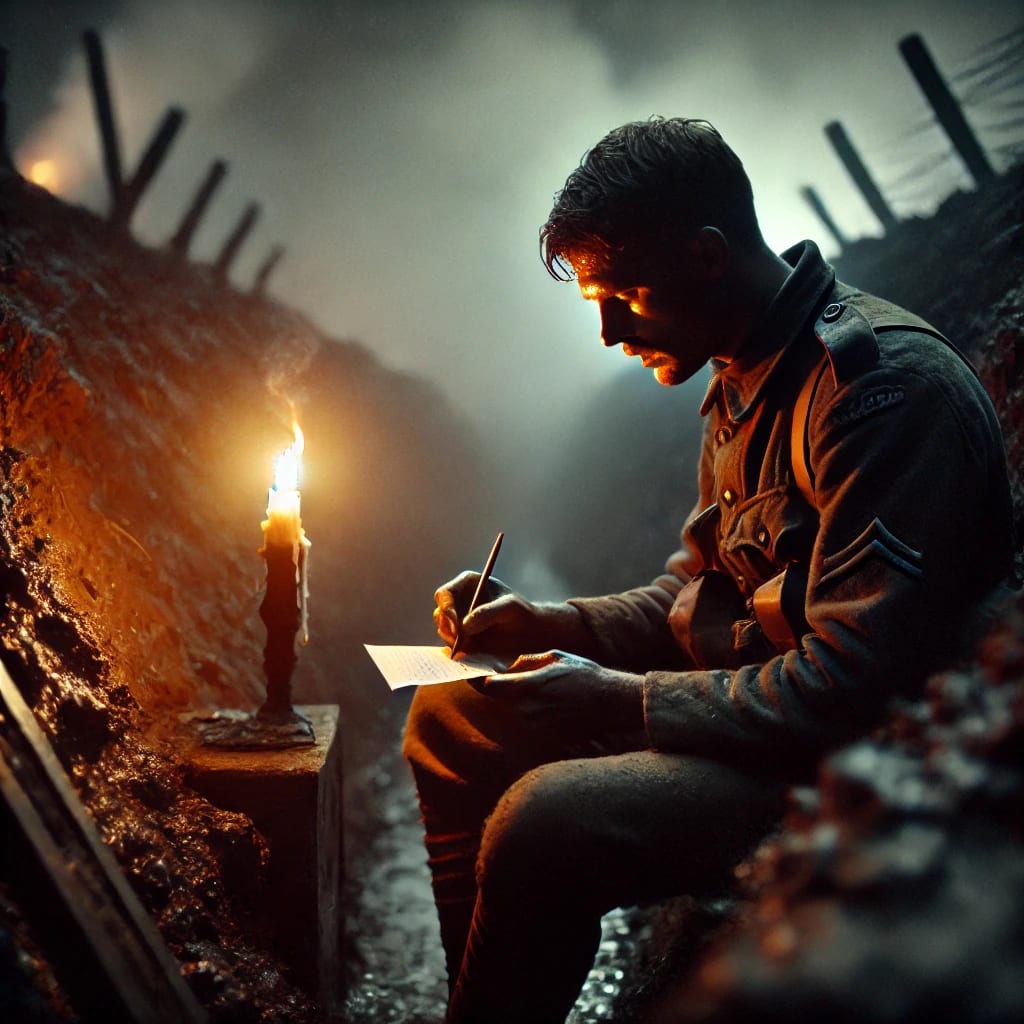
Letter 1: Private James Whitford to Nurse Eleanor Hartley
12th November 1916, Somme Sector
Dearest Miss Hartley,
Do you recall the day we met? It was raining—a cold, spiteful drizzle that seeped through the seams of my greatcoat—and I’d been hauled into your field hospital on a stretcher, half-mad with pain from the shrapnel in my leg. The air reeked of carbolic and blood, and somewhere, a man was screaming for his mother. But you appeared like a specter in that chaos, your apron streaked with rust-colored stains, and pressed a tin mug of tea into my hands. “Drink this,” you said, your voice steady as a metronome. “You’ll live to see another sunrise.”
How strange that such a small act of kindness could anchor a soul. I’ve replayed that moment a hundred times in the mud here. They’ve moved us back to the front now, to a stretch of trench they call “Devil’s Acre.” The walls ooze with sludge, and the rats are bold enough to gnaw at a man’s boots while he sleeps. Last night, young Private Hooper—a lad from Yorkshire with a sweetheart named Maggie—was caught in a sniper’s sight. We buried him at dawn, his pockets stuffed with letters he’ll never post.
But when the darkness closes in, I think of you. Of how you tucked a blanket around Private Collins as he trembled with shell shock, murmuring, “Hush now, you’re safe.” You’ve a soldier’s courage, Eleanor, though you wear no uniform. Forgive my forwardness in using your Christian name. Here, where death leans on every sandbag and the sky rains iron, propriety feels as distant as peace.
I write this by candlelight, the flame guttering in the damp. Do you ever glance at the stars from your infirmary window? However broken the world, they burn just the same.
Yours ever faithfully,
James
Letter 2: Eleanor Hartley to James Whitford
3rd December 1916, Field Hospital 14, Calais
My dear James,
Your letter arrived this morning, creased and smudged with mud, as though it had fought its own battle to reach me. I read it twice, then hid it beneath my pillow—a secret to warm me during the long nights.
You speak of courage, yet it is I who marvel at yours. Yesterday, a boy no older than seventeen died in my arms, whispering his mother’s name. His hands were still blistered from the factory where he’d worked before enlisting. I could not save him. But your words—your remembrance of small kindnesses—remind me why we endure this.
The hospital overflows. We’ve run out of morphine, and Sister Wilkins insists we reuse bandages. Last week, a lieutenant with a gangrenous foot begged me to write to his wife. “Tell her I died quickly,” he said. I lied.
You mentioned Sussex once—the chalk cliffs, the sea’s briny breath. I grew up in a vicarage in Kent, where Father preached sermons on God’s mercy. Now, when I kneel to pray, I hear only the groans of men. Will you tell me more of your home? Of yourself? The world feels vast and hollow, but your letters stitch the fragments together.
You are not forward. In this shattered place, we must grasp what light we can.
Yours in hope,
Eleanor
Letter 3: James Whitford to Eleanor Hartley
24th December 1916, Somme Sector
Eleanor,
Tonight, the Germans sang Stille Nacht across No Man’s Land. We answered with God Rest Ye Merry, Gentlemen. For a few hours, the guns fell silent. Men exchanged cigarettes and tins of bully beef, and a Saxon with a busted spectacles showed me a photograph of his daughter. “Greta,” he said, tapping the image. “Zwei Jahre alt.” Two years old.
I thought of you stitching wounds by candlelight, your hair escaping its pins. How I wish I could shield you from all this. They’re sending us over the top at dawn. Captain says it’s a “push to break the stalemate,” but we all know it’s a death sentence. I’ve made my peace, or tried to. The chaplin handed out crosses on strings this morning—tin things that leave a metallic taste on the tongue.
But I need you to know: these letters have been my lifeline. In Sussex, I was a gardener’s son, you a curate’s daughter. We’d have passed each other in the village with polite nods. Here, you’ve seen my fear, my frailty, and called it courage.
If I don’t return— No. Let me say instead: when the spring comes, look for the first crocuses by the churchyard wall. They’re stubborn little things, blooming through frost. Like you. Like us.
Yours, always,
James
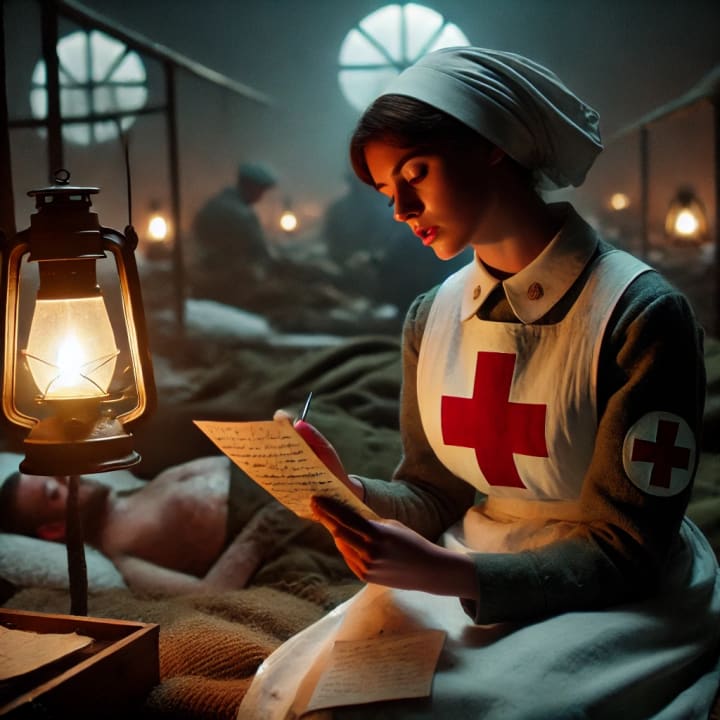
Letter 4: Eleanor Hartley to James Whitford
2nd January 1917, Field Hospital 14, Calais
James,
Your Christmas letter reached me today. The crocuses will rise, as you said, but oh, how I wish you’d be here to see them.
Word came yesterday of the assault. They told me you were brave—that you carried two wounded men to safety before— My hands shake. The ink blurs.
Do you remember Private Adams? The boy with the harmonica? He sits by his brother’s cot now, playing It’s a Long Way to Tipperary until the nurses scold him. Last night, I found him weeping in the supply closet. “They’re all gone, Sister,” he said. “All of them.”
I keep your letters tied with a ribbon from my apron. When the war ends, I’ll take them to Sussex and read them where the sea meets the sky. You’ll be in every petal, every sunrise.
You asked once why I work so tirelessly. It was never duty alone. It was you.
Goodbye, my dearest friend. My love.
Yours beyond the veil,
Eleanor
Letter 5: Eleanor’s Diary Entry
15th February 1917, Sussex
The vicarage is quiet now. Father’s cough worsens, and Mother frets over ration cards. This morning, I walked to the churchyard. Frost clung to the grass, brittle as bone, but there they were—crocuses, purple and gold, pushing through the iron-hard earth.
I knelt and pressed your last letter to my chest. A breeze carried the scent of the sea, and for a moment, I could almost hear your voice: “However dark the night, they remind me that beauty persists.”
They call you a hero in the village. A plaque will hang in the chapel. But what use are laurels to the dead?
I wear your mother’s locket now. Inside, she’s tucked a sprig of lavender from your garden. “He’d have wanted you to have it,” she said. We did not speak of the letters. Some truths are too fragile for words.
Letter 6: James’ Unposted Draft
Undated, found in his effects
Eleanor—
The stars are out tonight. Funny, how they still shine.
I’ve been thinking of Sussex in spring—the bluebells in Cuckmere Haven, the way the Downs turn green after rain. I’d have liked to show you the old oak by the river. We could’ve picnicked there, with bread and cheese and a flask of cider.
But this war has a way of stealing futures. If you read this, know that I meant every word. You are my crocus in the frost.
Always,
James

"Thanks for reading! ✨ If this spoke to you, let’s keep the conversation going leave a comment, hit that heart, and subscribe for more stories that spark growth! 🚀
About the Creator
sasanka perera
"Blogger ✍️ | Reviewer ⭐ | Traveler 🌍 | Storyteller 📖 | Sharing creative stories, insightful reviews & unique perspectives with authenticity. Join me on a journey of discovery & inspiration! ✨"
Keep reading
More stories from sasanka perera and writers in History and other communities.
The Quiet Name on Maple Street
Kim Jong-un was born into a world unlike almost any other—a world sealed by borders, ideology, and secrecy. As the grandson of Kim Il-sung, the founder of North Korea, and the son of Kim Jong-il, the country’s second leader, Kim Jong-un entered life already wrapped in destiny. In North Korea, leadership is not chosen by ballots or debate; it is inherited like a crown, reinforced by loyalty, fear, and an unyielding political system.
By The best writer 2 days ago in History



Comments
There are no comments for this story
Be the first to respond and start the conversation.