Lessons
🧻 The Toilet Paper Panic Buying During Various Pandemics: How a Mundane Household Item Became a Symbol of Global Anxiety
Part I: A Curious Phenomenon — Panic in the Aisles In the early months of the COVID-19 pandemic, a peculiar sight became common across the globe: barren supermarket shelves where once stood neat stacks of toilet paper. This wasn’t an isolated event. From Tokyo to Toronto, from Milan to Melbourne, scenes emerged of people rushing into stores, carts overflowing with bulky packs of toilet rolls, sometimes wrestling them away from fellow shoppers in desperate attempts to “stock up.” The rush on toilet paper became one of the most vivid, surreal images of the global health crisis, replayed in countless news reports and social media posts. As viral as the virus itself, these panic-buying frenzies turned toilet paper — a soft, white, everyday necessity — into a symbol of a world unmoored by fear.
By Kek Viktor8 months ago in History
Endless Struggle: The Israel-Palestine Conflict and the Human Cost of Power Politics
Introduction In the heart of the Middle East lies a conflict that has withstood the test of time, politics, and countless peace talks — the struggle between Israel and Palestine. What began as a territorial dispute in the early 20th century has spiraled into one of the most emotionally charged and politically complex crises in modern history. Today, it’s no longer just a battle over land, but a fight for identity, dignity, and survival. The Israel-Palestine conflict continues to claim lives, displace families, and divide nations, with its impact felt far beyond the borders of Gaza and Jerusalem.
By Umar Khattak8 months ago in History
Trump's Speech about Jerusalem: An Analysis on Persuasive Strategies. AI-Generated.
INTRODUCTION Jerusalem is a holy place where several beliefs and faiths live together. Islam, Christianity and Jews live and do worship in that city (BBC, 2017). Its territory surrounds Palestine and Israel. Both countries have been being a great rivalry in an old-world war since 1948 (Margolick, 2008). Donald Trump as the president of USA showed his sympathy toward both a long-world war and it was stated through his political speech. Stobbs (2012) considered that political speeches are written with a very great plan and purpose. As the president of USA, Trump is the most influential person in the world. His word will always provoke great responses from all people over the world. He showed his remark on his speech about Jerusalem on 23rd May 2017. Through his speech, he expected the three religions in Jerusalem, such as Jews, Islam and Christianity can build peace together. On 6th December 2017, Trump declared Jerusalem as the capital city of Israel. It provoked pros and cons from several leaders of nations over the world. He stated that his claim was to stop the war between Israel and Palestine, and to achieve peace. Through his speech, Trump intended to show his power and communicate what he wanted to. Speech is one the ways of having communication (Soedjarwo, 2020). In having communication, the speaker influences hearer to believe in what he says or doing something that he wants to. Alfian, Santi, and Sari (2019) stated that a good communication depends on how speaker can achieve the goal of what he says. Speaker absolutely persuades hearers to achieve the goals of communication. In Persuading hearers, speaker can uses persuasive strategies. Speaker uses persuasive strategies to influence other people through utterance without doing compulsion. Gass and Seiter (2010) stated that persuasion is an attempt to influence hearers motives and attitudes.
By Silas Blackwood8 months ago in History
A Historical Account of Difference: A Comparative History of the Literary Cultures of Lat- in America
Abstract: In his article "A Historical Account of Difference: A Comparative History of the Literary Cultures of Latin America," Mario J. Valdés addresses the well-recognized limitations of literary history as historical research. Valdés outlines the theoretical thinking that has guided the editors of The Oxford Comparative History of Latin American Literary Cultures to plan, organize, and com- plete the first history of literary culture of Latin America. The project is comparative, recognizing the radical diversity of the continent while at the same time it is an open-ended history that in- forms but does not attempt to provide a totalizing account of more than five hundred years of cul- tural development among the heterogeneous entities that make up Latin America. Valdés begins by considering the paradox of literary history, he then suggests ways that literary history can be shaped by the work of Michel Foucault, and he proposes a framework for a hermeneutics of literary history. Valdés also considers the challenges that face the literary historian whose work now in- cludes cultural history. All of these considerations are then placed within the context of an effort to create a literary and cultural history of Latin America.
By Silas Blackwood8 months ago in History
Beneath the Surface: The Kolar Gold Fields Story
The Gold Mine That Yielded 800 Tons: Discovered by a British East India Company Officer Just 90 kilometers away from the bustling city of Bengaluru lies Kolar, home to India’s largest gold mine—an underground marvel that has fascinated historians, geologists, filmmakers, and economists alike. Known as the Kolar Gold Fields (KGF), this mine has not only played a significant role in India's mining history but has also become a symbol of ambition, struggle, and forgotten glory.
By Ikram Ullah8 months ago in History
A Man Named Albert
The Civil War is probably one of the most important facets of American history taught in schools today, and for very good reason. It was by far the bloodiest and most brutal war Americans have ever been engaged in; brothers killing brothers, almost destroying the entire country from within. Perhaps that speaks to the stubbornness of Southern Americans in general, and their deeply ingrained inability to admit when they are wrong. The Civil War might just have been the darkest period in United States' history, which is why it's so important for our young people to study it. American schoolchildren are taught endlessly about the battles that were fought, the reasons their forefathers went to war, and the important figures who emerged on either side of it. More often than not, however, there are some people who are regularly forgotten. And of the forgotten few, one man just may be the most important of them all.
By Natalie Gray8 months ago in History
2024 Election Fallout: Supreme Court Rules on Trump’s Immunity Case
Introduction In a historic decision that could reshape the future of U.S. presidential accountability, the Supreme Court ruled on former President Donald Trump’s immunity case in 2024. The case, Trump v. United States, centered on whether a former president enjoys absolute immunity from criminal prosecution for actions taken while in office. The ruling not only impacts Trump’s multiple legal battles but also sets a precedent for the limits of executive power. This article examines the Court’s decision, its legal and political implications, and the potential consequences for the 2024 election and beyond. Background: The Legal Battle Over Presidential Immunity
By Silas Blackwood8 months ago in History
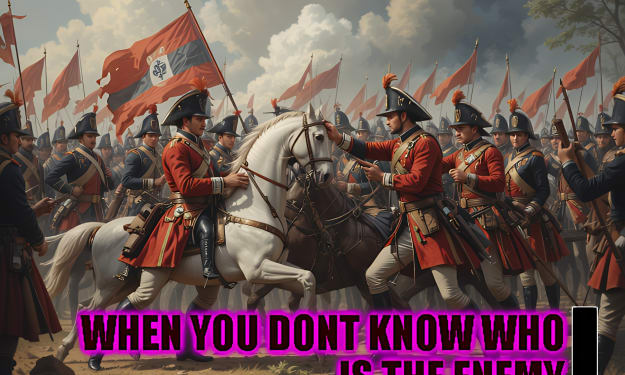
The Battle of Karansebes, 1788: The Austrian Army Accidentally Fighting Itself in the Chaos of War
Among the most bewildering and farcical episodes in military history, the Battle of Karansebes stands out as a stunning example of miscommunication, panic, and human error spiraling out of control. Fought during the Austro-Turkish War of 1787–1791, the event is infamous not for a valiant clash with the Ottoman enemy, but for a chaotic episode where an Austrian army ended up attacking itself. Taking place on the night of September 17–18, 1788, in what is now modern-day Romania, the so-called battle involved confusion, fear, and an abundance of alcohol - ultimately leading to hundreds of Austrian soldiers dead or wounded by friendly fire, long before the Ottomans even arrived.
By Kek Viktor8 months ago in History
Ashes of Pompeii: The Day the Sky Fell
**Ashes of Pompeii: The Day the Sky Fell** **Pompeii, Roman Empire – August 24, 79 AD** The morning sun was already warm as Lucia, the 16-year-old daughter of a wealthy merchant, stepped onto the balcony of her family’s villa in Pompeii. The sky above was a serene blue, and in the distance, the great mountain—Vesuvius—stood quietly, cloaked in a light mist. Lucia could hear the clatter of hooves and the distant calls of market sellers echoing through the city.
By Asia khanom8 months ago in History
🌷 The Tulip Mania Bubble in the Dutch Republic, 1636–1637: When Tulip Bulbs Became the World's Most Valuable Commodities Before the Crash
🏩 Part 1: A Blooming Republic - The Dutch Golden Age and the Rise of the Tulip In the early 17th century, the Dutch Republic stood at the pinnacle of European power and prosperity. This confederation of provinces, recently liberated from Spanish rule after decades of conflict, had rapidly evolved into a formidable maritime, financial, and cultural powerhouse. The Dutch Golden Age, as historians now call it, was marked by explosive growth in global trade, scientific exploration, art, and banking.
By Kek Viktor8 months ago in History