

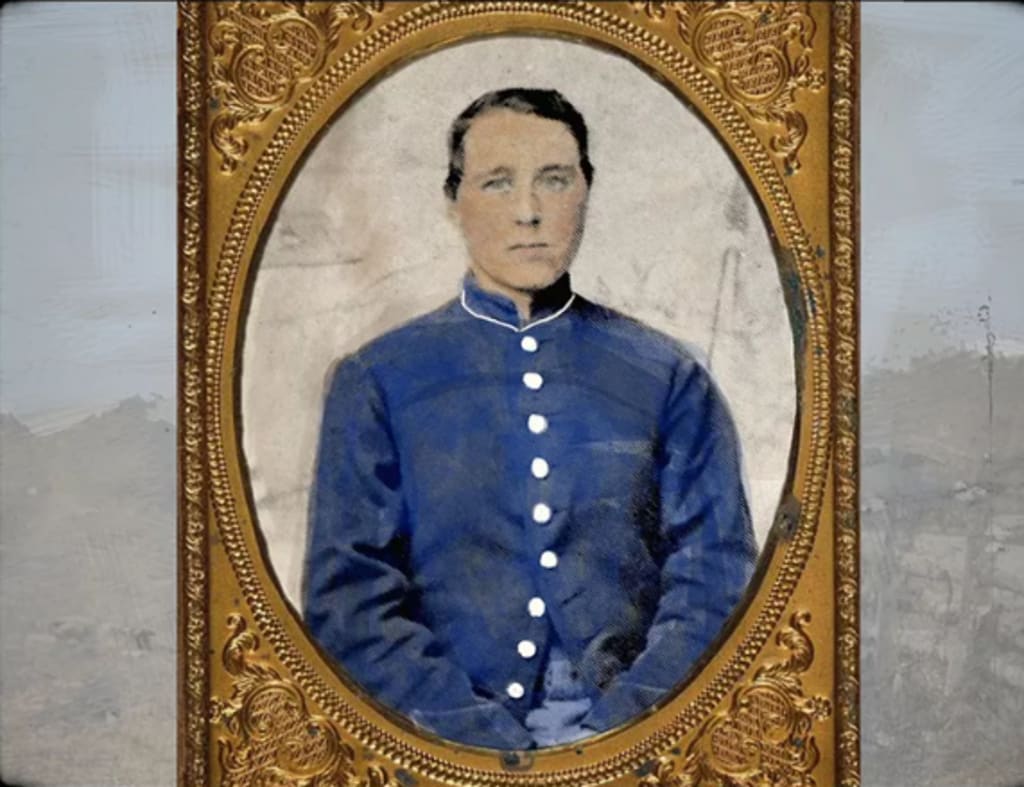
The Civil War is probably one of the most important facets of American history taught in schools today, and for very good reason. It was by far the bloodiest and most brutal war Americans have ever been engaged in; brothers killing brothers, almost destroying the entire country from within. Perhaps that speaks to the stubbornness of Southern Americans in general, and their deeply ingrained inability to admit when they are wrong. The Civil War might just have been the darkest period in United States' history, which is why it's so important for our young people to study it. American schoolchildren are taught endlessly about the battles that were fought, the reasons their forefathers went to war, and the important figures who emerged on either side of it. More often than not, however, there are some people who are regularly forgotten. And of the forgotten few, one man just may be the most important of them all.
On August 6th, 1862, a young man named Albert D.J. Cashier enlisted with the 95th Illinois Infantry. He was only eighteen, fair-skinned, with auburn hair and bright blue eyes. By far, he was the shortest and skinniest of his fellow enlisted, standing at barely five-foot-three and weighing no more than 110 pounds. No one knew much about him, as he was quiet and kept to himself mostly, but the accent he carried was unmistakably Irish.
He didn't know how to read or write, as he signed his enlistment papers with an "X". Being literate was not a requirement for the Union Army, however. Albert may have been young and uneducated, but he was strong, dedicated, and not afraid of hard work. While he chose to occupy his tent alone, he was polite and got along well with the other soldiers. Despite his odd and introverted nature, Albert proved himself to be a good soldier. Before long, he was just "one of the boys"; well liked and respected by everyone who served alongside him.
Albert's career in the Union Army was long and commendable. He fought in over forty battles, including Vicksburg, the Battle of Nashville, the Red River Campaign, and the battles of Kennesaw Mountain and Jonesborough, Georgia. He even served under General Ulysses S. Grant, as part of the Army of the Tennessee. At one point, Albert was taken prisoner by the enemy, but he managed to overpower the man guarding him and escape. After three long years with the 95th and marching over nine thousand miles, Albert was finally and honorably discharged with the rest of his company on August 17th, 1875. They had lost nearly 300 men by then, but Albert had managed to survive the hellish war.
Once the Confederacy surrendered, Albert transitioned quietly into civilian life. He worked as a church janitor, a farmhand, a lamp lighter, and a grave digger, as well as other odd jobs. For most of his adult life he was homeless, traveling around the town of Belvidere, Illinois, and the surrounding towns, working in exchange for a place to hang his hat for the night. Whether he chose to live as a rolling stone or simply couldn't afford to buy or build his own house was unclear, but it seemed that Albert cared more about helping his community than earning a living wage. Eventually, one of his employers - Joshua Chesbro - took the liberty of building a small, one-room house for Albert on the corner of his property in 1885, as a thank you for all his hard work. And Albert happily made it his own.
For the next forty years, Albert continued his quiet lifestyle. He had become a pillar of the community, making a habit of helping out his neighbors whenever they were in need, even though he lived rather humbly himself. He proudly participated in elections, casting his vote with his fellow men as part of his civic duty, and after a while he even qualified to draw pension as a veteran in 1907.
Around 1911, Albert was working for a state senator, Ira Lish, when he was accidentally struck by the senator's car. The accident resulted in Albert suffering a broken leg, and he was admitted to the Illinois Soldiers and Sailors Home to recover from his injury. By that time, Albert was well into old age, and looking forward to spending his declining years there in comfort, surrounded by members of his old company. A few years later, however, everything began to quickly unravel.
Not long after he moved into the Soldiers Home, Albert showed signs of failing mental faculties, and was shortly after diagnosed with dementia. As the Soldiers Home was unable to manage his rapidly declining condition, they moved Albert to the Watertown State Hospital for the Insane in 1913. Before long, the attendants caring for Albert at the asylum made a shocking and unusual discovery.
Albert was female.
With the help of state records and Albert's rambling stories about his childhood in Ireland, they were able to divulge the truth about him. He had been born Jennie Irene Hodgers, in Clogherhead, County Louth, Ireland, on December 25th, 1843. Although Albert had been assigned as a girl at birth, he'd lived his entire adult life as a man after immigrating to America. None of his friends or former brothers in arms had any idea of Albert's origins, and they were understandably shocked when they found out. It wasn't long before Albert's story made it to the local papers, and soon after that it traveled all the way to the veteran's pension board.
The members of the board launched a full investigation into Albert's involvement with the 95th Infantry. They tried to charge him with fraud, for enlisting as a man even though he'd been born a woman, and threatened to strip him of all his well-earned benefits. Thankfully, Albert's old comrades fought back for him, insisting that he was indeed the same person who'd served with them and providing proof of all his courageous efforts during the war. Eventually the board conceded to their wills, allowing Albert to keep collecting his pension checks until the end of his life. But that was only half the battle.
Poor Albert was treated miserably at the asylum. His attendants forced him to wear dresses, and constantly addressed him as his given name, Jennie. Again, Albert's comrades protested this degrading treatment on his behalf, as he had lived the last fifty years happily as a man. All their complaints fell on deaf ears, however, until Albert sadly passed away on October 10th, 1915.
After his death, Albert's surviving brothers in arms put him to rest at Sunny Slope Cemetery in Saunemin, Illinois. Albert was given full military honors at his funeral, buried in his uniform with his preferred name inscribed upon his tombstone. His name has since been added to the Illinois Memorial at the Vicksburg National Military Park, and his one-room house is now a historic site. Today, many people consider Albert Cashier to be one of America's first well-known trans men, and the first transgender soldier to serve in the U.S. Army. SPARTA - a transgender military advocacy organization - has even created an award in his name, which is proudly given to honor trans soldiers for their excellence in contributing to the transgender military community.
Although the end of Albert Cashier's life was tragic, the legacy he leaves lives on. The true tragedy is that his story is not as widely taught in American classrooms, often glossed over by the more "important" figures relating to the Civil War. It is this author's opinion that such omissions are narrow-minded and grossly unfair, not just to Cashier's memory but to the many American youths who identify with his struggles. We need to show our young people not to fear being who they are if, like Albert, they happened to be born in a body that doesn't match who they are in their minds and souls. Those young people need a figure like Albert Cashier, who lived his life according to his own doctrine in a time where such things were not only unspeakable but actively punished by imprisonment, commitment, or death.
If he could do it, so can you.
About the Creator
Natalie Gray
Welcome, Travelers! Allow me to introduce you to a compelling world of Magick and Mystery. My stories are not for the faint of heart, but should you deign to read them I hope you will find them entertaining and intriguing to say the least.
Keep reading
More stories from Natalie Gray and writers in History and other communities.
All My Love, Buford McClaine. Runner-Up in Love Letters Through Time Challenge.
July 4th, 1861 To my Darling Rebecca, Not a day goes by that I do not think of you. Right now, I wish with all my heart that I could be there today at your uncle's plantation. My mouth waters at the thought of all I will be missing at that barbecue. I can smell the pit now, with those hogs all dressed and sizzling away on it, just about ready to eat. Were I not a gentleman, I might insist that you try to save some for me, and send it up here in a basket. The mail around here is awful slow lately, however, and some of the boys running it get powerful hungry. If you ask them, though, they will blame the half-open care packages they give us on mice. Such was the fate of that sponge cake you tried to send me on my birthday, which I am told was delicious.
By Natalie Grayabout a year ago in History


Comments
There are no comments for this story
Be the first to respond and start the conversation.