Lessons
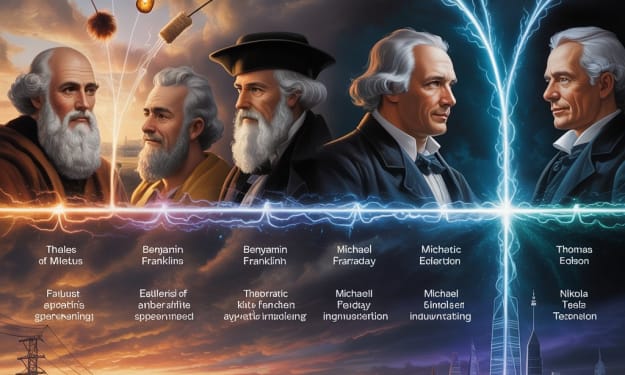
The Spark That Changed the World. AI-Generated.
Long ago, before cities glowed at night and phones buzzed with messages, the world was dark when the sun went down. Fires lit the way, oil lamps flickered in homes, and the sky’s lightning was the only dramatic display of power people could witness. Electricity—today so essential to daily life—was once a mystery, a force unseen, misunderstood, and thought to belong only to the gods.
By Zain Ul Abedin Khan8 months ago in History
Waves Through the Air. AI-Generated.
At the dawn of the 19th century, the world was bound by wires. Telegraphs clicked and tapped along cables that snaked across continents and oceans, delivering messages with astonishing speed—at least by the standards of the time. But for all their brilliance, these systems had a tether: metal wires that needed to be laid, maintained, and protected. The dream of sending a message through the air—untethered and invisible—remained just that: a dream.
By Zain Ul Abedin Khan8 months ago in History
99-million-year-old dinosaur tail found preserved inside amber fossil
**99-Million-Year-Old Dinosaur Tail Found Preserved Inside Amber Fossil** In one of the most extraordinary paleontological discoveries of the 21st century, scientists have uncovered a 99-million-year-old dinosaur tail preserved in amber. This rare and stunning find, unearthed in Myanmar, has provided researchers with a unique glimpse into the ancient world, revealing incredible details about feather evolution, dinosaur biology, and the ecosystems of the Cretaceous period.
By GLOBAL NEWS8 months ago in History
Creative Cruelties
I could not choose one specific moment that history would burn, so I highlighted a few. Each one deserves a more indepth look, for us to appreciate where we come from. But each one also is more than enough for us to know, without doubt, to be better.
By Kelli Sheckler-Amsden8 months ago in History
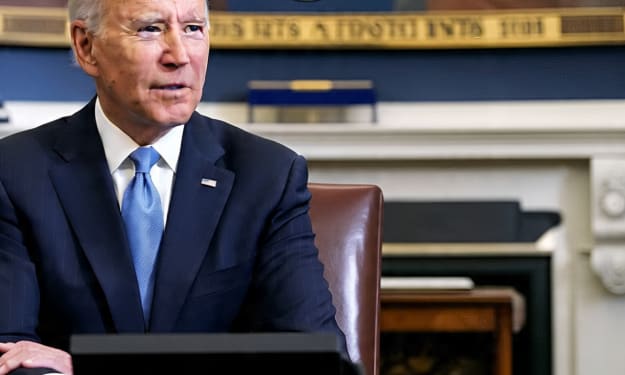
Joe Biden. AI-Generated.
Joe Biden was born on November 20, 1942, in Scranton, Pennsylvania, a small city in the United States. He grew up in a working-class family. His father, Joseph Biden Sr., worked very hard to take care of the family. At times, the family had little money. But they stayed strong and close together.
By Khalil Rehman8 months ago in History
All the Light We Cannot See – Anthony Doerr
The sky over Saint-Brieuc was heavy with clouds, the kind that hung low and pressed against the roofs like a threat. Though the war had quieted in the north, its whispers still roamed the air—through radio static, cracked windows, and the wary glances of strangers.
By Jawad Khan8 months ago in History
Gerrymandering the Presidency: Why Trump could lose the popular vote in 2020 by 6 percent and still win a second term.
Donald Trump was the clear Electoral College winner in the 2016 election, despite losing the popular vote by a wide margin to Hillary Clinton. Anthony J. McGann, Charles Anthony Smith, Michael Latner and Alex Keena write that, unless the Supreme Court stops congressional gerrymandering, President Trump can guarantee re-election in 2020 – even if he loses by 6 percent. When the US Supreme Court takes up the issue of partisan gerrymandering this year, they will decide not only the fate of popular control in the House of Representatives and many state legislatures, but quite possibly the Presidency as well. If four Republican controlled state governments (Pennsylvania, Michigan, Wisconsin and Florida) change the way they allocate Electoral College votes, President Trump could be re-elected in 2020, even if he loses the popular vote by 6 percentage points. All the states need do is to allocate Electoral College votes by congressional district (like Nebraska and Maine), instead of giving all of the state’s electors to the statewide winner. Of course, this strategy only works to the benefit of the Republicans because the congressional districts in these states are heavily gerrymandered. As we argue in our book Gerrymandering in America, the congressional districts in many states are drawn to advantage the Republican Party. For example, in Pennsylvania in 2012 the Republicans took 13 out of 18 House districts even though the Democrats received more votes. If this partisan gerrymandering were outlawed, then allocating Electoral College votes by congressional district in the four states would actually disadvantage the Republican candidate for President. However, if the Supreme Court continues to allow partisan gerrymandering – as it has since its decision Vieth v. Jubelirer in 2004 – then the plan is highly effective and there is nothing that can stop the four states adopting it. Allocating Electors by congressional district is clearly legal – Nebraska and Maine already do it this way. Furthermore, the Republicans control the state legislature and the governor’s mansion in all four states. How allocating Electors by congressional districts could benefit the Republican candidate Surprisingly, the strategy that is most effective for the Republicans is to change how Presidential Electors are allocated in certain states that voted for Trump in 2016. Of course, the Republicans would get an advantage by allocating Electors more proportionally in states that Clinton won. The problem is that this would require the support of Democrats. For example, Republican legislators in Virginia and Minnesota have already proposed such measures, and Stephen Wolf describes this as an attempt to “gerrymander the electoral college”. The problem is that both these states have Democratic governors, who would surely veto such proposals. Similarly Harry Enten at fivethirtyeight.com shows that if all states allocated Electors by Congressional districts, the Republicans could win the Presidency despite a 5 percent popular vote deficit. Again the problem is that this would require Democratic controlled states to agree to such a system. However, in Pennsylvania, Wisconsin, Michigan and Florida, Republicans control both the state legislature and the
By Silas Blackwood8 months ago in History
🤢The Great Stink of London, Summer 1858: How the Thames River's Filth Nearly Shut Down Parliament and Sparked Sewer Reforms
The Summer That Stank to High Heaven In the sweltering summer of 1858, London became the setting for one of the foulest crises in urban history. For several weeks, an unbearable stench rose from the River Thames, the city's main waterway and open sewer, engulfing the metropolis in a nauseating miasma that no one - not even the powerful lawmakers in the Palace of Westminster - could escape. The event, which became known as "The Great Stink," was more than just a sensory nightmare; it was a pivotal moment in the evolution of public health and urban infrastructure.
By Kek Viktor8 months ago in History
Major Tufail Muhammad Shaheed
Major Tufail Muhammad Shaheed is a name etched in the golden pages of Pakistan's military history. A man of unshakable courage, devotion to duty, and exceptional leadership, Major Tufail laid down his life defending Pakistan's borders and became one of the country's most celebrated war heroes. He was posthumously awarded Nishan-e-Haider, Pakistan’s highest military award for valor, becoming the second recipient of this prestigious honor.
By ijaz ahmad8 months ago in History