
The father of the atomic bomb! Who is this Oppenheimer?
Oppenheimer - The father of the atomic bomb!
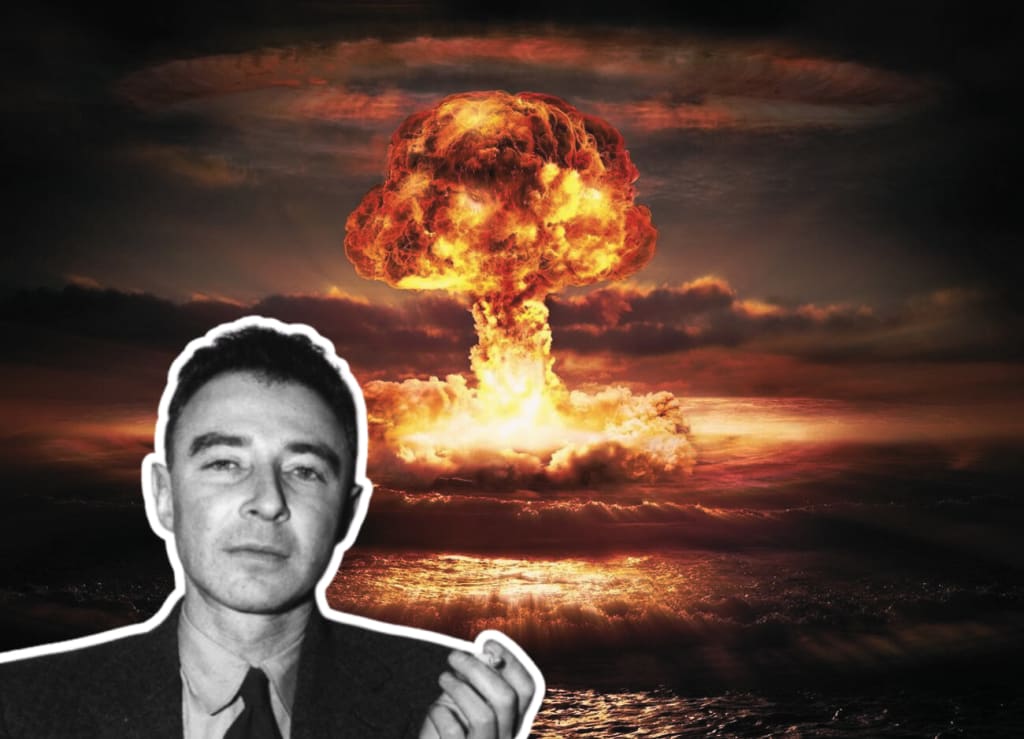
Christopher Nolan's new movie 'Oppenheimer' was released on July 21, 2023. And Nolan means noise in the cinema. He has made many successful movies like Interstellar, Dark Knight Trilogy, Inception. However, this time the story is a little different. Because at the center of this movie is a man whose decision changed the course of World War II. He is Robert J. Oppenheimer, who is also called the father of the atomic bomb.
However, Oppenheimer's life is not only stuck in the rigid rules of scientific life. His life is surrounded by a complex, exciting web. He was self-contradictory in his personal life. He was proud at one point in his life, but was filled with regret the next moment.
Today we will know about a man who brought the atomic bomb to human society.
Birth, childhood and education
Robert Oppenheimer was born on April 22, 1904, in New York City, to a German-Jewish immigrant family. His father was a wealthy textile merchant who came to America as a teenager with absolutely nothing. He had no formal education, not even knowing English. And his mother was a painter and an art lover. Oppenheimer was very talented from a young age. At the age of 9, he was reading philosophy books written in Greek and Latin, and had a strange attraction to mineralogy. He would write letters to the New York Mineralogical Society so fluently and discuss his discoveries that the organization thought he was an adult!
Oppenheimer's higher education began at Harvard, in chemistry. During this time, he was diagnosed with mental problems. This condition continued even after he was admitted to a postgraduate course in Cambridge, England. He was weak in chemistry laboratory work. Nevertheless, his teacher Patrick Blackett allowed him to work there. Oppenheimer was very annoyed with working in the laboratory. He felt that he could not learn anything from it. His annoyance became so widespread that in 1925, Oppenheimer left an apple laced with toxic chemicals from the lab on his teacher's desk. Although Patrick Blackett did not eat the apple, he might not have received the Nobel Prize in 1948 if he had eaten it. Although Oppenheimer did this to scare him, the incident was reported to a psychiatrist. Later, he found some peace in his own poetry and literature.
Journey to Physics
In 1926, while studying theoretical physics at the University of Göttingen in Germany, he began working as an assistant to scientist Max Born. During this time, Oppenheimer became acquainted with the pioneering scientists of quantum mechanics and later earned a PhD in theoretical physics.
Returning to the United States, he began his professional career at the University of California. He worked closely with scientists researching cosmic rays and nuclear fission. However, he was the only person who was able to master the whole subject. Many of his students later joined the Manhattan Project.
Bhagavad Gita and Love
Oppenheimer's life was not limited to science. He learned Sanskrit and read the Bhagavad Gita. He had a strong interest in the stories of Hindu mythology. At this time, he fell in love with Jane Tetlock, who rejected him several times, but her influence on Oppenheimer's life and thinking was strong. Jane Tetlock introduced him to the literary works of John Dunne. Inspired by Dunne's poetry, he gave the bomb test the codename 'Trinity.'
In 1940, Oppenheimer married Katherine Kitti, a colleague of the atomic bomb project 'Project Y'. Katherine's responsibility was to research the dangers of radiation.
Atomic Bomb and Manhattan Project
The idea of the atomic bomb is the result of a strange combination of science and politics. The original idea for the atomic bomb began in 1938, when two German scientists, Otto Hahn and Fritz Strassmann, discovered that uranium could be split by bombarding it with neutrons, releasing a lot of energy. This process is called "nuclear fission."
Then, in Germany, scientists Lise Meitner and Otto Frisch analyzed the fission process and showed that it could be a source of tremendous energy, not just in theory, but in practice.
But how did it become a bomb?
It was the beginning of World War II. Hitler was in power in Germany. Many Jewish scientists from all over Europe came to the United States out of fear of the Nazis. Among them were Leo Szilard and Albert Einstein. These scientists understood that if Germany turned this first discovery of nuclear fission into a weapon, the world would be destroyed. So in 1939, at Szilard's request, Einstein wrote a letter to US President Roosevelt, warning that it was possible to make a terrible weapon from this technology. This letter was a turning point in the history of the atomic bomb.
Then, in the wake of this letter, America undertook a secret project called the "Manhattan Project". The world's most talented scientists, led by Oppenheimer, joined this project. They basically used uranium-235 and plutonium-239 to turn fission technology into a weapon.
On July 16, 1945, the world's first atomic bomb was tested in the Jornada del Muerto desert in New Mexico. The test was codenamed "Trinity." The explosion, which produced the energy equivalent of 21 kilotons of TNT, created a shockwave that was felt 100 miles (160 km) away.
Just two weeks later, the first atomic bomb was used in warfare in human history. On August 6 and 9 of that year, two atomic bombs were dropped on the Japanese cities of Hiroshima and Nagasaki.
His colleague on the Manhattan Project, Jeremy Bernstein, said that Oppenheimer was the main character in the creation of the atomic bomb. He was the person who made the bomb a reality. However, two weeks later, Oppenheimer was disappointed with the consequences of his creation for the Japanese people. At that time, the physicist deeply regretted it, his friend said.
In an interview in the 1960s, Oppenheimer said in response that during the bomb test, he remembered a line from the Hindu scripture Bhagavad Gita. That line was - Now I have become Death, the destroyer of worlds.
Surprisingly, Oppenheimer returned to work the day after the Hiroshima bombing. He gave instructions on how to further improve the atomic bomb.
Such was Oppenheimer's confusing personality. In the book 'American Prometheus: The Triumph and Tragedy of J. Robert Oppenheimer', authors Kai Bird and Martin J. Sherwin, and close associates talk about this aspect of his character. Director Christopher Nolan based the film 'Oppenheimer' on this book.
Pride, Regret and Disaster
After World War II, Oppenheimer's thinking changed. He described the atomic bomb as a weapon of aggression and terror. He also described the development of weapons as "the work of the devil." Oppenheimer told President Truman, "I think my hands are stained with blood."
Oppenheimer argued about the moral ambiguity of the bomb's development. He said that as scientists, it was our job to do our part. It didn't matter how it was used. If someone died, it was the politicians who were responsible. However, he later changed his position. He wanted to work to prevent the spread of nuclear weapons. But in 1954, the US government revoked his security clearance, considering him a "risk" in the politics of the Cold War with Europe. This removed him from his main research responsibilities.
In 1963, the US government awarded him the Enrico Fermi Prize. The physicist died in 1967. He spent the last 20 years of his life as director of the Institute for Advanced Study at Princeton University. He worked with Einstein and other leading physicists. Throughout this time, he simultaneously felt proud of his ability to create the atomic bomb and regretted the impact of his creation. Finally, in 2022, 55 years after his death, the US government overturned the convictions against him and officially freed him.
Robert Oppenheimer was a complex character, whose life was both a symbol of science and genius and an example of moral conflict and sorrow. To understand Oppenheimer, you need to understand not only history, but also human psychology.
About the Creator
Abraham Lincoln: The Long Road to Leadership
Abraham Lincoln’s journey to leadership was not a straight path paved with privilege or certainty. It was a long, uneven road marked by hardship, failure, patience, and moral growth. Born into poverty and shaped by loss, Lincoln rose not through inherited power but through resilience and a deepening sense of justice. His life story is a testament to how character is forged over time, and how leadership often grows out of struggle rather than success. Lincoln was born on February 12, 1809, in a small log cabin in Hardin County, Kentucky. His parents, Thomas and Nancy Lincoln, were poor farmers who owned little land and even fewer possessions. The frontier life was harsh and unpredictable, and young Abraham learned early the realities of physical labor. He helped clear fields, split rails, and work the soil, developing the strength and endurance that would later become legendary. Yet it was not physical work alone that shaped him—it was loss. When Abraham was just nine years old, his mother died from milk sickness, a tragedy that left a deep emotional scar. The quiet, thoughtful boy grew more introspective, learning early how fragile life could be. Formal education was rare on the frontier. Lincoln attended school only sporadically, totaling less than a year of classroom learning. But he possessed an intense hunger for knowledge. He borrowed books whenever he could—reading the Bible, Aesop’s Fables, Shakespeare, and books on history and law. He read by firelight after long days of labor, teaching himself grammar, logic, and storytelling. This self-education sharpened his mind and gave him a powerful command of language, a skill that would later define his leadership. As a young man, Lincoln left home and moved to New Salem, Illinois. There, he tried his hand at various jobs: store clerk, postmaster, surveyor, and finally lawyer. Many of these early efforts ended in failure. His first business collapsed, leaving him deeply in debt for years. He lost elections, struggled financially, and endured periods of deep sadness. Yet each setback strengthened his resolve. Lincoln developed a reputation for honesty—earning the nickname “Honest Abe”—and for fairness in his dealings with others. People trusted him not because he was flawless, but because he was sincere. Lincoln’s first steps into politics came in the Illinois state legislature, where he served multiple terms. He was not a fiery revolutionary but a careful thinker who believed in progress through law and debate. During this period, he also trained himself in the practice of law, riding the legal circuit across rural Illinois. In courtrooms and taverns, Lincoln listened to people’s concerns, learned their values, and understood the rhythms of ordinary American life. These experiences grounded his leadership in empathy and realism. The issue that would ultimately define Lincoln’s legacy—slavery—was one he approached with moral seriousness and caution. He personally believed slavery was wrong, but he also understood the deep divisions it caused in the nation. Rather than calling for immediate upheaval, Lincoln argued that slavery should not expand into new territories. His belief was rooted in the idea that the nation could not endure permanently half slave and half free. This position brought him national attention during the famous debates with Senator Stephen A. Douglas in 1858. Although Lincoln lost that Senate race, the debates revealed his clarity of thought, moral conviction, and ability to speak to the conscience of the nation. In 1860, amid rising sectional tensions, Lincoln was elected the 16th President of the United States. His victory was achieved without carrying a single Southern state, highlighting how divided the country had become. Soon after his election, several Southern states seceded from the Union, and the nation stood on the brink of collapse. Lincoln entered the presidency at its darkest hour, facing a civil war that threatened the very existence of the United States. Lincoln’s leadership during the Civil War was tested daily. He was mocked for his appearance, criticized for his decisions, and blamed for the immense suffering the war caused. He faced generals who disobeyed him, politicians who doubted him, and citizens who lost faith. Yet Lincoln remained steady. He believed the Union must be preserved, not for power, but for the principle that a democratic nation could survive internal conflict. Over time, Lincoln’s thinking on slavery evolved. What began as a desire to limit its spread grew into a firm commitment to its abolition. In 1863, he issued the Emancipation Proclamation, declaring freedom for enslaved people in Confederate-held territories. Though limited in immediate effect, it transformed the moral purpose of the war. The fight was no longer only about saving the Union—it was about human freedom. Lincoln’s greatest strength as a leader was not dominance, but humility. He listened to opposing views, admitted mistakes, and learned from experience. His speeches reflected this depth of character. The Gettysburg Address, delivered in just a few minutes, redefined the war as a struggle for equality and democratic ideals. His Second Inaugural Address showed compassion even toward the defeated South, urging the nation to heal “with malice toward none, with charity for all.” Tragically, Lincoln would not live to see the full reconstruction of the nation he fought to preserve. He was assassinated in April 1865, just days after the Civil War effectively ended. His death shocked the nation and turned him into a symbol of sacrifice and unity. Abraham Lincoln’s long road to leadership teaches us that greatness is rarely born—it is built. It is built through hardship, patience, learning, and moral courage. Lincoln did not rise because he never failed; he rose because he never stopped growing. From a poor boy in a log cabin to a president who reshaped a nation, his life remains one of the most powerful examples of leadership grounded in humanity, perseverance, and principle.
By The best writer about 11 hours ago in History



Comments