General
⛏️260–320 million year old Gold chain found in Illinois coal
In the early 1940s, a woman named Mrs. Myrtle Craft of Morrisonville, Illinois, experienced something completely unexpected during an otherwise ordinary day. She was breaking up a lump of coal to use in her stove when, to her astonishment, a small gold chain approximately 10 inches long fell out from the center of the coal. Given that coal forms over millions of years through the slow compression and fossilization of ancient plant matter, the discovery of a man-made gold object embedded in the middle of a coal lump was nothing short of astonishing. According to reports at the time, Mrs. Craft showed the coal and the chain to her neighbors, and word of the bizarre finding quickly spread. What made the event even more compelling was that the chain had apparently left a distinct impression in both halves of the broken coal, suggesting that it had been completely encased inside the mass long before it had hardened.
By Kek Viktor8 months ago in History
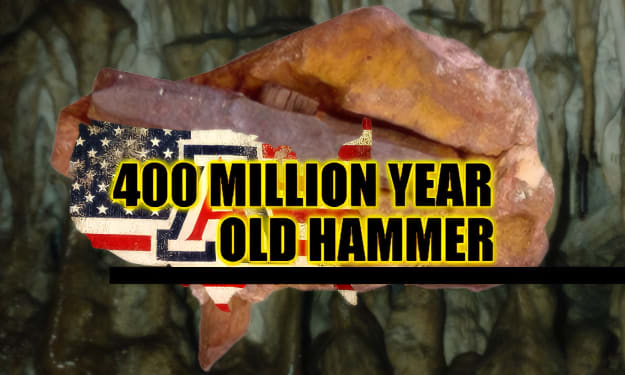
400 million year old modern hammer found in rock
In the summer of 1936, near the small town of London in central Texas, a curious object was discovered that would become the focus of intense debate among archaeologists, geologists, creationists, and skeptics for decades to come. It all began when Max Hahn, a local resident, and his wife were walking along a creek near Red Creek in the region of London, Texas—not to be confused with the city of the same name in England. During their walk, they noticed a strange, heavily weathered rock with a piece of wood sticking out of it. Intrigued by its odd appearance and unusual composition, they brought the rock home and later broke it open with a hammer and chisel. Inside the rock, they discovered what appeared to be a man-made hammer — complete with a wooden handle and a metallic head.
By Kek Viktor8 months ago in History
⚡The Baghdad Battery: an ancient jar generated electrocity
In the dusty heart of Iraq, not far from the site of the ancient city of Ctesiphon, a strange and controversial artifact was uncovered in the 1930s that would go on to stir decades of debate in archaeological and scientific circles. This small, unadorned object—a clay vessel with a copper cylinder and an iron rod—would become known as the Baghdad Battery, a name that would electrify imaginations around the world. The artifact was discovered during excavations at Khujut Rabu, a village near Baghdad, and was eventually examined by Wilhelm König, an Austrian archaeologist who was at the time the director of the National Museum of Iraq. König believed that the object, which dated to roughly between 250 BCE and 250 CE, may have been used as a kind of galvanic cell—a primitive battery that could generate electrical current.
By Kek Viktor8 months ago in History
Saddam Hussein: The Lion Who Roared Against the West
In the modern history of the Muslim world, few leaders have stood as boldly against the West as Saddam Hussein, the former president of Iraq. Loved by many, hated by some, and feared by his enemies — Saddam was a man who fought not just wars, but a battle of honor, pride, and resistance. His name still echoes in the hearts of those who believe in standing tall, even when the whole world is against you.
By Abuzar khan8 months ago in History
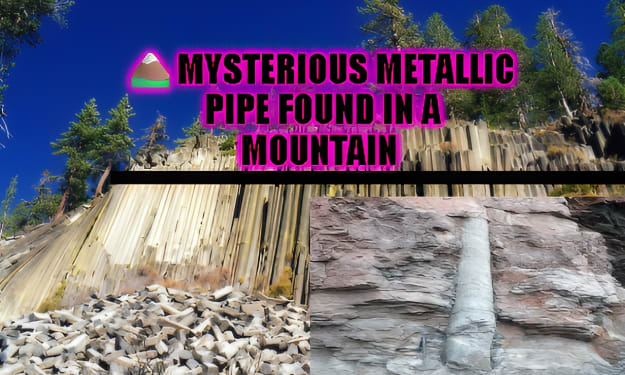
🏔️Mysterious metallic pipe found in a remote mountain, embedded in solid rock
High in the desolate reaches of China’s Qinghai Province, near the banks of a salty, windswept lake called Tuosu, a rocky mountain known as Mount Baigong juts out of the earth with an eerie presence. Its name, Baigong—or “White Palace”—has long been tied to local folklore, but in the late 1990s, it was thrust into the spotlight for something far more tangible and mysterious: embedded within its cave walls and nearby lakebed were strange, metallic-looking tubes—rust-red, hollow, and seemingly purposeful. These objects, later dubbed the “Baigong Pipes,” appeared to defy natural explanation. From their placement and appearance to their chemical makeup and alignment, the pipes have confounded visitors, stirred online forums, and inspired both scientific investigation and wild extraterrestrial speculation.
By Kek Viktor8 months ago in History
💣 The Lost Nuke of Tybee Island – A nuclear bomb was dropped off the coast of Georgia
On the quiet shores of Tybee Island, Georgia—a sleepy barrier island known for its sandy beaches and laid-back Southern charm—few beachgoers suspect that just a few miles offshore, beneath the murky waters of Wassaw Sound, may lie one of the most unsettling secrets of the Cold War era: a fully armed nuclear bomb, lost in 1958 and never recovered.
By Kek Viktor8 months ago in History
🦷 Shark Teeth on Mount Everest: The Marine Fossils That Rewrote Earth’s History
Mount Everest, the highest peak on Earth, towers at an altitude of 8,848 meters (29,029 feet) above sea level. It's a place of snowstorms, glaciers, and rock-strewn desolation, seemingly as far from the sea as one can imagine. And yet, hidden within the rocks of Everest’s upper slopes lies a discovery so extraordinary that it completely reshaped our understanding of Earth's geologic past: fossilized remains of ancient marine life, including shark teeth, seashells, and trilobites, embedded in the very bones of the Himalayas. These remnants of long-extinct ocean creatures are undeniable proof that this colossal mountain range was once at the bottom of a vast, ancient sea.
By Kek Viktor8 months ago in History
Tiny Africa, Massive Europe
Imagine trying to draw a map of the Earth. At first, it might seem simple—until you realize you're trying to flatten a sphere. Our planet is round, but maps are flat, which makes representing it accurately a huge challenge. Think of it like peeling an orange and trying to lay the peel flat on a table without tearing or stretching it. That’s impossible, and so is making a flawless flat map of the globe. As a result, nearly all world maps are wrong and some are misleading by design.
By Francis Osei8 months ago in History
Divorce By Combat. Content Warning.
Let’s travel back in time, shall we? Imagine yourself in an open town square of the 15th-century Trier, Germany. The town square is full of people, clamoring in anticipation. You are about to watch a marital combat, a duel between a husband and wife.
By Lana V Lynx8 months ago in History