
400 million year old modern hammer found in rock
The London Hammer (Texas)


In the summer of 1936, near the small town of London in central Texas, a curious object was discovered that would become the focus of intense debate among archaeologists, geologists, creationists, and skeptics for decades to come. It all began when Max Hahn, a local resident, and his wife were walking along a creek near Red Creek in the region of London, Texas—not to be confused with the city of the same name in England. During their walk, they noticed a strange, heavily weathered rock with a piece of wood sticking out of it. Intrigued by its odd appearance and unusual composition, they brought the rock home and later broke it open with a hammer and chisel. Inside the rock, they discovered what appeared to be a man-made hammer — complete with a wooden handle and a metallic head.

The most shocking aspect, however, was that this hammer appeared to be encased in ancient rock, giving the impression that it was geologically sealed within stone millions of years old. Over time, this object came to be known as the "London Hammer" or the "London Artifact," and its discovery quickly began to stir controversy and wild speculation about the history of human civilization and the timeline of technological development.
The hammer itself measures about 15.24 centimeters (6 inches) in length with a metal head approximately 2.5 centimeters (1 inch) in diameter. The metal portion is composed of iron and is attached to a partially fossilized wooden handle. What distinguishes this hammer from ordinary modern tools is the condition and composition of the rock in which it was found. According to those who examined it early on, the hammer was embedded in a concretion, a type of rock formed when mineral-laden water hardens around an object. The outer rock was claimed to be consistent with Ordovician stone — a geological period dating back approximately 400 million years. For those inclined to challenge mainstream scientific chronology, this implied something profoundly unsettling: either human technology existed hundreds of millions of years ago, or our understanding of geology and archaeology was fundamentally flawed.
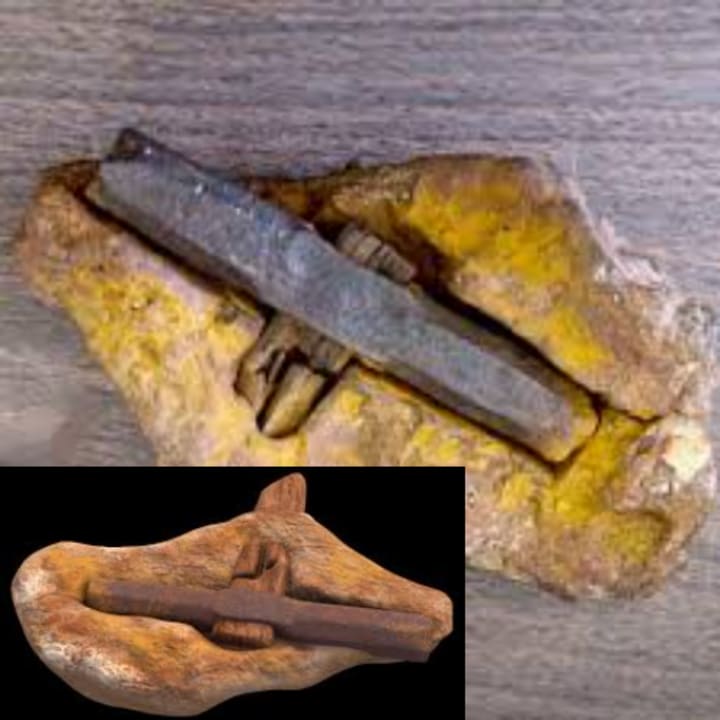
The artifact gained even more notoriety in the 1980s when it was purchased and exhibited by Carl Baugh, a young-earth creationist who believed the hammer was evidence that humans and modern technology existed before the timeframes established by conventional science. Baugh, who founded the Creation Evidence Museum in Glen Rose, Texas, claimed the hammer was proof that the Earth was not billions or even millions of years old, but rather only a few thousand years old as described by a literal reading of the Bible. According to Baugh’s interpretation, the London Hammer was a “pre-Flood” artifact from the antediluvian world described in the Book of Genesis. He argued that it was evidence of advanced technology before Noah’s flood and used it to bolster claims about the sudden creation of mankind with full technological capacity.

However, Baugh’s claims were met with immediate and sustained skepticism from both mainstream scientists and even some in the creationist community. A major issue is the process by which the hammer became encased in the rock. Geologists note that concretions can form relatively quickly under the right conditions, particularly in areas with highly mineral-rich water. There are well-documented cases of modern artifacts, including bottles, tools, and even Civil War-era relics, being found embedded in sedimentary concretions or within layers of soil that have hardened around them. These rock-like shells can form in decades, not millions of years, particularly in areas with high concentrations of calcium carbonate or iron oxides. This process, known as “permineralization,” is well-understood, and scientists generally agree that the presence of an object inside such a formation does not necessarily date the object to the age of the surrounding stone.
As for the composition of the hammer head itself, metallurgical analysis has been conducted, though not with the rigor demanded by peer-reviewed scientific research. According to tests cited by Carl Baugh and others, the hammer head is made up of approximately 96% iron, 2.6% chlorine, and 0.74% sulfur. What’s unusual here is the high level of purity of the iron and the presence of chlorine, which could suggest a refining process distinct from modern smelting techniques. However, without rigorous documentation and replication of these tests by independent laboratories, the significance of the metal composition remains speculative. The presence of chlorine in particular may be explained by environmental exposure or post-burial mineral interaction rather than an unknown ancient technology.
Critics of the artifact's supposed antiquity argue that there is no credible geological evidence that the hammer was part of Ordovician rock, nor that it was actually sealed in rock 400 million years old. The concretion in which the hammer was found is small and does not exhibit the clear, stratified features or fossil record typical of truly ancient stone formations. Furthermore, there has been no stratigraphic survey of the site where the artifact was found, no core sampling, and no academic geological study published in a peer-reviewed journal confirming the age of the rock. In fact, the rock appears to have been formed in situ around the object after it had already been made and discarded — perhaps into a body of water with mineral-rich deposits. The hammer itself resembles 19th-century mining or blacksmithing hammers, and its style is not inconsistent with tools used in the region during the late 1800s. Given that the Red Creek area saw settlement and mining activity in the 19th century, it's entirely plausible that the hammer was simply lost or discarded, after which it became the nucleus for a concretion to form over decades or a century.

The notion that the hammer is hundreds of millions of years old is further undermined by the lack of contextual evidence. In archaeology, isolated finds are rarely accepted without supporting data: additional artifacts, stratigraphic context, carbon dating of associated organic material, or documentation of the excavation process. None of these are present in the case of the London Hammer. There are no additional tools or human remains nearby, no documentation of the hammer’s original geological location, and no photos of the site prior to the rock being broken open. The discovery was casual, not professional, and while that doesn’t invalidate it outright, it leaves enormous gaps in the chain of evidence required to support extraordinary claims.
That hasn’t stopped the hammer from becoming a recurring star in books, websites, and documentaries that promote fringe theories, including ancient aliens, forbidden archaeology, and revisionist history. To some, it represents irrefutable proof that mainstream science is suppressing alternative explanations for humanity’s origins. For others, it’s a classic example of confirmation bias — people seeing what they want to see, interpreting ambiguous data in ways that support their existing beliefs. In reality, the hammer likely falls into a category that’s both mundane and fascinating: an example of how complex geological processes can create objects that appear far older or more mysterious than they are. Similar instances have occurred elsewhere — fossilized spark plugs, entombed modern tools, and other cases of natural concretions forming around human-made objects, creating the illusion of great antiquity.
The London Hammer remains on display at the Creation Evidence Museum, where it is presented as evidence of pre-Flood technology. Despite calls from the scientific community for more rigorous testing, no peer-reviewed scientific study of the hammer has ever been published. Its legend continues, not because it has been proven to be ancient, but because it sits at the crossroads of science, belief, and the irresistible human attraction to mystery. People want to believe that history is more complicated, more magical, and more strange than textbooks suggest. Artifacts like the London Hammer feed that hunger for the unknown. But until the object is studied with transparent, repeatable, and properly contextualized scientific methods, it will remain a curiosity rather than a revolution in our understanding of the past.

In the end, the London Hammer is a compelling case study in how artifacts can be misinterpreted, and how popular narratives can outpace the slow and cautious march of scientific inquiry. It reminds us that extraordinary claims require extraordinary evidence — and that, more often than not, the truth is not buried under hundreds of millions of years, but under layers of human interpretation, hope, and imagination.
About the Creator
Kek Viktor
I like the metal music I like the good food and the history...
Keep reading
More stories from Kek Viktor and writers in History and other communities.
⚡The Baghdad Battery: an ancient jar generated electrocity
In the dusty heart of Iraq, not far from the site of the ancient city of Ctesiphon, a strange and controversial artifact was uncovered in the 1930s that would go on to stir decades of debate in archaeological and scientific circles. This small, unadorned object—a clay vessel with a copper cylinder and an iron rod—would become known as the Baghdad Battery, a name that would electrify imaginations around the world. The artifact was discovered during excavations at Khujut Rabu, a village near Baghdad, and was eventually examined by Wilhelm König, an Austrian archaeologist who was at the time the director of the National Museum of Iraq. König believed that the object, which dated to roughly between 250 BCE and 250 CE, may have been used as a kind of galvanic cell—a primitive battery that could generate electrical current.
By Kek Viktor9 months ago in History
The Year 1945 in Review: Fun Facts, Trivia, and Historic Highlights
This quick read is a collection of fun facts, trivia, and historic events from the year 1945. Discover the year’s top news stories, most influential people, notable inventions, sports facts, the cost of living, entertainment trivia, and much more.
By Gregory DeVictor3 days ago in History




Comments
There are no comments for this story
Be the first to respond and start the conversation.