
💣 The Lost Nuke of Tybee Island – A nuclear bomb was dropped off the coast of Georgia
America’s Missing Atomic Bomb That Still Haunts the Deep

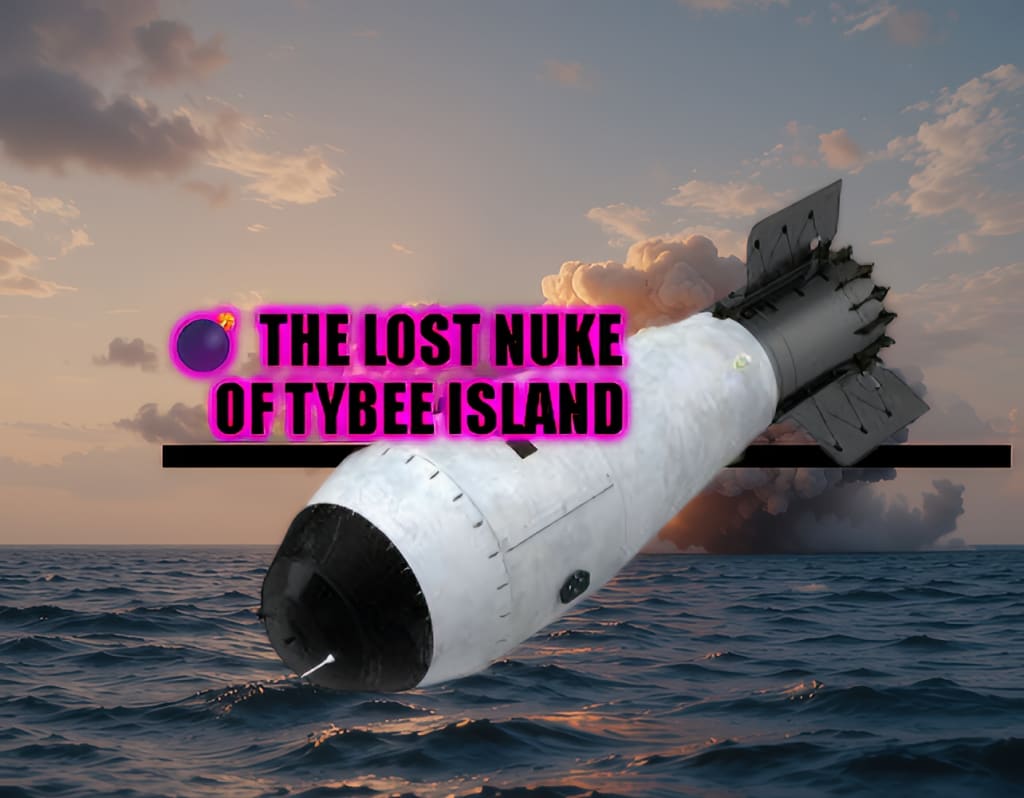
On the quiet shores of Tybee Island, Georgia—a sleepy barrier island known for its sandy beaches and laid-back Southern charm—few beachgoers suspect that just a few miles offshore, beneath the murky waters of Wassaw Sound, may lie one of the most unsettling secrets of the Cold War era: a fully armed nuclear bomb, lost in 1958 and never recovered.
Known as the Tybee Bomb, this 1.7-ton Mark 15 nuclear weapon, equipped with a high-explosive trigger and potentially even a full nuclear core, disappeared during a routine military training exercise gone horribly wrong. Despite decades of investigation, controversy, and speculation, the bomb has never been found, making it one of the most chilling "oops" moments in nuclear history.
This is the true story of how a nuclear bomb went missing in the United States—and why it may still be sitting silently on the ocean floor.
🌐 The Cold War Context: Tensions and Training
In the late 1950s, the world was firmly gripped by the Cold War. The U.S. Air Force and Navy were on high alert, continuously preparing for a potential nuclear conflict with the Soviet Union. During this period, the Strategic Air Command (SAC) frequently conducted simulated bombing missions, many of which involved actual nuclear bombs—sometimes with nuclear cores removed for safety, but not always.
It was under this climate of constant military readiness that the Tybee incident occurred. On February 5, 1958, a B-47 Stratojet bomber from Homestead Air Force Base in Florida was taking part in a mock combat mission off the southeastern coast of the United States. The bomber was carrying a Mark 15 Mod 0 hydrogen bomb—a massive, multi-megaton weapon designed to be deployed in the event of nuclear war.
The mission was intended to simulate an attack scenario and test the Air Force's ability to carry out bombing runs under hostile conditions. But things quickly spiraled out of control.

✈️ The Mid-Air Collision: Chaos at 36,000 Feet
As the B-47 bomber, piloted by Colonel Howard Richardson, approached the Savannah area around midnight, it was intercepted by an F-86 Saberjet fighter as part of the exercise. The fighter pilot, Lt. Clarence Stewart, had trouble locating the bomber in the darkness and, relying on radar guidance, accidentally collided with the B-47 at an altitude of about 36,000 feet.
The impact destroyed the F-86's left wing, forcing Lt. Stewart to eject. He survived, parachuting into a swampy area of Georgia and was later rescued. The B-47, though severely damaged, remained airborne—but just barely. One of its fuel tanks was punctured, and it was rapidly losing altitude.
Faced with an imminent crash, Col. Richardson had to make a split-second decision. His aircraft was carrying a nuclear bomb, and attempting an emergency landing with it still onboard could be catastrophic. At 2:00 AM, with permission from his command, Richardson jettisoned the bomb into the waters near Tybee Island to lighten the load and avoid a nuclear catastrophe on land.
The B-47 limped back to Hunter Air Force Base in Savannah, where Richardson managed a safe landing. The bomb, however, was gone.

💣 The Mark 15 Bomb: A Hydrogen Monster
The weapon dropped off the coast was the Mark 15 thermonuclear bomb, also known as the Mk-15 Mod 0. It was over 12 feet long, weighed about 7,600 pounds (3,447 kg), and had a yield estimated between 1.7 to 3.8 megatons—hundreds of times more powerful than the bombs dropped on Hiroshima or Nagasaki.
At the time, officials stated that the bomb did not contain a plutonium core—meaning it was a “dummy” or “training” bomb. However, later reports, declassified documents, and internal inconsistencies raised serious doubts about this claim.
In 1966, Assistant Secretary of Defense W.J. Howard testified before Congress that the Tybee bomb was one of two weapons in the U.S. arsenal known to be “fully armed” when lost. According to his statement, the bomb likely contained a nuclear capsule (or “pit”), which would make it a complete thermonuclear device capable of a massive detonation. If true, this meant a live hydrogen bomb had been lying just off the U.S. coast for years.

🌊 The Search Begins: Navy Divers and Dead Ends
Immediately after the incident, a large-scale recovery operation was launched involving the U.S. Navy, Air Force, and Army Corps of Engineers. For six weeks, divers scoured Wassaw Sound, an area with shifting sands, strong tidal currents, and low visibility.
Despite their efforts, no trace of the bomb was ever found. Searchers used magnetic anomaly detectors, sonar, and even dredging equipment, but the bomb had vanished into the soft, silty seabed. The U.S. government eventually called off the search, concluding that the bomb was likely buried under 10–15 feet of sediment, rendering it virtually unrecoverable.
Authorities insisted at the time that the bomb posed no danger to public safety, stating that the explosive components could not detonate without a deliberate arming mechanism and that there was no risk of radioactive leakage. However, concerns among scientists and environmentalists persisted.
One of the most contentious elements of the Tybee bomb saga is whether it actually contained nuclear material at the time of its loss. Official Air Force reports claimed the bomb lacked its plutonium core and was therefore incapable of a nuclear explosion.
But subsequent revelations suggest otherwise:
- The aforementioned 1966 congressional testimony implies it was fully armed.
- Some military personnel involved in the recovery expressed skepticism about the training bomb claim, citing the secrecy surrounding the operation.
- Declassified documents revealed that officials feared “unauthorized recovery” by foreign entities, such as the Soviets—hardly a concern for a dummy bomb.
- In 2001, an independent investigation conducted by former Air Force officer Derek Duke and geologist Michael H. Fay detected unusual levels of radioactivity in the waters northeast of Tybee Island. These findings, while not conclusive proof, added fuel to the theory that the bomb was indeed “hot.”
The U.S. government has continued to maintain that the bomb is “inert,” poses no hazard to human life, and should be left undisturbed to prevent unintended consequences.
The exact location of the Tybee bomb remains a mystery, though many believe it lies within a few miles of Little Tybee Island, perhaps beneath a deep layer of mud in Wassaw Sound. The coordinates most frequently cited are roughly 31°54′N 80°54′W, based on the pilot’s recollections and analysis of the jettison trajectory.
Attempts to relocate the bomb over the years—by the military, private researchers, and even treasure hunters—have all failed. In 2004, the Air Force released a detailed report confirming that the bomb had never been recovered but posed “no significant threat” if left undisturbed.
Still, skeptics remain unconvinced. The idea that a fully functional thermonuclear device is still sitting off the coast of a popular tourist destination is chilling, especially considering natural events like hurricanes or human activity like dredging could potentially disturb it.

🏝️ Tybee Today: A Bomb Beneath the Beach?
Today, Tybee Island is a popular vacation spot. Its beaches are filled with sunbathers, swimmers, and tourists blissfully unaware of the mystery lurking offshore. Despite its dark legacy, the Tybee Bomb has become something of a local legend, even appearing on T-shirts, in pub trivia, and on ghost tours.
But the reality is far from folklore. The possibility that a megaton-class nuclear weapon lies just beneath the waves remains one of the most disturbing unsolved military incidents in U.S. history. As of 2025, the bomb is still classified as “missing,” and the Department of Defense has made no plans to resume the search.
The story of the lost Tybee bomb highlights the incredible risks of Cold War brinkmanship and the fallibility of human error in the nuclear age. It raises disturbing questions: How many other nuclear weapons were lost and never recovered? What safeguards truly exist to prevent such accidents today?
While officials continue to assert that the bomb is safe and non-threatening, independent experts warn that corrosion, shifting geology, or even human interference could one day change that. The detonation of the bomb is considered extremely unlikely, but if it contains uranium or plutonium, leakage into the marine environment could pose long-term ecological and health risks.

More than six decades after it disappeared beneath the Atlantic waves, the Tybee Bomb remains an unnerving chapter in American military history. It is a reminder of how close the world came—through accident or oversight—to unspeakable destruction during the Cold War.
Whether you view it as a harmless relic entombed in silt or a ticking time bomb waiting to be disturbed, one thing is certain: the Lost Nuke of Tybee Island is not a myth. It is real. It is out there. And as long as it remains missing, so too does a piece of America’s nuclear past—one capable of rewriting the coastline in the blink of an eye. 💣🌊
About the Creator
Kek Viktor
I like the metal music I like the good food and the history...
Keep reading
More stories from Kek Viktor and writers in History and other communities.
🦷 Shark Teeth on Mount Everest: The Marine Fossils That Rewrote Earth’s History
Mount Everest, the highest peak on Earth, towers at an altitude of 8,848 meters (29,029 feet) above sea level. It's a place of snowstorms, glaciers, and rock-strewn desolation, seemingly as far from the sea as one can imagine. And yet, hidden within the rocks of Everest’s upper slopes lies a discovery so extraordinary that it completely reshaped our understanding of Earth's geologic past: fossilized remains of ancient marine life, including shark teeth, seashells, and trilobites, embedded in the very bones of the Himalayas. These remnants of long-extinct ocean creatures are undeniable proof that this colossal mountain range was once at the bottom of a vast, ancient sea.
By Kek Viktor7 months ago in History
Military Strength of Alexander the Great and the Chola Empire: A Historical Comparison
Though separated by more than a thousand years and operating in vastly different geographical and cultural contexts, both forces achieved extraordinary success through discipline, innovation, and strategic brilliance. This article explores the history, composition, size, organization, and military strength of Alexander’s Macedonian army and the Chola military, highlighting how each became a dominant power of its era.
By Say the truth 6 days ago in History



Comments
There are no comments for this story
Be the first to respond and start the conversation.