Ancient
The Life and Legacy of Plato
The Life and Legacy of Plato: A Comprehensive Biography Introduction Plato, one of the most influential philosophers in Western thought, was a student of Socrates and the teacher of Aristotle. His contributions to philosophy, political theory, and education remain foundational to this day. Through his extensive writings, primarily in the form of dialogues, Plato explored topics ranging from ethics and metaphysics to politics and epistemology. His legacy continues to shape contemporary discourse in philosophy and beyond.
By Banik Sojib12 months ago in History
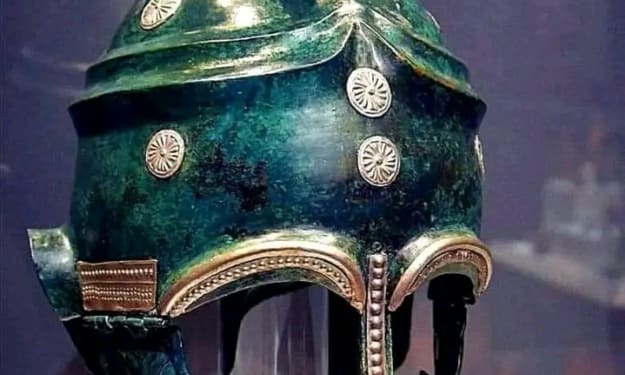
A 4thC BC bronze #Thracian helmet discovered at the village of Pletena, Bulgaria.
The Thracian Helmet of Pletena: A 4th-Century BC Masterpiece In 1997, a remarkable archaeological discovery was made in the village of Pletena, nestled in the western Rhodope Mountains of Bulgaria. Unearthed from the depths of history was a 4th-century BC bronze Thracian helmet, adorned with intricate silver decorations. This extraordinary artifact, now housed in the National History Museum in Sofia, offers profound insights into the martial culture, artistry, and societal structures of the ancient Thracians.
By Tosin Akomolafe 12 months ago in History
A 600 year old bra belonging to Humayun's mother discovered in excavation.
A 600 year old bra belonging to Humayun's mother discovered in excavation. Archaeologists have recently made a startling discovery during an excavation at a historical site linked to the Mughal Empire. Among various unearthed artifacts one item has particularly intrigued historians and researchers a 600 year old brassiere like garment that is believed to have belonged to a woman of high status from the Mughal era. Some experts suggest that it could have been worn by Maham Begum the mother of Emperor Humayun. This unexpected finding has opened up discussions on historical fashion the role of women in the Mughal court and the sophistication of undergarments in South Asian history. The excavation site where this garment was found has long been associated with the Mughal royal family. Researchers were originally looking for everyday items from the era such as pottery ornaments, and tools. However when they uncovered a delicate yet remarkably well preserved piece of clothing, they were taken aback. The garment resembles modern-day bras in structure but it also features intricate embroidery and fine craftsmanship indicative of Mughal era textiles. Experts are now closely examining the fabric stitching and design to determine its exact origin and confirm its historical significance.
By Adnan Rasheed12 months ago in History
The Majestic Pyramids of Teotihuacan – Sun and Moon
The Pyramid of the Sun and the Moon: The Age-old Wonders of Teotihuacan The Pyramid of the Sun and the Pyramid of the Moon are two of the best cogent structures in the age-old burghal of Teotihuacan, amid in modern-day Mexico. Congenital by the Teotihuacanos about 100-450 CE, these pyramids were not alone architectural marvels but additionally acutely angry to religion, astronomy, and political power.
By Say the truth 12 months ago in History
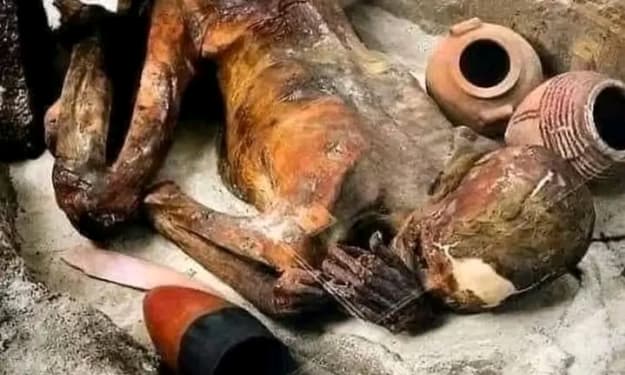
Ginger: The Oldest Egyptian Mummy and His Ancient Tattoo
Egyptian history is filled with fascinating discoveries, from towering pyramids to intricate hieroglyphics. But among the most remarkable finds is "Ginger," the world's oldest known naturally preserved Egyptian mummy, dating back over 5,500 years to the pre-dynastic period. Named for the reddish tint of his hair, Ginger offers a unique glimpse into ancient burial practices and the early development of Egyptian civilization. Even more intriguing is the tattoo on his arm, which is recognized as the oldest known figurative tattoo in the world. This discovery sheds new light on the significance of body art in ancient Egyptian society, revealing that tattooing was practiced far earlier than previously believed.
By Tosin Akomolafe 12 months ago in History
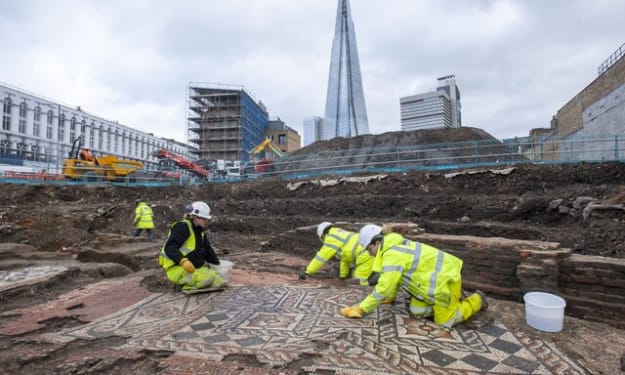
Large Roman mosaic floor discovery on London building development in Southwark.
Large Roman mosaic floor discovery on London building development in Southwark. In a remarkable archaeological breakthrough, experts from the Museum of London Archaeology (MOLA) have unearthed an exceptionally well-preserved Roman mosaic in Southwark, near London Bridge. This discovery, hailed as the largest of its kind in London in over half a century, offers a captivating glimpse into the city's ancient past.
By Tosin Akomolafe 12 months ago in History
The Greatest Female Pharaoh: Hatshepsut, Egypt’s Forgotten Queen
Hatshepsut, often overshadowed by her male counterparts, was one of ancient Egypt’s most accomplished and visionary rulers. Despite ruling in a time when female pharaohs were rare, she not only claimed the throne but also flourished, leaving behind an extraordinary legacy of wealth, art, and diplomacy. Her reign, from 1479 to 1458 BCE, remains a testament to her intelligence, ambition, and political acumen.
By Siboli Mukherjee12 months ago in History
Africa's incredible ancient city that's over 2,000 years old and abandoned for 700 years
Africa's incredible ancient city that's over 2,000 years old and abandoned for 700 years Volubilis nestled in the fertile plains of Morocco stands as a testament to the grandeur of ancient civilizations. This incredible city over 2,000 years old offers a glimpse into a bygone era frozen in time and steeped in history. Once a thriving Roman outpost Volubilis was abandoned nearly 700 years ago yet its ruins continue to captivate visitors with their timeless beauty and historical significance. The city’s story is one of cultural fusion architectural brilliance and the inexorable passage of time.BLocated near the modern city of Meknes Volubilis was originally settled by the Carthaginians as early as the 3rd century BCE. However it was under Roman rule beginning around 40 CE that the city flourished. As part of the Roman Empire’s vast network of provinces Volubilis became an important administrative and agricultural center. Its fertile surroundings made it a hub for olive oil and grain production which were exported to other parts of the empire. The city’s wealth and strategic importance are evident in the grandeur of its architecture which blends Roman engineering with local Berber and Phoenician influences.
By Adnan Rasheed12 months ago in History
The Death of Socrates – A Moment of Philosophical Martyrdom
The Afterlife of Socrates: A Defining Moment in Abstract History Socrates, one of the greatest philosophers of age-old Greece, was a man whose account shaped Western philosophy. He was accepted for his different way of questioning, which came to be accepted as the Socratic method. However, his commodity challenged the cachet quo, and in 399 BCE, he was bedevilled to afterlife by the Athenian government. His execution, agitated out by bubbler a cup of adulteration hemlock, charcoal one of the best acclaimed moments in abstract history.
By Say the truth 12 months ago in History