Ancient
2500 Year Old Tombs With Artifacts Discovered in Israel Shed Light on Ancient Trading
2500 Year Old Tombs With Artifacts Discovered in Israel Shed Light on Ancient Trading Archaeologists have made a groundbreaking discovery near Tlalim Junction in Israel unearthing 2,500 year old tombs and artifacts that shed new light on ancient trade networks and cultural exchanges. The findings led by the Israel Antiquities Authority IAA reveal the Negev Highlands' role as a significant hub for long distance commerce connecting the region to distant civilizations such as Yemen Phoenicia and Egypt. This discovery not only highlights the movement of goods but also underscores the exchange of ideas and traditions across the ancient world. The excavation uncovered a wealth of artifacts that provide insights into the region's historical significance. Among the most notable findings were flint arrowheads which researchers believe originated from Yemen and Oman. These arrowheads along with copper and silver jewelry suggest that the Negev Highlands were a key stopover for traders traveling along ancient routes. Additionally small alabaster vessels historically used to transport incense were discovered further emphasizing the area's role in the trade of luxury goods. One of the most striking artifacts was an amulet depicting Bes the Egyptian deity associated with protection and fertility. This amulet not only highlights the cultural influence of Egypt but also suggests that traders and travelers carried religious symbols for personal protection and spiritual significance.
By Adnan Rasheed12 months ago in History
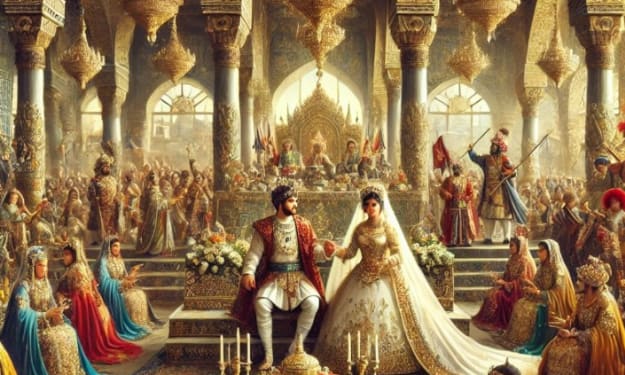
The Royal Splendor of Alexander and Roxana’s Wedding
The Wealth and Spending Habits of Alexander the Great and His Romantic Life Introduction Alexander the Great (356–323 BCE) was not only one of the greatest military conquerors in history but also one of the wealthiest individuals of his time. His empire stretched from Greece to India, and with it came unimaginable riches. From gold-plated palaces to extravagant banquets, Alexander spent his wealth generously—on his army, on cultural advancements, and on his personal life, including the women in his life.
By Say the truth 12 months ago in History
Alexander the Great – The Warrior King. AI-Generated.
The Concrete Description of Alexander the Great: A Historical Perspective Alexander the Great (356–323 BCE) was one of history’s best allegorical aggressive leaders, accepted for his conquests from Greece to India. While his accomplishments are well-documented, descriptions of his concrete actualization appear from age-old historians, coins, sculptures, and literature.
By Say the truth 12 months ago in History
Lost Riches of America – Hidden Gold and Forgotten Fortunes
The History of Abundance in America: Legends, Absent Gold, and Hidden Fortunes America has continued been a acreage of abstruseness and adventure, with endless belief of absent treasures, active gold, and hidden fortunes broadcast beyond the continent. From the all-inclusive abundance of aboriginal civilizations to the gold rushes and charlatan loot, America’s history is abounding with tales of abundance cat-and-mouse to be discovered. Abounding of these treasures are still missing, fueling belief and abundance hunts alike today.
By Say the truth 12 months ago in History
Voynich Vampire Blog. Content Warning. AI-Generated.
The Voynich Manuscript: A Secret Book Written by Vampires? The Voynich Manuscript has baffled scholars, cryptographers, and historians for centuries. Discovered in 1912 by book dealer Wilfrid Voynich, this mysterious text is written in an unknown language and contains bizarre botanical illustrations, astrological charts, and alchemical symbols. But what if we’ve been looking at it all wrong? What if this isn’t just an undeciphered medieval manuscript—but a book written by **vampires themselves**?
By Letsmake vfxeasy12 months ago in History
Why Was the Ancient Greek City of Hadrianopolis Suddenly Abandoned?
Why Was the Ancient Greek City of Hadrianopolis Suddenly Abandoned? The ancient Greek city of Hadrianopolis located in the Eskipazar district of Karabuk Turkey has long been a site of fascination for archaeologists and historians. Known for its stunning mosaics and historical significance the city was a prominent center in the western Black Sea region during antiquity. However its sudden and complete abandonment in the 7th century AD has remained a mystery for centuries. Recent excavations led by Ibrahim Sahin the culture and tourism director of Karabuk and Ersin Celikbas an archaeology professor at Karabuk University are shedding new light on this enigmatic event offering clues that may finally explain why the city was deserted.
By Adnan Rasheed12 months ago in History
Historic Kama Sutra Sculptures of Khajuraho Temple India UNESCO world Heritage Site Khajuraho India.
Historic Kama Sutra Sculptures of Khajuraho Temple India UNESCO world Heritage Site Khajuraho India. The Khajuraho Temple complex in India is a remarkable testament to the artistic and cultural achievements of ancient India. Recognized as a UNESCO World Heritage Site these temples are renowned for their intricate and exquisite sculptures particularly those depicting themes from the Kama Sutra. Located in the Chhatarpur district of Madhya Pradesh Khajuraho is a symbol of India's rich heritage and architectural brilliance. The temples built between 950 and 1050 CE during the Chandela dynasty were once part of a larger group of 85 temples of which only 25 survive today. These temples are divided into three groups Western Eastern and Southern and are dedicated to both Hindu and Jain traditions. The most striking feature of the Khajuraho temples is their elaborate and detailed sculptures which adorn the walls pillars and ceilings. Among these the sculptures inspired by the Kama Sutra are the most celebrated. The Kama Sutra an ancient Indian text attributed to Vatsyayana is a treatise on human relationships love and intimacy. While the text itself is often misunderstood as merely a manual on sexual positions it is, in fact, a comprehensive guide to the art of living encompassing ethics relationships and the pursuit of pleasure as one of the four goals of human life Purusharthas. The sculptures at Khajuraho beautifully capture the essence of this philosophy depicting various aspects of human life, including love romance and intimacy, in a highly artistic and sophisticated manner.
By Adnan Rasheed12 months ago in History
A Love Beyond Time
Paris, March 3, 1762 My Dearest Éléonore, As I sit here this evening, the flickering light of a solitary candle is my only companion. It casts long shadows on the walls, and it is in this quiet solitude that I take up my pen. My heart, full of yearning, compels me to write to you, my beloved, for your absence is a burden too heavy for me to bear in silence. Each pulse of my heart echoes with your name, each breath I take seems to call out for the warmth of your presence. How I long for the gentle touch of your hand upon mine, to hear the sweet melody of your voice that always soothes my troubled soul. Oh, how I ache for the softness of your embrace, a comfort I once knew so well.
By Alain SUPPINI12 months ago in History
Part 1 Hannibal’s Early Life
On the northern shore of modern-day Tunisia, less than four hundred miles from Rome sat the city of Carthage which was a substantial rival for the Roman republic. Nothing better encapsulated the severity of the threat of Carthage to Rome than that of Hannibal and his conquests of Italy. His decision to ally with previously thought Italian allies changed the fabric of the Roman Republic. No longer could Roman allies be seen as insignificant but rather vital to the sustainability of Rome. Hannibal's rise to power can be attributed to many things but the best quality that encapsulates him as a figure is his ability to adapt his father's tactics and learn from the mistakes of Carthage in the first Punic War. Hannibal Barca was born to a distinguished Carthaginian family around 247 BCE. Hamilcar Barca, his father, fought in the first Punic war taking control of the Carthaginian fleet around the same time Hannibal was born. After the war was over with the Romans, Carthage was in a state of turmoil because of its unpaid debts to mercenaries resulting in a revolution referred to as the Mercenary War. Hannibal was a young child while this was happening and witnessed his city being ravaged by revolution. Rome seized the opportunity to further weaken Carthage by conquering the islands of Sardinia and Corsica. As the story goes, this so enraged Hamilcar he made his young son swear to one day destroy Rome. While this story is untruthful and an attempt to further villainize Hannibal, one thing is undeniable. Hannibal from an early age was exposed to war, and his father was well distinguished in Carthage for his tactics. These two things made him ready to take on the Roman military. Not an oath, his father made him swear as a child. With these two factors, one can see how Hannibal grew up to become one of Ancient History's greatest generals. From then until his father died in his late teens Hannibal was instructed by his father in warfare and leadership. By his twenties, he was given command by his father’s successor in Spain and later took over control of the entire Spanish province by his mid-twenties. Hannibal’s journey starting in Spain and ending with his death in Bithynia around 182 BCE, helped shape Rome into the militaristic empire it became following the Punic wars.
By Nate James12 months ago in History
The Chrysanthemum and the Crane: A Diary & Correspondence, Japan, Edo Period (1703)
Part 1: Hana's Diary - Musings on a Changing World Date: Kagen 6, Month 2, Day 10 (March 17, 1703) The cherry blossoms are beginning to unfurl their delicate petals, a pale blush against the grey stone walls of the garden. It is a beautiful time, a time for poetry and contemplation. Yet, my heart feels none of that peace. Father has declared he intends to arrange a marriage for me.
By Israt Jahan 12 months ago in History
The Golden Age of the Tsar Empire. AI-Generated.
The Golden Period of the Tsar Empire: Power, Wealth, and Expansion The Tsarist Empire, also known as the Russian Empire, was one of the largest and most powerful empires in history. Its golden period, spanning from the late 17th century to the early 20th century, saw immense territorial expansion, military dominance, economic prosperity, and cultural achievements. Under the rule of powerful tsars like Peter the Great and Catherine the Great, Russia transformed into a global superpower. This article explores the factors that led to the empire’s golden period, its military strength, economic development, and eventual decline.
By Say the truth 12 months ago in History
The Most Beautiful Neil Island in the World
Neil Island, a hidden gem in the Andaman and Nicobar Islands of India, is a paradise that boasts stunning landscapes, pristine beaches, and a tranquil atmosphere. Known for its natural beauty and untouched charm, Neil Island is a must-visit destination for nature lovers, adventure seekers, and anyone looking for a peaceful escape from the hustle and bustle of city life.
By Zinnat ara Begum12 months ago in History