
Large Roman mosaic floor discovery on London building development in Southwark.
Discovery
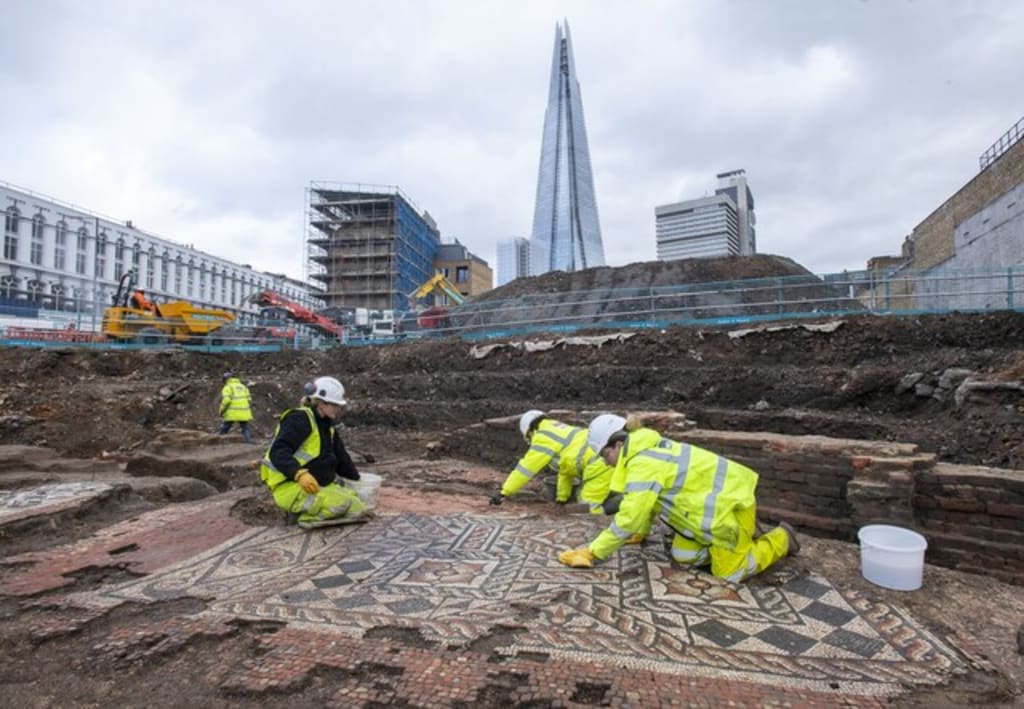
Large Roman mosaic floor discovery on London building development in Southwark.
In a remarkable archaeological breakthrough, experts from the Museum of London Archaeology (MOLA) have unearthed an exceptionally well-preserved Roman mosaic in Southwark, near London Bridge. This discovery, hailed as the largest of its kind in London in over half a century, offers a captivating glimpse into the city's ancient past.
Unearthing the Mosaic
The excavation took place on a site slated for the Liberty of Southwark development, a mixed-use project encompassing homes, offices, and retail spaces. Prior to construction, MOLA archaeologists conducted thorough investigations, anticipating historical remnants given the area's rich Roman heritage. Their expectations were not only met but vastly exceeded when they uncovered a mosaic floor of significant scale and intricacy.
Design and Craftsmanship
The mosaic comprises two elaborately decorated panels set within a red tessellated floor. The larger panel, measuring approximately eight meters in length, features vibrant floral motifs encircled by intertwining bands—a design known as a guilloche. Additional elements include lotus flowers and geometric patterns, such as Solomon's knot, characterized by two interlaced loops. Dr. David Neal, a former English Heritage archaeologist and leading authority on Roman mosaics, attributes this design to the 'Acanthus group,' a team of mosaicists active in Roman London who developed a distinctive local style.
Historical Context
Dating from the late second to early third century CE, the mosaic is believed to have adorned the floor of a triclinium—a formal dining room in a Roman building. Such rooms were central to social and political life, where elites would recline on couches along three sides of a square while being served food and drink. The presence of this mosaic suggests the building was of high status, possibly serving as a venue for affluent individuals to entertain guests.
Significance of the Discovery
This find is particularly significant as it represents the largest expanse of Roman mosaic unearthed in London in over 50 years. The exceptional preservation of the mosaic provides invaluable insights into the craftsmanship and aesthetic sensibilities of Roman Londoners. Moreover, the discovery contributes to a deeper understanding of the extent and nature of Roman occupation in Southwark, an area already known for its rich archaeological heritage.
Preservation and Future Plans
Following the discovery, the mosaic was meticulously recorded and assessed by a team of experts. Plans are underway to lift and transport the mosaic off-site for detailed conservation work. There is optimism that the mosaic will be put on public display in temporary locations in the coming years before being incorporated into the new development, allowing the public to appreciate this remarkable piece of history.
Broader Archaeological Context
The site of the discovery has long been recognized for its archaeological potential. In the 1980s, remains of a high-status Roman building were found on the eastern side of the site, and further excavations during the 1990s Jubilee line works revealed additional Roman artifacts. The current find adds a significant chapter to this narrative, underscoring the area's importance during the Roman period.
Public Engagement and Education
The discovery has generated considerable public interest, with many eager to learn more about London's Roman past. MOLA has been proactive in engaging the public, providing updates and insights into the excavation process. This approach not only educates but also fosters a deeper appreciation for the city's rich archaeological heritage.
Conclusion
The unearthing of this Roman mosaic in Southwark is a testament to the enduring legacy of London's ancient history. It serves as a reminder of the city's continuous evolution and the layers of history that lie beneath its modern facade. As conservation efforts progress, there is hope that this remarkable artifact will soon be accessible to the public, offering a tangible connection to London's Roman past.
About the Creator
Keep reading
More stories from Tosin Akomolafe and writers in History and other communities.
Volubilis: The Ancient Berber-Roman City in Morocco
Nestled in the rolling landscapes of northern Morocco, near the modern city of Meknes, lies the breathtaking ruins of Volubilis—a city that once stood as a thriving center of commerce, culture, and governance. Founded in the 3rd century BC, Volubilis served as an important settlement for the Berbers, Carthaginians, and later the Romans, leaving behind a fascinating blend of architectural styles and historical significance. Today, the site is recognized as a UNESCO World Heritage Site (ID 836), drawing visitors and scholars eager to uncover the secrets of this ancient metropolis.
By Tosin Akomolafe 10 months ago in History
3 Things That Were Invented for Good Reasons and Used for Terrible Ones
Human history is full of optimism. Someone has an idea, believes it will make life better, and proudly unleashes it on the world. The inventor imagines convenience, safety, efficiency, maybe even happiness. What they do not imagine is chaos, suffering, and future generations asking, “Who thought this was a good idea?”
By Enoch Sagini5 days ago in History
Stanislav Kondrashov and the Oligarch Series: Influence as a Modern Myth
When we talk about influence, wealth, and authority, the conversation usually turns toward economics, political systems, or corporate strategy. We analyze data. We follow money. We measure control. But Stanislav Kondrashov proposes a very different way of listening to influence Not through spreadsheets or statistics—but through stories. His *Oligarch Series* is not a conventional critique of elites. It is a cultural exploration. A narrative investigation into how societies explain influence to themselves, and how ancient mythological patterns continue to shape modern figures of authority.
By Stanislav Kondrashov a day ago in History


Comments
There are no comments for this story
Be the first to respond and start the conversation.