
🔥 Pompeii and Herculaneum: Cities Frozen in Time by Vesuvius’ Fury
🌋The Tragic Eruption That Preserved Roman Life Nearly Two Millennia Ago

🔥 Pompeii and Herculaneum: Cities Frozen in Time by Vesuvius’ Fury
🌋 Part I: The Calm Before the Disaster—Life in Pompeii and Herculaneum
Around 79 CE, the cities of Pompeii and Herculaneum were flourishing Roman urban centers situated on the southwestern coast of the Italian peninsula along the beautiful Bay of Naples. They were strategically important settlements located near fertile volcanic soils supporting rich agriculture and benefiting from their proximity to trade routes across the Mediterranean. Pompeii was a larger city, home to roughly 11,000 to 15,000 people, its streets buzzing with the activity of merchants, shopkeepers, artisans, and politicians. Meanwhile, the smaller Herculaneum was considered a more exclusive resort town, with an estimated population of about 4,000 to 5,000 inhabitants, known for its luxurious villas owned by wealthy patricians and senators.
Both cities had impressive infrastructures, including aqueducts that supplied fresh water, public baths where Romans socialized and relaxed, markets full of diverse goods, and religious temples dedicated to deities like Jupiter, Apollo, and Venus. The architecture displayed a mixture of traditional Roman and local Italic influences, while murals and frescoes decorated many homes and public buildings, depicting mythological scenes, everyday life, and nature. The inhabitants were deeply engaged in Roman political and religious customs. Their daily lives were rich with festivals, banquets, and commercial enterprises despite social hierarchies evident in the division between the wealthy elites and working classes. The cities were well connected through roads and waterways, facilitating commerce and cultural exchange, making Pompeii and Herculaneum vital hubs of Roman economic and social life at the height of the empire.

⚠️ Part II: Mount Vesuvius Awakens—The Deadly Eruption of 79 CE
On the fateful morning of August 24th, 79 CE, Mount Vesuvius, which had slumbered silently for centuries, erupted violently, sending an immense column of ash, pumice, and toxic gases high into the atmosphere. The eruption was one of the most catastrophic volcanic events of antiquity, lasting over 24 hours and dramatically transforming the landscape. The initial phase began with heavy pumice and ash raining down, particularly over Pompeii, which was covered under meters of volcanic debris, forcing many residents to flee, though some stayed, hoping the danger would pass or to protect their possessions. The volcanic material caused roofs to collapse and streets to become impassable.
The later phase unleashed devastating pyroclastic flows—deadly avalanches of scorching hot gas, ash, and rock fragments—that rushed down the volcano’s slopes at hundreds of kilometers per hour, wiping out everything in their path. Herculaneum was the first to be engulfed, buried rapidly under a thick layer of pyroclastic material reaching nearly 20 meters deep. Its inhabitants perished from thermal shock, suffocation, or asphyxiation almost instantaneously. The city was sealed beneath the volcanic deposits, preserving buildings, wooden structures, and even organic materials in remarkable condition.
Pompeii was then struck by further pyroclastic surges and ash fall, which covered the city under 4 to 6 meters of hardened volcanic ash and pumice, preserving the ruins in extraordinary detail. However, these pyroclastic flows caused suffocation deaths and trauma among those trapped and unable to escape. It is estimated that around 1,500 people died in Pompeii and several hundred in Herculaneum, though exact figures remain uncertain due to the difficulty in locating all victims. The eruption changed the Bay of Naples’ geography, depositing volcanic debris and causing tsunamis, altering coastal lines. The cities remained buried and lost to history until rediscovered nearly two millennia later.

🏛️ Part III: Rediscovery—Unearthing Lost Roman Cities
The long-forgotten ruins of Pompeii first came to light in 1599 during canal works when workers stumbled upon ancient walls, but meaningful archaeological excavations did not begin until 1748 under the direction of the Spanish Bourbon king Charles III, who sought to uncover the historical treasures hidden beneath the ash. Early excavations were challenging, crude, and damaging, but over decades they revealed an extraordinary snapshot of Roman urban life, remarkably preserved with streets, shops, houses, public baths, temples, and theaters.
The excavated frescoes, mosaics, and everyday objects stunned scholars and the European public, offering unprecedented insights into Roman art, culture, and society. These discoveries led to the birth of modern archaeology and the preservation movement. Meanwhile, Herculaneum was rediscovered in 1709 during well-digging activities but remained more difficult to excavate due to its deeper burial beneath hardened volcanic material. Excavations used tunnels and shafts to reach the city, which yielded even more spectacular finds, such as wooden furniture, carbonized scrolls from the nearby Villa of the Papyri, and organic materials that were rarely preserved elsewhere.
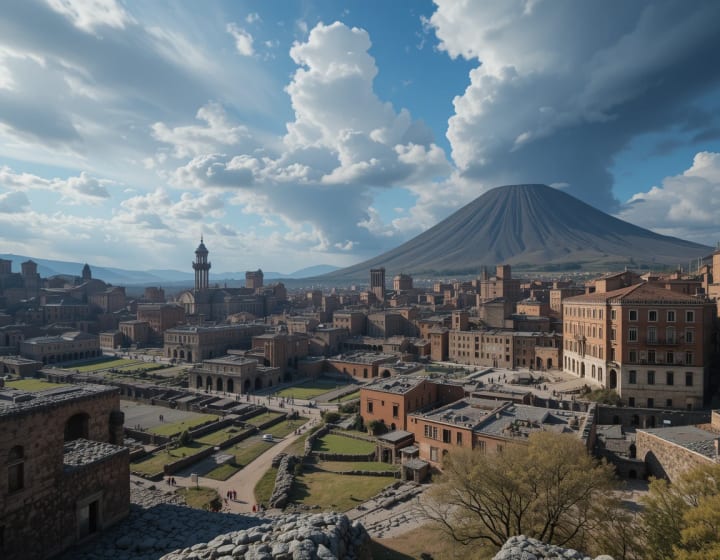
The organic remains at Herculaneum provided unparalleled data about Roman domestic life, architecture, and material culture. The painstaking work continued over centuries with periods of neglect followed by renewed scientific interest. Modern archaeological techniques have greatly expanded knowledge about these cities. Their finds include everything from graffiti that captures the voice of everyday Romans to luxurious villas that tell stories of wealth and politics. Their rediscovery was transformative for historians, archaeologists, and the general public, revealing the complexity of Roman civilization and the catastrophic power of nature.

🖼️ Part IV: Art, Architecture, and Daily Life—A Glimpse Into Ancient Roman Society
The artistic and architectural remains of Pompeii and Herculaneum provide unmatched windows into Roman aesthetics, beliefs, and lifestyles. Homes ranged from simple insulae apartments housing poorer families to grand domus and villas owned by the elite, many decorated with elaborate frescoes and intricate mosaics portraying mythological stories, religious scenes, and daily activities. The use of perspective and vibrant color in the frescoes demonstrated advanced artistic techniques and evolving Roman tastes.
Public buildings like the Pompeii Forum stood as centers of civic life, with temples dedicated to Jupiter, Apollo, and Venus alongside marketplaces and basilicas used for administration and legal matters. The amphitheater in Pompeii, which could seat around 20,000 spectators, was among the oldest Roman arenas used for gladiatorial games and other public spectacles, showcasing entertainment’s role in social life.
Herculaneum’s preserved villas offered exquisite examples of luxury with sophisticated wooden furniture, wall paintings, and advanced plumbing systems including private baths, latrines, and running water. The volcanic burial remarkably preserved organic materials such as foodstuffs, wooden beams, and even carbonized papyrus scrolls, including a rare library revealing literary works lost elsewhere.
The casts of victims from Pompeii, made by pouring plaster into voids left by decomposed bodies, create hauntingly vivid impressions of the people’s final moments, capturing their posture, expressions, and clothing details, offering poignant reminders of the human tragedy. The cities’ streets were lined with shops, bakeries, and workshops highlighting the diverse trades practiced. The graffiti found on walls includes political slogans, advertisements, love poems, and even rude jokes, offering a lively picture of Roman social interactions and daily concerns.
The cities also show evidence of complex social stratification with signs of slavery, freedmen, artisans, merchants, and the wealthy elite interacting within the urban fabric.

🏺 Part V: Scientific Techniques and Modern Archaeology
Contemporary archaeological efforts at Pompeii and Herculaneum combine traditional excavation with cutting-edge technologies aimed at preserving the fragile ruins and uncovering new information. Ground-penetrating radar, laser scanning, photogrammetry, and drones are now routinely used to map sites with incredible precision, allowing for virtual reconstructions and detailed analysis of structures without intrusive digging.
Advances in chemical and microscopic analysis help determine the composition of pigments used in frescoes and the diet of ancient inhabitants through residue examination. Forensic anthropology studies skeletal remains, revealing demographics, health conditions, nutritional status, and trauma patterns, shedding light on life expectancy and causes of death.
The study of volcanic deposits and ash layers helps volcanologists reconstruct the eruption’s timeline and dynamics, informing modern hazard assessments. Conservation is a major challenge given exposure to weathering, pollution, and the high volume of tourism. Ongoing projects include measures to stabilize walls, roofs, and frescoes, as well as educational programs to promote responsible visitation.
Collaborative international research and digital archiving ensure that Pompeii and Herculaneum continue to yield invaluable data while preserving their integrity for future generations. The sites are living laboratories advancing knowledge in archaeology, geology, anthropology, and cultural heritage management.
Pompeii and Herculaneum remain among the most significant archaeological sites in the world. Their preservation and discoveries have profoundly influenced historical understanding and popular imagination. Their frozen state provides rare direct evidence of Roman urban planning, architecture, art, and social life unlike any other site.
The discovery inspired the development of archaeology as a scientific discipline and contributed to the European Enlightenment’s interest in classical antiquity. The sites have permeated art, literature, and film from early travelogues to modern cinema, shaping perceptions of ancient Rome. They also serve as cautionary tales on the devastating power of natural disasters and the importance of disaster preparedness in urban environments.
Today, they are UNESCO World Heritage Sites, drawing millions of visitors annually, whose footsteps trace those of ancient Romans. The continuing excavations and research enrich knowledge of Roman civilization and foster appreciation of cultural heritage preservation. The lessons learned from these cities inform modern urban design, emergency planning, and heritage conservation, underscoring the enduring connection between past and present.

Pompeii and Herculaneum not only reveal the tragic human cost of Vesuvius’ eruption but celebrate the resilience and achievements of one of history’s greatest civilizations whose legacy still resonates profoundly in contemporary society.
About the Creator
Kek Viktor
I like the metal music I like the good food and the history...
Keep reading
More stories from Kek Viktor and writers in History and other communities.
Savoy Hotel – Mussoorie: The Colonial Luxury Hotel Where an Unsolved Murder Still Walks the Corridors
The First Night: Beauty Wrapped in Silence Mussoorie looks peaceful from a distance. Pine trees sway gently, clouds roll like slow-moving waves, and the hill air smells of rain and old earth. But as evening falls, the silence becomes heavier—almost watchful.
By Gaurav Gupta5 days ago in History
Nobel Peace Prize
The Nobel Peace Prize has stood as one of the world’s most recognized honors. Awarded annually in Oslo, it is meant to celebrate individuals or organizations that have made significant contributions toward peace, diplomacy, and humanitarian progress. While its mission appears straightforward, the Nobel Peace Prize has never been free from debate. In recent years, conversations surrounding global politics—particularly discussions about the Trump Nobel Peace Prize—have brought renewed attention to how peace is defined, measured, and rewarded in the modern era. The Origins and Meaning of the Nobel Peace Prize The Nobel Peace Prize was established by Alfred Nobel, the Swedish inventor best known for creating dynamite. In his final will, Nobel directed that a portion of his wealth be used to recognize efforts that foster peace among nations, reduce standing armies, or promote diplomacy and cooperation. Since its first award in 1901, the prize has honored activists, diplomats, organizations, and world leaders whose actions shaped international dialogue. Unlike other Nobel categories, the peace prize is awarded by a Norwegian committee rather than a Swedish institution. This distinction reflects Nobel’s desire to separate the prize from national interests and focus instead on global responsibility. Over time, the definition of “peace” has expanded. Early recipients were often disarmament advocates or mediators. More recent laureates have included human rights defenders, climate activists, and international organizations working in conflict zones. Politics and the Nobel Peace Prize Despite its humanitarian ideals, the Nobel Peace Prize has always intersected with politics. Recognizing peace efforts often means evaluating political leadership, international negotiations, and long-term consequences—none of which are easy to measure in real time. Some awards have been widely celebrated, while others sparked controversy. Critics often argue that certain laureates were honored prematurely, before the lasting results of their actions became clear. Supporters counter that the prize is meant to encourage peace efforts, not merely reward completed achievements. This tension has made the Nobel Peace Prize a reflection of global priorities at any given moment, rather than a simple historical judgment. Donald Trump and Nobel Peace Prize Discussions Few modern political figures have generated as much debate in connection with the Nobel Peace Prize as Donald Trump. During and after his presidency, conversations about a potential Trump Nobel Prize emerged repeatedly, particularly among supporters who pointed to his role in diplomatic initiatives. The phrase Trump Nobel Peace Prize gained traction following agreements and negotiations in regions long marked by conflict. Advocates argued that these diplomatic efforts aligned with Alfred Nobel’s vision of reducing international tension through dialogue rather than force. At the same time, critics questioned whether these actions met the broader ethical and humanitarian standards traditionally associated with the award. They pointed to domestic divisions, foreign policy controversies, and unresolved global conflicts as reasons for skepticism. This divide highlights a core challenge of the Nobel Peace Prize: peace is rarely absolute, and political leadership is often complex and contradictory. Trump Nobel Peace Prize 2026: Speculation and Context As global politics continue to evolve, speculation around a Trump Nobel Peace Prize 2026 has appeared in media discussions and public commentary. It is important to note that nominations for the Nobel Peace Prize are confidential for decades, and speculation does not confirm consideration or selection. However, the mere discussion of Trump Nobel Peace Prize 2026 reflects how the award has become part of broader cultural and political conversations. Supporters view such recognition as validation of diplomatic achievements, while critics see the speculation as politicizing an institution meant to rise above partisan debate. This dynamic is not unique to Trump. Many past leaders, from various ideological backgrounds, were debated heavily before or after receiving the prize. The Nobel Peace Prize often mirrors global disagreements rather than resolving them. How the Nobel Committee Makes Its Decision Each year, hundreds of nominations are submitted by qualified individuals, including academics, lawmakers, and previous laureates. The Nobel Committee evaluates these nominations through research, expert consultation, and internal debate. The process considers intent, impact, and long-term significance. However, because peace efforts often unfold over years or decades, the committee must make decisions without full historical clarity. This reality explains why some awards age gracefully while others remain controversial. The committee rarely responds directly to public pressure or online campaigns. Media attention, including discussions around a Trump Nobel, does not guarantee influence over the final decision. The Broader Impact of the Nobel Peace Prize Beyond individual recipients, the Nobel Peace Prize plays a symbolic role. It brings global attention to issues that might otherwise be ignored, from humanitarian crises to fragile peace processes. Even controversial nominations can spark meaningful debate about what peace truly means in the modern world. The prize also raises questions about accountability. When leaders are considered for such recognition, the public is encouraged to examine policies, outcomes, and moral responsibility more closely. In this sense, discussions surrounding the Trump Nobel Peace Prize are not just about one individual. They reflect deeper conversations about diplomacy, leadership, and the evolving standards by which peace is judged. Conclusion: A Prize That Reflects the World The Nobel Peace Prize remains one of the most influential and debated honors in global society. Its power lies not only in recognizing peace efforts but also in challenging the world to think critically about conflict, cooperation, and responsibility. Whether discussions involve historic activists or modern political figures like those associated with Trump Nobel Peace Prize 2026 speculation, the award continues to reflect the complexities of international relations. Peace is rarely simple, and neither is the process of honoring it. Ultimately, the Nobel Peace Prize serves as a reminder that striving for peace is an ongoing journey—one shaped by ideals, actions, and the difficult choices that define human history.
By Saboor Brohi 4 days ago in History
Silver Screen Magic with Mae West
American actress and singer Mae West became a popular film actress during the Great Depression. She started entertaining in vaudeville, then performed on Broadway, and finally went to Hollywood. She signed up with Paramount Pictures and made her debut in the 1932 film “Night After Night.” She also starred in musicals, comedies, and crime dramas. The American Film Institute named her one of the best classic Hollywood actresses.
By Rasma Raisters7 days ago in Geeks


Comments
There are no comments for this story
Be the first to respond and start the conversation.