
Perfect brownies baked at high altitude are possible thanks to Colorado’s home economics pioneer Inga Allison
Perfect brownies baked at high altitude are possible thanks to Colorado’s home economics pioneer Inga Allison

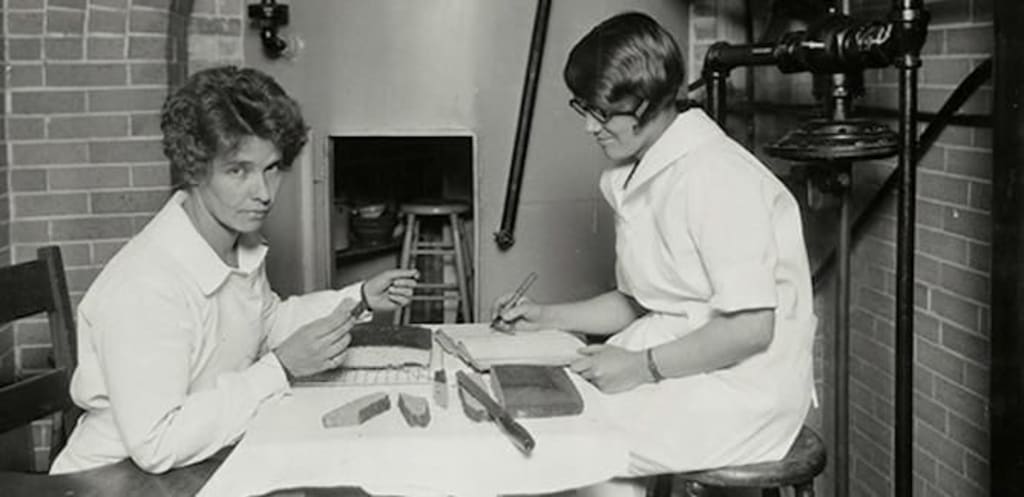
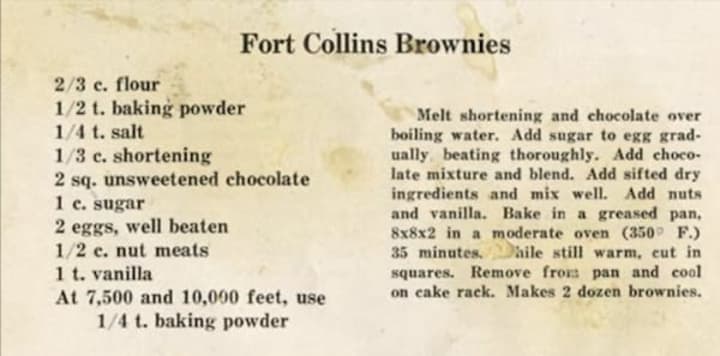
Many bakers working at high altitudes have carefully followed a standard recipe only to reach into the oven to find a sunken cake, flat cookies or dry muffins.
Experienced mountain bakers know they need a few tricks to achieve the same results as their fellow artisans working at sea level.
These tricks are more than family lore, however. They originated in the early 20th century thanks to research on high-altitude baking done by Inga Allison, then a professor at Colorado State University. It was Allison’s scientific prowess and experimentation that brought us the possibility of perfect high-altitude brownies and other baked goods.
We are two current academics at CSU whose work has been touched by Allison’s legacy.
One of us – Caitlin Clark – still relies on Allison’s lessons a century later in her work as a food scientist in Colorado. The other – Tobi Jacobi – is a scholar of women’s rhetoric and community writing, and an enthusiastic home baker in the Rocky Mountains, who learned about Allison while conducting archival research on women’s work and leadership at CSU.
That research developed into “Knowing Her,” an exhibition Jacobi developed with Suzanne Faris, a CSU sculpture professor. The exhibit highlights dozens of women across 100 years of women’s work and leadership at CSU and will be on display through mid-August 2025 in the CSU Fort Collins campus Morgan Library.
A pioneer in home economics
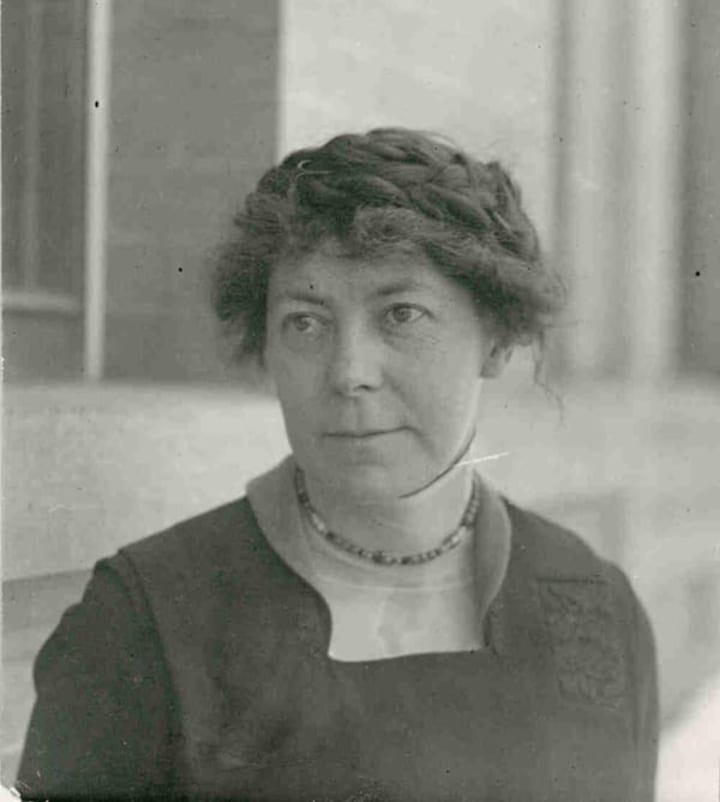
Inga Allison is one of the fascinating and accomplished women who is part of the exhibit.
Allison was born in 1876 in Illinois and attended the University of Chicago, where she completed the prestigious “science course” work that heavily influenced her career trajectory. Her studies and research also set the stage for her belief that women’s education was more than preparation for domestic life.
In 1908, Allison was hired as a faculty member in home economics at Colorado Agricultural College, which is now CSU. She joined a group of faculty who were beginning to study the effects of altitude on baking and crop growth. The department was located inside Guggenheim Hall, a building that was constructed for home economics education but lacked lab equipment or serious research materials.
Allison took both the land grant mission of the university with its focus on teaching, research and extension and her particular charge to prepare women for the future seriously. She urged her students to move beyond simple conceptions of home economics as mere preparation for domestic life. She wanted them to engage with the physical, biological and social sciences to understand the larger context for home economics work.
Such thinking, according to CSU historian James E. Hansen, pushed women college students in the early 20th century to expand the reach of home economics to include “extension and welfare work, dietetics, institutional management, laboratory research work, child development and teaching.”
News articles from the early 1900s track Allison giving lectures like “The Economic Side of Natural Living” to the Colorado Health Club and talks on domestic science to ladies clubs and at schools across Colorado. One of her talks in 1910 focused on the art of dishwashing.
Allison became the home economics department chair in 1910 and eventually dean. In this leadership role, she urged then-CSU President Charles Lory to fund lab materials for the home economics department. It took 19 years for this dream to come to fruition.
In the meantime, Allison collaborated with Lory, who gave her access to lab equipment in the physics department. She pieced together equipment to conduct research on the relationship between cooking foods in water and atmospheric pressure, but systematic control of heat, temperature and pressure was difficult to achieve.
She sought other ways to conduct high-altitude experiments and traveled across Colorado where she worked with students to test baking recipes in varied conditions, including at 11,797 feet in a shelter house on Fall River Road near Estes Park.
About the Creator
Keep reading
More stories from Abjol Hussain Laskar and writers in History and other communities.
The Violent and Mysterious Death of Christopher Marlowe
Christopher Marlowe, one of Elizabethan England’s most enigmatic and brilliant playwrights, died young and under circumstances so suspicious that his death has become one of literary history’s most enduring mysteries. Known for his powerful blank verse and provocative themes, Marlowe’s meteoric rise in the late 16th century was matched only by the suddenness and violence of his demise.
By Abjol Hussain Laskar9 months ago in History
Understanding the Insurrection Act
The Insurrection Act is one of the most powerful and least understood laws in American history. Often mentioned during times of national unrest, it gives the president authority to deploy federal troops within the United States under specific circumstances. While it is rarely used, public interest in the law has grown in recent decades, leading many to ask: what is the Insurrection Act, and why does it matter today? What Is the Insurrection Act? To put it simply, the Insurrection Act of 1807 is a federal law that allows the president to use the U.S. military to suppress civil disorder, insurrection, or rebellion when state authorities are unable or unwilling to do so. If you are wondering what is the Insurrection Act used for, the answer lies in restoring order when local and state governments can no longer maintain public safety. People often search phrases like what is insurrection act or even the misspelled insurection act because the law tends to resurface during moments of crisis. Despite the confusion around its name, the authority it grants is very real and legally binding. What Is the Insurrection Act of the U.S.? So, what is the Insurrection Act of the US in legal terms? It is a collection of statutes now codified under Title 10 of the U.S. Code. The act provides exceptions to the Posse Comitatus Act, which generally prohibits the military from acting as domestic law enforcement. Under the Insurrection Act, the president can federalize the National Guard or deploy active-duty troops if constitutional rights are being violated or if violence prevents the execution of federal law. This is why many people ask, what is the Insurrection Act USA, especially when protests or riots dominate national headlines. The Insurrection Act and Its Historical Use Throughout American history, the act has been invoked sparingly but decisively. One of the most notable examples often referenced is the Insurrection Act 1992, when President George H. W. Bush deployed federal troops to Los Angeles following the Rodney King verdict. Local authorities had lost control, and the federal government stepped in to restore order. Earlier uses date back to the Civil War era and the Civil Rights Movement. Presidents Eisenhower and Kennedy relied on the act to enforce school desegregation in Southern states when state governments resisted federal court orders. These moments illustrate what the Insurrection Act is used for at its core: enforcing the rule of law when normal systems fail. Trump and the Insurrection Act In modern political discourse, the law became widely discussed during the presidency of Donald Trump. Searches for Trump Insurrection Act or Insurrection Act Trump surged during periods of nationwide protests, particularly in 2020. Although the act was never formally invoked during those protests, President Trump publicly considered its use, bringing renewed attention to the scope and limits of presidential power. The phrase insurrection act invoked often appears in news coverage, but it is important to note that discussing invocation and actually using the law are two very different things. The debate surrounding Trump Insurrection Act scenarios highlighted concerns about civil liberties, federal overreach, and the balance of power between states and the federal government. What Is the Insurrection Act in Minnesota? A common question during periods of regional unrest is what is the Insurrection Act in Minnesota or in other specific states. Legally, the act does not change from state to state. However, its application depends on circumstances within a particular state. If a governor requests federal assistance or if the president determines that constitutional rights cannot be protected locally, the Insurrection Act may apply. Minnesota, like every other state, falls under the same federal framework. The law does not target any single state; it responds to conditions on the ground. What Is the Insurrection Act Used For Today? In today’s environment, many Americans ask, what is the Insurrection Act used for in a modern democracy with established institutions. Supporters argue it is a necessary safeguard for extreme emergencies. Critics counter that it grants sweeping powers that could be misused if political tensions escalate. Understanding what is the Insurrection Act? requires recognizing that it is both a legal tool and a symbol. Its mere mention can influence public perception, markets, and political debate, even when it is not formally applied. Ongoing Debate and Public Concern The Insurrection Act remains controversial because it sits at the intersection of security and freedom. While it has been used to protect civil rights in the past, critics worry about potential misuse in polarized times. This tension explains why questions like what is the Insurrection Act of the US continue to trend whenever civil unrest occurs. Ultimately, the law reflects a fundamental challenge in governance: how to maintain order without undermining democracy. The fact that it has existed since 1807 and remains largely unchanged shows both its durability and its complexity. Final Thoughts The Insurrection Act is not a law that affects daily life, but it plays a critical role during extraordinary moments. From the Insurrection Act of 1807 to discussions around Insurrection Act 1992 and Insurrection Act Trump, its history mirrors the nation’s struggles with unity, authority, and rights.
By Saboor Brohi 4 days ago in History
From Desert Sands to a Global City
Long before Dubai became a city of glittering skyscrapers and global ambition, it was a quiet settlement shaped by the desert, the sea, and the determination of its people. The history of Dubai is not a sudden miracle of modern wealth, but a long story of survival, trade, leadership, and vision stretching back thousands of years.
By The best writer 6 days ago in History



Comments
There are no comments for this story
Be the first to respond and start the conversation.