
From Desert Sands to a Global City
The Historical Journey of Dubai

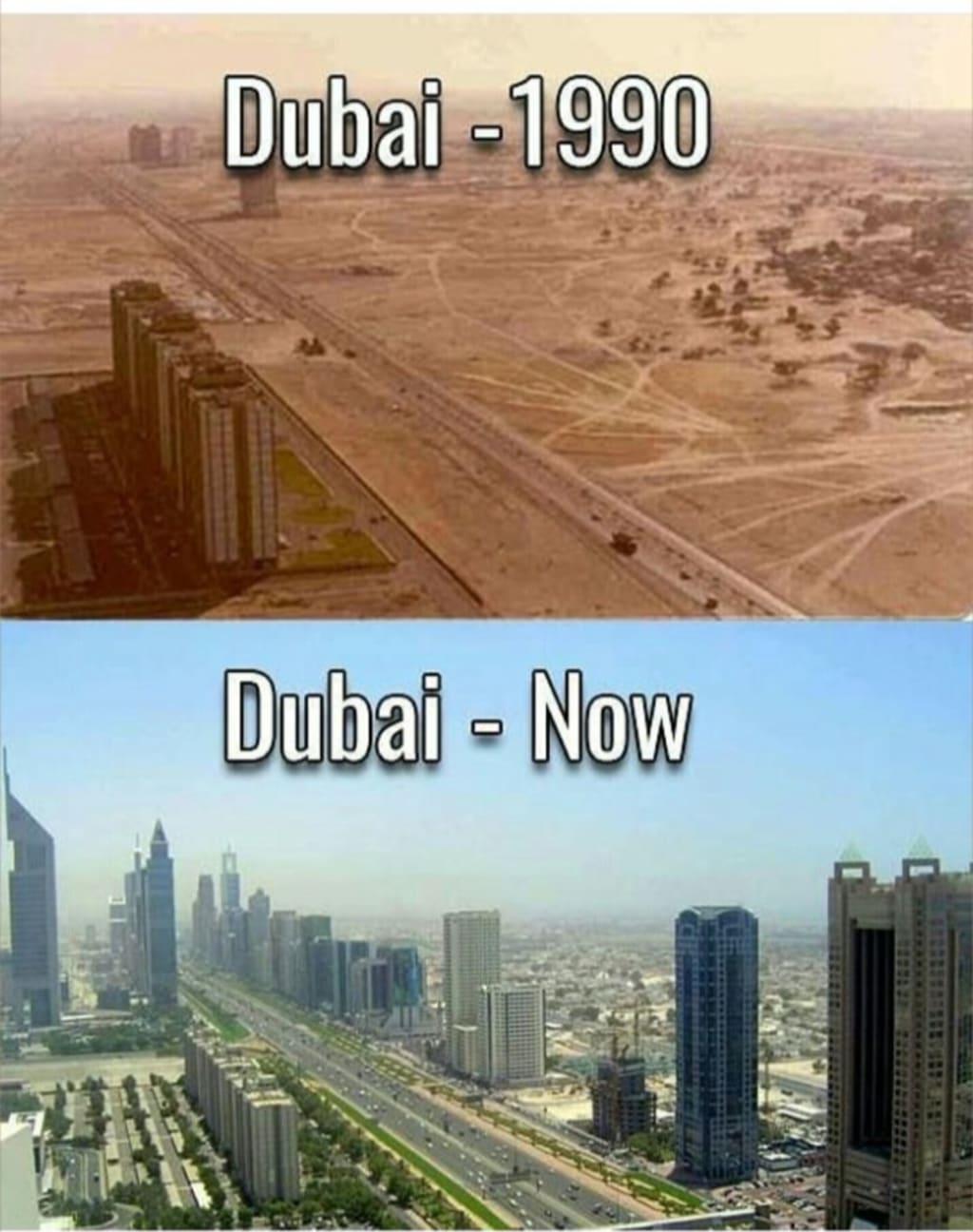
Long before Dubai became a city of glittering skyscrapers and global ambition, it was a quiet settlement shaped by the desert, the sea, and the determination of its people. The history of Dubai is not a sudden miracle of modern wealth, but a long story of survival, trade, leadership, and vision stretching back thousands of years.
Archaeological evidence shows that the region around Dubai was inhabited as early as 3000 BCE. Small communities lived along the coast and near oases, relying on fishing, hunting, and limited agriculture. The sea was their lifeline. Even in ancient times, Dubai’s location along important trade routes made it a natural meeting point between East and West. Traders traveling between Mesopotamia, the Indus Valley, and Africa passed through the Arabian Gulf, exchanging goods, ideas, and cultures.
For centuries, the people of the region lived modestly. The harsh desert climate demanded resilience. Palm trees provided dates for food, while camels were used for transport across the sands. Coastal life revolved around fishing and, most importantly, pearl diving. By the 18th and 19th centuries, Dubai had become one of the most important pearling centers in the Gulf. Each summer, fleets of wooden boats sailed into the sea, and divers risked their lives to collect pearls from the ocean floor. These pearls were highly valued in India, Persia, and Europe, forming the backbone of Dubai’s early economy.
The modern political story of Dubai began in 1833, when Sheikh Maktoum bin Butti of the Bani Yas tribe led his people to settle at the mouth of Dubai Creek. This moment marked the founding of the Al Maktoum dynasty, which still rules Dubai today. Sheikh Maktoum established Dubai as an independent sheikhdom, separating it from Abu Dhabi. His leadership laid the foundations of stability, openness, and trade that would define Dubai’s future.
Dubai Creek played a crucial role in the city’s development. The natural waterway allowed ships to anchor close to land, making it ideal for commerce. Merchants from Iran, India, and beyond settled along the creek, turning Dubai into a bustling trading port. Unlike many neighboring regions, Dubai adopted an open-door policy. Low taxes and minimal restrictions attracted traders, craftsmen, and entrepreneurs. This spirit of openness became a defining characteristic of the city.
In the late 19th and early 20th centuries, Dubai came under British protection as part of the Trucial States. While Britain controlled foreign policy and security, local rulers retained internal authority. This period brought relative peace to the region, allowing trade to flourish. Dubai continued to grow as a commercial hub, even as it remained a small town by global standards.
However, the 1930s brought hardship. The global economic depression and the invention of cultured pearls in Japan caused the pearling industry to collapse. Many families lost their primary source of income, and poverty spread across the region. It was one of the most difficult periods in Dubai’s history. Yet even in these dark times, the city’s leaders looked for new paths forward.
A turning point came in the mid-20th century under the leadership of Sheikh Rashid bin Saeed Al Maktoum. A visionary ruler, Sheikh Rashid believed deeply in infrastructure, planning, and long-term growth. In the 1950s and 1960s, he invested heavily in improving Dubai Creek, dredging it to allow larger ships to enter. He also supported the construction of roads, schools, hospitals, and an airport—projects that seemed ambitious for a small desert town.
In 1966, oil was discovered in Dubai. Although Dubai’s oil reserves were smaller than those of Abu Dhabi, the discovery provided vital revenue. Sheikh Rashid used oil wealth wisely, reinvesting it into trade, real estate, and public services rather than relying solely on oil income. This decision would later prove crucial to Dubai’s long-term success.
The year 1971 marked another historic milestone when the United Arab Emirates was formed. Dubai joined with six other emirates under the leadership of Sheikh Zayed bin Sultan Al Nahyan of Abu Dhabi. The union brought political stability, shared resources, and a united vision for the future. Dubai retained a significant degree of autonomy, allowing it to pursue its unique economic strategies.
In the decades that followed, Dubai transformed at an astonishing pace. Free trade zones such as Jebel Ali Port attracted multinational companies. Tourism, aviation, finance, and real estate became key pillars of the economy. Iconic projects like the Burj Al Arab, Palm Jumeirah, and later the Burj Khalifa symbolized Dubai’s ambition to stand on the world stage.
Despite its rapid modernization, Dubai never fully abandoned its past. Traditional souks still operate along Dubai Creek, wooden dhows continue to cross the water, and cultural heritage sites preserve memories of earlier life. The city’s leadership consistently emphasized a balance between tradition and innovation.
Today, Dubai is a global city known for its diversity. People from hundreds of nationalities live and work there, continuing the ancient tradition of trade and cultural exchange. What began as a small settlement of fishermen and pearl divers has become a symbol of possibility.
The history of Dubai is not just about wealth or tall buildings. It is the story of adaptation in a harsh land, of leaders who planned beyond their time, and of a society that embraced change without losing its identity. From desert sands to a global crossroads, Dubai’s journey is one of the most remarkable transformations in modern history.
About the Creator
The best writer
I’m a passionate writer who believes words have the power to inspire, heal, and challenge perspectives. On Vocal, I share stories, reflections, and creative pieces that explore real emotions, human experiences, and meaningful ideas.
Keep reading
More stories from The best writer and writers in History and other communities.
Napoleon Bonaparte — From Corsican Outsider to Emperor of Europe
Napoleon Bonaparte was born on August 15, 1769, on the Mediterranean island of Corsica, a land that had only recently come under French control. His family was of modest noble status, and young Napoleon grew up feeling like an outsider—Corsican by culture, yet educated as a Frenchman. This sense of being different shaped his fierce ambition and iron will. From an early age, he showed a sharp mind, a deep love for history, and an unusual talent for mathematics, which later proved essential in warfare.
By The best writer a day ago in History
Can the United States Leave NATO?
Can the United States Leave NATO? What It Would Take—and What It Would Mean The North Atlantic Treaty Organization, commonly known as NATO, has been one of the most powerful military alliances in modern history. Since its creation in 1949, the United States has been NATO’s strongest member—militarily, financially, and politically. But in recent years, debates have grown louder about whether the U.S. should remain in the alliance. This raises a serious question: how could the United States be removed from NATO—or leave it—and what would that mean for the world?
By Wings of Time 3 days ago in History



Comments
There are no comments for this story
Be the first to respond and start the conversation.