
Murder, Marriage, and the Throne: Hürrem Sultan’s Ruthless Ascent
The Most Dangerous Woman in Ottoman History
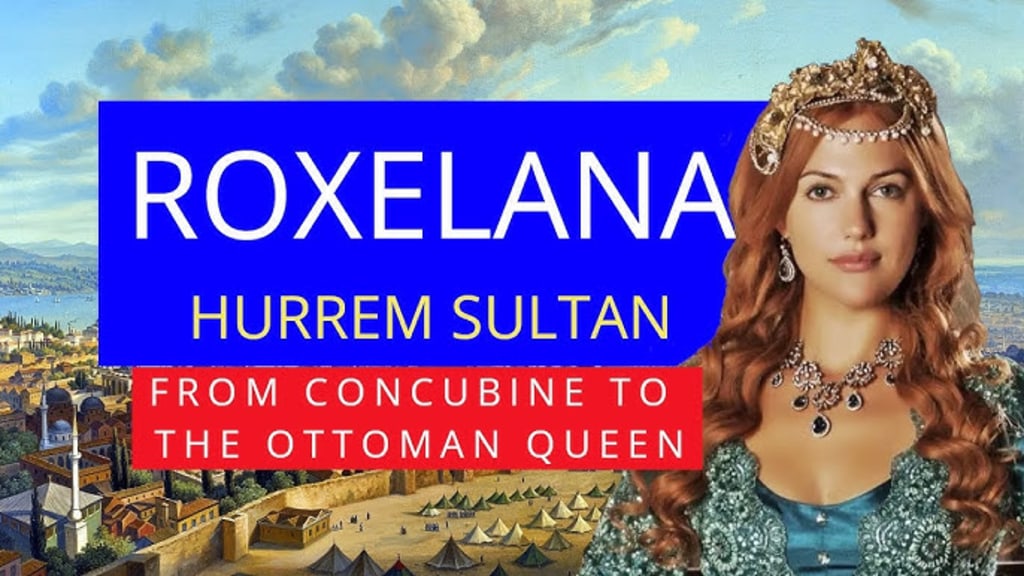
She arrived in chains—nameless, powerless, just another terrified girl ripped from her homeland and thrust into the opulent prison of the Ottoman harem. But behind her wide eyes and fiery red hair burned something no chains could hold: ambition.
Her name would become legend.
Hürrem Sultan—the woman who defied an empire, bewitched a sultan, and ruled from behind the veil of silk and gold.
She was no ordinary concubine. When she caught the eye of Suleiman the Magnificent, it was as though the fates themselves paused to watch. He had hundreds of women at his disposal, yet he chose her again... and again... until the harem whispers turned to gasps, and the empire held its breath.
For centuries, Ottoman sultans took lovers, not wives. Love was weakness. Power was cold. But for Hürrem, Suleiman broke the ancient rule. He married her. Publicly. Officially. Outrageously.
And from that moment on, the game changed.
Inside the palace, daggers hid behind smiles. Her rivals sharpened their claws, none more dangerously than Mahidevran, Suleiman’s former favorite and the mother of his first-born son. Their rivalry was legendary, filled with violent outbursts, cruel rumors, and an escalating war of influence. Hürrem didn’t just survive it—she crushed it.
With a mind as sharp as any sword, she became her husband’s advisor, muse, and equal. Foreign ambassadors marveled at her hold over the Sultan. Some called it sorcery. Others called it seduction. But it was neither.
It was power.
She whispered strategies that swayed empires. She wrote letters that stirred wars and brokered peace. She protected her children with the tenacity of a lioness, ensuring her son Selim would wear the crown—even if it meant seeing rivals fall.
Yes, some believe she orchestrated the downfall of Mustafa, Suleiman’s eldest son. Yes, some say blood was on her hands. But history isn’t written by the timid. It belongs to the bold.
And Hürrem was the boldest of them all.
Yet she was more than just cunning. Hürrem was a visionary. She poured her wealth into the people—building mosques, hospitals, schools, and soup kitchens. Istanbul still bears her touch, stone by stone, as if the city itself remembers her reign.
Even in death, she defied expectations. She wasn’t buried in obscurity like so many women of the harem. No, she rests beside Suleiman, in the grand Süleymaniye Mosque—his queen, even in eternity.
Hürrem Sultan didn’t just capture a man’s heart—she conquered it. She didn’t just rise from slavery—she rewrote the rules of power in a world ruled by men.
History tried to tame her with footnotes and controversy. But her legend lives on, burning brighter than ever—in TV dramas, in whispered tales, in the heart of every woman who dares to dream bigger than her circumstances.
She came to the palace in chains.
She left it as a queen.
Legacy
So extraordinary was Roxelana’s success that her enemies saw witchcraft as the only possible explanation for it. She was also characterized as a schemer who plotted the assassination of İbrahim Paşa, the sultan’s grand vizier (chief minister), in 1536, in order to eliminate a rival influence on the sultan. She increased the importance of her harem by arranging for it to be moved from the Old Seraglio (Eski Saray) to the Topkapı Palace, where Süleyman lived and held court. Süleyman and Roxelana grieved when Mehmed, the heir apparent, died in 1543. Their daughter Mihrimah was given in marriage to a courtier named Rüstem, who became grand vizier in 1544. Rüstem and Roxelana were suspected of plotting the execution in 1553 of Gülbahar’s son Mustafa, who, as Süleyman’s oldest surviving son, stood between Roxelana’s own remaining sons and the imperial succession.
Roxelana died in April 1558. Süleyman lived on until 1566 and was succeeded as Ottoman emperor by Selim II, sometimes known as “the sot,” a weak ruler who was nonetheless Roxelana’s last surviving son. During Selim’s reign, the influence of the harem often overshadowed that of the grand vizier, resulting in the so-called “Sultanate of the Women,” a state of affairs often attributed to Roxelana’s legacy.
Hürrem Sultan remains one of the most fascinating women in Islamic and world history. She defied every expectation placed on her: a foreign-born slave who became an empress, a mother, a political strategist, and a symbol of female power in an overwhelmingly male world.
Her life continues to inspire books, TV shows like Muhteşem Yüzyıl ("Magnificent Century"), and academic debate. Whether seen as a power-hungry schemer or a brilliant survivor, Hürrem Sultan’s legacy endures as a reminder that even within the strictest boundaries, a clever mind and fierce spirit can rewrite destiny.
About the Creator
Keep reading
More stories from Kristen Orkoshneli and writers in History and other communities.
Versace’s legacy is more than just daring dresses
London (CNN) -From bondage styles to safety pinned dresses, daring party frocks are widely considered to be the key protagonists of Gianni Versace’s sartorial legacy. But the late Italian fashion designer was also responsible for some of the most majestic silk shirts of the 1990s, and his close friend Elton John owned one in every print. “They’re just works of art,” shared the acclaimed singer-songwriter in a promotional video for auction house Christie’s last year, characterizing his deep affection for Versace’s patterns. “I never wore half of them, I just wanted to hang them. It was like an art installation with shirts, and it looked so beautiful.”
By Kristen Orkoshneli6 months ago in History
How Early Aircraft Failures Created Modern Flight Safety
When we look at modern aviation today with its redundant systems, strict regulations, and impressive safety record it’s easy to forget how fragile flight once was. Early aviation wasn’t built on confidence or certainty. It was built on risk. Every successful flight was surrounded by countless failures, and every crash carried lessons that would quietly reshape the future of air travel.
By Beckett Dowhana day ago in History
The Accidents That Quietly Improved Aviation Forever
I used to think aviation history was a story of bold successes, record-breaking flights, sleek aircraft, and triumphant landings. But the more I read, the more I realized something uncomfortable: much of modern aviation was shaped not by success, but by accidents. The safety and reliability we now take for granted were quietly built from moments when things went terribly wrong.
By Beckett Dowhanabout 12 hours ago in History


Comments
There are no comments for this story
Be the first to respond and start the conversation.