
Versace’s legacy is more than just daring dresses
It's the history
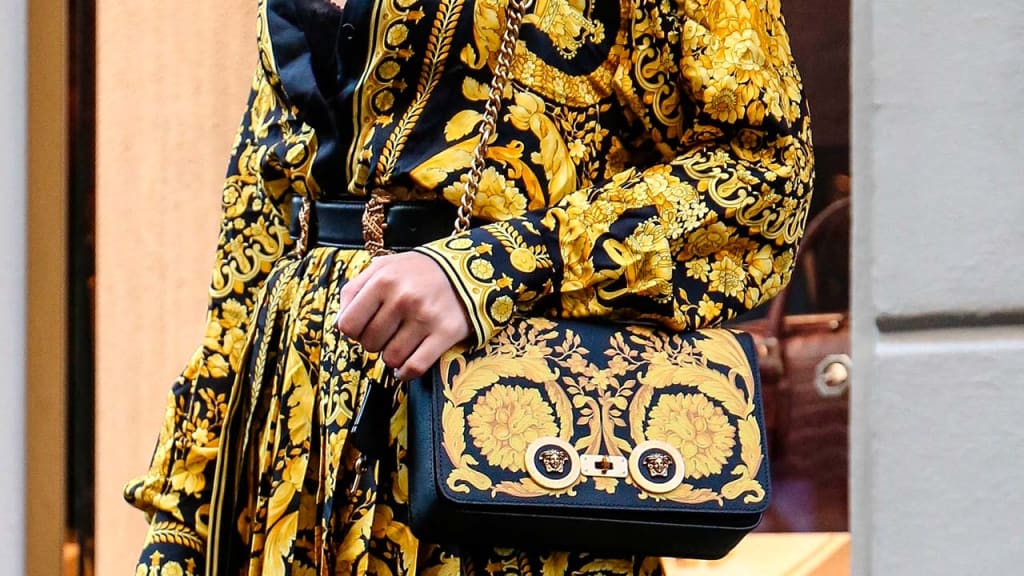
London (CNN) -From bondage styles to safety pinned dresses, daring party frocks are widely considered to be the key protagonists of Gianni Versace’s sartorial legacy. But the late Italian fashion designer was also responsible for some of the most majestic silk shirts of the 1990s, and his close friend Elton John owned one in every print. “They’re just works of art,” shared the acclaimed singer-songwriter in a promotional video for auction house Christie’s last year, characterizing his deep affection for Versace’s patterns. “I never wore half of them, I just wanted to hang them. It was like an art installation with shirts, and it looked so beautiful.”
Versace, who founded his eponymous label in 1978, made his name shaping the fashion landscape in the 1980s and early ‘90s with glamorous and often provocative designs. And his influence continues to be pervasive in fashion and culture today.
In an email to CNN, Dutch-Swedish model Marcus Schenkenberg recalled that the first piece of Versace clothing he ever owned was also a colorful green and yellow silk shirt. “It was one of my favorite shirts,” explained Schenkenberg, who gained prominence in the late ‘80s and is widely considered as one of the first male supermodels. Introduced to Gianni Versace at a casting in 1990, three years later he would front a couture campaign for the house with Stephanie Seymour, shot by Richard Avedon.
Versace was one of the first designers to merge fashion with pop culture. In doing so, he made fashion feel glamorous, accessible, and alive in a way few others had done before.
Since 2017, Lubnow and von der Ahe have poured over the designer’s work, building an impressive archive of pieces borrowed from long time collectors, and subsequently showcasing the retrospective at museums across Europe, first in Berlin, Germany in 2018 and most recently in Málaga, Spain.
The latest London iteration however, feels particularly special, not least because of the expanded offering (it boasts 50 more pieces than its Spanish counterpart), but also the relationship Versace had with the city, staging an exhibition at the V&A museum in 1985 (when the house was still in its relative infancy), and surrounding himself with people based in the capital, from Elton John and George Michael to fashion editors Anna Wintour and Suzy Menkes, as well as Naomi Campbell and Kate Moss, and of course Princess Diana. “It had a very strong impact on him, and London was also a kind of bridge towards the USA,” noted von der Ahe.
The exhibition’s timing is also significant, arriving just four months after Gianni Versace’s sister Donatella announced she was stepping down as chief creative officer of the house, a role she has held since Gianni’s murder in 1997. The news that her successor would be someone outside the family for the first time — former Miu Miu design director Dario Vitale took over in April — marks an important new era for the brand. The retrospective feels particularly apt as a result.
“It was always nice to work for Gianni,” Schenkenberg continued, reflecting on his experiences with the designer in the 1990s. “He was always very kind and he was really one of the hottest designers at the time — everybody wanted to work with him, it could really make your career.” Indeed, while a copy of Versace’s “Men Without Ties”, a book about menswear fronted by Schenkenberg and authored by the designer in 1994, is amongst the featured ephemera; so too is the January 1990 issue of British Vogue. Cementing the age of the supermodel — a concept largely engineered by Versace — it featured Campbell, Linda Evangelista, Tatjana Patitz, Christy Turlington, and Cindy Crawford on the cover (the following year, four of the five would lip-sync to George Michael’s’ “Freedom” at Versace’s fall-winter 1991 show).
Versace, who was widely credited for "making" the supermodels of the '80s, caused a sensation by agreeing to pay Cindy Crawford, Linda Evangelista, Naomi Campbell and Christy Turlington up to $30,000 each to appear in his shows. For his autumn/winter 1991 show in Milan, all four models appeared on the catwalk together, a moment that has gone down in history as one of fashion's most memorable.Versace was instrumental in marrying fashion and celebrity, a practice typical by today’s standards but groundbreaking amongst his peers at the time. “Elton John was basically his billboard, he wore (Versace) on the street, on the stage — he was always advertising,” said Lubnow.
“He revolutionized the relationship between fashion and celebrity,” agreed Schenkenberg. “Versace was one of the first designers to merge fashion with pop culture. In doing so, he made fashion feel glamorous, accessible, and alive in a way few others had done before, especially with celebs like Madonna, Prince, Tupac Shakur, Demi Moore, and of course all the supermodels.”
This affinity for fame and dressing influential artists can easily be read as a precursor to today’s influencer culture, and von der Ahe observed that Versace was privy to a unique position during his tenure. “He was in-between the old and the new. He had a profound knowledge about making fashion and the background of Italian manufacturing, but on the other hand, he started to separate the product from the brand,” von der Ahe said. “He was coming from the old world, but opened the doors to the new world.”
Central to the exhibition are the collections from spring-summer 1988 through to fall-winter 1997 which are curated in chronological order. Versace “changed so much from collection to collection, but there is a red thread,” explained Lubnow. “He had the ability to mix patterns and colors. You never looked like a clown, but actually quite sophisticated, and that’s really an ability he had, and this vision he took from his culture — from his mother and from the tailor shop into street style, putting jeans on the haute couture runway; all these things he meshed together.”
Versace himself was keenly attuned to the various influences that informed his work, once commenting, “There is a Versace who is very conservative, there is a Versace who is very crazy, there is a Versace who is very theatre … I haven’t decided yet which I choose to be.”
“The depth of what you can learn from him and his work is amazing,” said von der Ahe, speaking to the impact of Versace. “You might think everything is superficial, the bold fashion, but when you work with it, you really understand a lot about Italian culture, Italian history, about the time. And with Gianni Versace, you remember pieces that perhaps you only briefly saw in a magazine, a book or on TV. You remember it, even if you don’t know why, and that is really the magic with him.”
Or, as Lubnow simply described Versace’s designs, “they are showstoppers.”
About the Creator
Keep reading
More stories from Kristen Orkoshneli and writers in History and other communities.
How an Enslaved Man Helped Jack Daniel Develop His Famous Whiskey
Jack Daniel’s stands as one of the most iconic American brands and most popular spirits in the world. Yet while the whiskey and its eponymous founder have become dominant names in American liquor lore, the person perhaps most responsible for its success—an enslaved man named Nathan “Nearest” Green, who taught Jack Daniel the art of whiskey distillation—went unacknowledged for more than 150 years.
By Kristen Orkoshneli8 months ago in History
The Arab Revolt: How Arab Forces Allied with the British to Defeat the Ottoman Empire and Create Transjordan
During the early twentieth century, the Middle East was largely under the control of the Ottoman Empire, which had ruled Arab lands for nearly four centuries. However, the outbreak of World War I dramatically changed the political landscape of the region. One of the most significant developments of the war in the Middle East was the Arab Revolt, a rebellion led by Arab leaders with the support of the British. This revolt ultimately contributed to the defeat of Ottoman forces in the region and laid the groundwork for the creation of Transjordan.
By Irshad Abbasi 5 days ago in History




Comments
There are no comments for this story
Be the first to respond and start the conversation.