
Malin Kundang: The Cursed Son – Padang, Indonesia
A Traditional Indonesian Folktale of Pride, Betrayal, and a Mother’s Curse

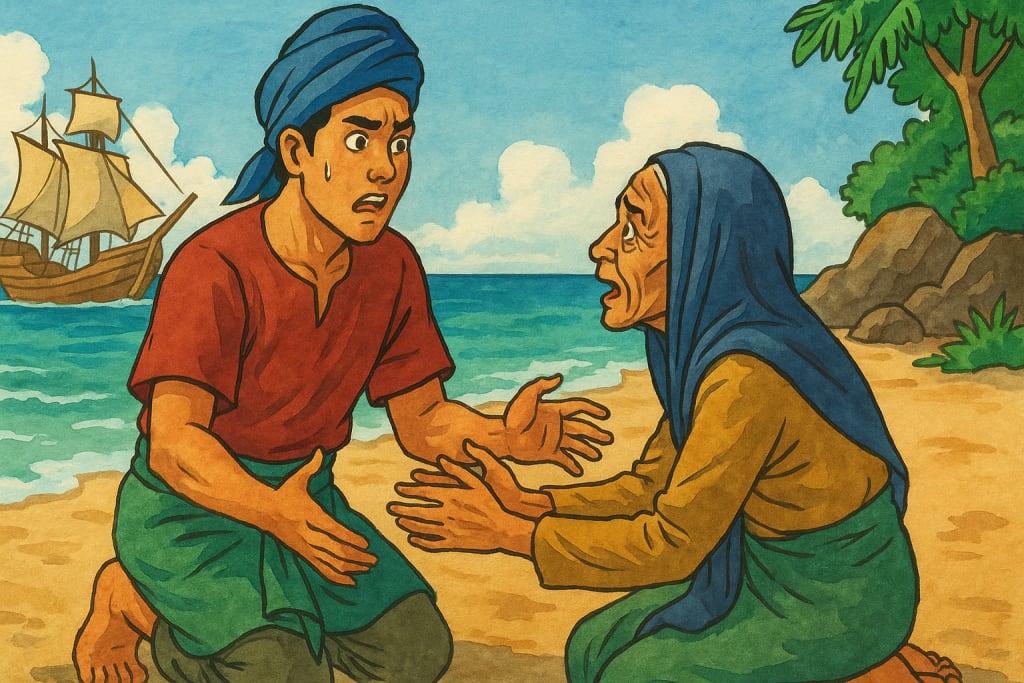
Long ago in a quiet fishing village on the coast of West Sumatra, Indonesia, there lived a poor widow named Mande Rubayah and her only son, Malin Kundang. They lived in a modest hut near the sea, relying on Mande Rubayah’s small income from selling traditional cakes to survive. Although they lived in poverty, Mande Rubayah poured all her love into raising Malin, teaching him the value of hard work, humility, and gratitude.
Malin was a clever and hardworking boy. From an early age, he helped his mother gather firewood, fetch water, and sell food at the market. He often gazed longingly at the ships anchored offshore, carrying wealthy merchants from distant lands. In his heart, Malin dreamed of a better life—not for himself alone, but also to lift his beloved mother out of poverty.
One day, a merchant ship docked at the village. Malin, bold and full of hope, approached the crew and asked to join them. He wished to travel the seas, earn wealth, and return one day as a successful man. Mande Rubayah was reluctant to let her only son go. She feared the dangers of the ocean and the loneliness that would follow his absence. But seeing Malin’s determination, she finally gave her blessing, with one condition—that he never forget his roots or his mother who loved him more than life itself.
Malin swore to return and hugged his mother tightly. With tears in her eyes, Mande Rubayah waved goodbye as her son sailed away into the horizon.
Years passed. The villagers often asked Mande Rubayah if she had heard from Malin. She always replied with hopeful eyes, “One day, he will return.”
Meanwhile, Malin’s life changed drastically. He worked tirelessly and learned the ways of trade and navigation. Fortune smiled upon him. He became a respected merchant and eventually married the beautiful daughter of a nobleman. Wealth and status surrounded him. However, in his pursuit of grandeur, Malin gradually erased his humble past from memory—including the mother who waited faithfully for his return.
One bright morning, Malin’s ship, now luxurious and grand, anchored near his old village. The villagers were astonished to see such a fine vessel, and the news quickly spread: Malin Kundang had returned! Mande Rubayah, frail and aging, was overjoyed. She hurried to the shore with weak steps but a strong heart, longing to embrace the son she had missed for so many years.
Malin stood on the deck, clad in fine garments, surrounded by guards and his elegant wife. As Mande Rubayah called out his name and reached toward him, Malin's face turned pale with shame. He was afraid that acknowledging his poor, old mother might tarnish his reputation before his noble wife and crew. In a moment of pride and fear, he shouted, “I do not know this woman! I am not her son!”
Mande Rubayah was stunned. Her heart shattered into pieces. She fell to her knees, tears rolling down her cheeks. “Malin… it’s me, your mother. I raised you with my love, prayed for you every night, and waited all these years.”
But Malin turned away coldly and ordered his guards to remove her. His wife looked at him with confusion, but Malin remained silent, blinded by pride.
The villagers watched in sorrow. Mande Rubayah, humiliated and broken, looked up at the sky. With a trembling voice filled with grief, she whispered a curse: “Oh, God… if that is truly my son, then let him be punished for his cruelty.”
The sky darkened. Thunder rolled across the ocean. The winds howled, and waves grew taller. Malin’s grand ship was caught in the storm. The sea raged with fury, tossing the vessel like a toy. Malin tried to command his crew, but it was too late. A blinding flash of lightning struck the ship, and Malin Kundang was thrown onto the rocks near the shore.
Before he could rise, his body began to stiffen. He looked at his hands—his skin was turning cold and gray. He cried out for forgiveness, but his voice echoed into silence. Before the eyes of the villagers and his weeping mother, Malin Kundang turned into stone.
The villagers believed it was the curse of a mother’s tears—tears too heavy to bear.
To this day, a large rock formation lies on the beach near the village of Air Manis. Locals say it resembles a man kneeling in despair, forever facing the sea. It is known as Batu Malin Kundang—Malin Kundang’s Stone.
Mande Rubayah, heartbroken, spent her remaining days praying by the sea. Though her son had brought her sorrow, she never stopped loving him.
About the Creator
Sky
hi!
Iran hails ‘encouraging signals’ from US ahead of nuclear talks in Geneva
Iranian President Masoud Pezeshkian has said that nuclear talks with the United States have produced “encouraging signals”, but warned that Tehran is prepared for any scenario ahead of another round of negotiations set for Thursday.
By Wings of Time 6 days ago in History
Magic
Note from the Author: I want to let you know that this is an unusual story, and it has been written purely from whatever is in my unconscious mind, because before I start writing, I get into a flow state that reaches my unconsciousness. I also write in my subconscious mind, which is like a mid-flow state between the conscious and unconscious mind.
By Denise Larkin6 days ago in Fiction


Comments (1)
This story of Malin Kundang is a classic. It shows how easy it is to forget our roots when we get caught up in success. Happens more often than you'd think.