
India and Pakistan Escalate Military Attacks on Bases Amid Rising Tensions
Pakistan accused India of launching air-to-surface missiles that targeted at least three bases. Soon after, Pakistani officials said retaliatory action against Indian bases had begun.

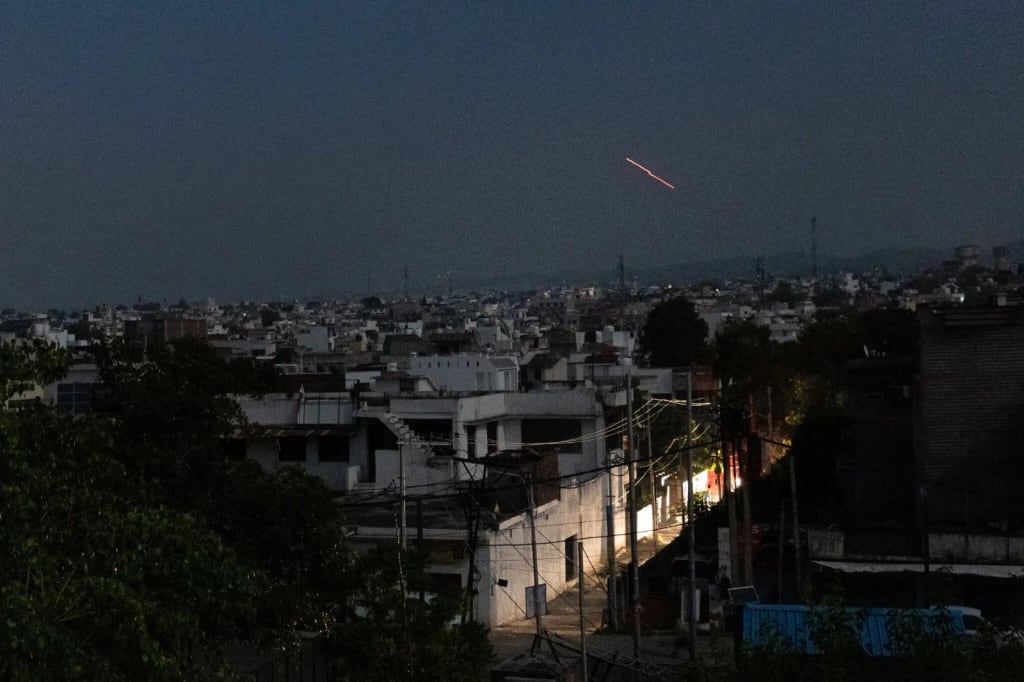
In a significant escalation of hostilities, India and Pakistan have launched reciprocal attacks on each other's military bases, marking one of the most severe confrontations between the nuclear-armed neighbors in recent years.
Genesis of the Conflict
The current tensions were ignited by a deadly attack on Hindu tourists in Indian-administered Kashmir, which resulted in 26 fatalities. India attributed the assault to the Pakistan-based militant group Lashkar-e-Taiba, prompting a series of retaliatory measures.
Military Strikes and Counterstrikes
In response to the Kashmir attack, India initiated "Operation Sindoor," targeting nine sites in Pakistan and Pakistan-administered Kashmir, including areas in Bahawalpur, Muridke, and Muzaffarabad. These strikes aimed at dismantling terrorist infrastructure.
Pakistan retaliated with "Operation Bunyan Ul Marsoos," launching attacks on key Indian military installations such as Pathankot, Udhampur, and a BrahMos missile storage facility. The Pakistani military claimed successful hits on India's S-400 air defense system, though India denied these assertions.
Both nations have reported casualties and damage, with at least 48 fatalities confirmed.
Use of Advanced Weaponry
The conflict has seen the deployment of advanced military technology. India utilized its Rafale jets equipped with SCALP missiles and AASM Hammer bombs during Operation Sindoor. Pakistan, on the other hand, employed drones and missile strikes, with reports indicating the use of Turkish-made Songar drones targeting 36 sites in India.
India's S-400 missile defense system played a crucial role in intercepting incoming threats, marking its first combat use.
Civilian Impact and Displacement
The escalation has severely affected civilian populations on both sides. In Pakistan, Indian shelling resulted in the deaths of five civilians, including a child, near the Line of Control. Conversely, India reported casualties from Pakistani shelling and drone attacks.
Civilians in border areas are evacuating and stockpiling essentials amid fears of further escalation. The Indian Premier League has suspended games due to the unrest.
International Reactions and Calls for De-escalation
The international community has expressed grave concern over the escalating conflict. The United States, via Secretary of State Marco Rubio, and the G7 nations have urged both sides to de-escalate and restore direct communication. China has also called for restraint.
Former U.S. President Donald Trump offered to mediate, emphasizing the need for both nations to exercise maximum restraint.
Nuclear Concerns and Strategic Meetings
Amid the heightened tensions, Pakistan's Prime Minister Shehbaz Sharif convened a meeting of the National Command Authority, the body responsible for overseeing the nation's nuclear arsenal. This move underscores the gravity of the situation and raises concerns about potential nuclear escalation.
Current Status and Outlook
As of now, both India and Pakistan have signaled a willingness to avoid further escalation if the other reciprocates. However, the situation remains volatile, with continued military engagements and a significant troop buildup along the border.
The international community continues to monitor the developments closely, emphasizing the need for dialogue and peaceful resolution to prevent a full-scale war between the two nations.
Diplomatic Fallout and Regional Ramifications
The ongoing military escalation between India and Pakistan has not only strained bilateral ties but has also destabilized the broader South Asian region. Diplomatic channels between the two countries have fallen silent, with backchannel communications reportedly severed following the recent cross-border airstrikes. Regional forums such as the South Asian Association for Regional Cooperation (SAARC) have expressed concern over the rising hostilities, warning that continued aggression could plunge the entire region into prolonged instability.
The conflict has disrupted trade routes, impacted regional stock markets, and raised insurance premiums on South Asian airspaces. Several international airlines have rerouted flights to avoid the Indo-Pakistani border zones, citing safety risks. India has put its northern airbases on high alert, while Pakistan has suspended civilian air traffic in key cities including Lahore and Islamabad.
Humanitarian organizations are now preparing for potential refugee influxes from border areas. Thousands have already fled their homes in Jammu & Kashmir and Punjab, seeking shelter in relief camps. In Pakistan’s Sindh and Punjab provinces, civil defense drills have been initiated in anticipation of further Indian strikes.
Observers fear that unless a diplomatic intervention is brokered soon, this escalation could spiral into a broader war, with devastating consequences for both nations and global peace.
About the Creator
Keep reading
More stories from Abjol Hussain Laskar and writers in History and other communities.
Rabindranath Tagore Jayanti 2025: 25+ Wishes, Messages, and Inspirational Quotes to Share
On May 9, 2025, we commemorate the 164th birth anniversary of Rabindranath Tagore—India’s Nobel laureate poet, philosopher, and cultural icon. Known as Gurudev, Kabiguru, and the Bard of Bengal, Tagore’s legacy transcends literature, music, and art, leaving an indelible mark on the world. His timeless words continue to inspire generations, making Rabindra Jayanti a day of reflection and celebration.
By Abjol Hussain Laskar10 months ago in History
Echoes of the Empire
Long before modern cities filled the world with noise and light, there stood a powerful civilization known as the Aurorian Empire. Its cities were built from shining white stone, its roads stretched across vast lands, and its people believed their empire would last forever. The story of Auroria began beside a wide river called Lumeris. The river brought life to the dry lands around it, and small villages slowly grew along its banks. Farmers planted wheat and barley in the fertile soil, fishermen filled their nets each morning, and traders carried goods from village to village. Among these early settlers was a wise leader named Arkon. He believed that the scattered villages would be stronger if they united. Arkon spoke to the villagers, saying, “If we build together, protect one another, and share our knowledge, we can create something greater than any single village.” Inspired by his vision, the people joined together and built the first great city of Auroria. As years passed, the small alliance grew into an empire. Massive stone walls surrounded the cities, grand temples rose toward the sky, and marketplaces filled with merchants from distant lands. The Aurorians invented clever irrigation systems that carried river water across their farms, allowing them to grow food even during dry seasons. Scholars studied the stars, artists carved beautiful statues, and engineers built strong bridges and roads that connected the empire from one end to the other. The empire flourished under a line of capable rulers. Each generation expanded the borders further, bringing new cultures, languages, and ideas into Auroria. Soldiers marched proudly beneath golden banners, while caravans carried silk, spices, and precious metals along the empire’s vast trade routes. People from faraway lands admired the strength of Auroria. Travelers would say, “Its cities shine like jewels in the desert, and its people are masters of knowledge and craft.” For centuries, Auroria grew richer and more powerful. But empires, like seasons, cannot remain unchanged forever. After many generations, the empire came under the rule of Emperor Darius II. Unlike the wise leaders before him, Darius cared more for luxury than leadership. He built enormous palaces decorated with gold and rare gems while ignoring the needs of farmers, soldiers, and ordinary citizens. Taxes grew heavier, and many people struggled to survive. The once-great roads fell into disrepair, and corruption spread among officials who cared only about their own wealth. At the same time, the empire’s borders began to weaken. Neighboring kingdoms that had once feared Auroria saw its growing problems. Small raids turned into larger attacks, and the empire’s army—once disciplined and united—began to lose its strength. Within the cities, people argued about how to save their civilization. Some called for reform and wise leadership, while others fought for power. Among the citizens was a young historian named Lyra. Lyra spent her days studying ancient scrolls that told the story of Auroria’s beginnings. She admired the wisdom of Arkon and the early leaders who had built the empire through unity and cooperation. One evening, while standing on the balcony of the grand library, she looked over the city. The buildings were still magnificent, but cracks had begun to appear in the stone walls, and the once-busy streets were quieter than before. Lyra realized something important. Empires were not destroyed in a single day. They slowly weakened when people forgot the values that had made them strong. Determined to preserve the truth, Lyra began writing a detailed history of Auroria. She recorded the achievements of its people—the inventions, the art, the trade, and the wisdom that had shaped their world. But she also wrote about the mistakes: the greed, the neglect, and the division that had slowly torn the empire apart. Years later, the final collapse came. Enemy armies crossed the borders, and the empire’s weakened defenses could not stop them. Cities fell one by one, and the great capital was eventually abandoned. The once-mighty empire disappeared into history. Centuries passed. Wind and sand covered many of Auroria’s ruins, and nature slowly reclaimed the empty cities. Trees grew through broken streets, and birds nested in the crumbling towers. But the story of Auroria did not vanish completely. Travelers exploring the ancient lands sometimes discovered old stone carvings or fragments of buildings that hinted at the empire’s former greatness. And deep within the ruins of the grand library, explorers eventually found Lyra’s carefully preserved writings. Her scrolls told the full story—the rise, the glory, and the fall of the Aurorian Empire. Scholars who read them understood an important lesson. Great civilizations are not remembered only for their power, but for the wisdom they leave behind. The ruins of Auroria became a place of study and reflection. Historians, students, and travelers came to learn from the echoes of the empire. They walked along the broken roads, looked up at the towering remains of ancient temples, and imagined the vibrant world that had once existed there. Though the empire itself was gone, its story continued to teach future generations about ambition, unity, and the fragile nature of power. And in the quiet wind that moved through the ruins, it sometimes seemed as if the past was whispering its lessons to anyone willing to listen—the lasting echoes of a once-great empire. 📜
By Sahir E Shafqatabout 3 hours ago in History




Comments
There are no comments for this story
Be the first to respond and start the conversation.