
History, Power, and Conflict: How the Past Shapes Today’s Global Tensions
How power, politics, and misunderstanding shaped centuries of conflict—and what history really teaches us


Understanding Muslim History and Global Conflict: A Simple Explanation
History is often told in pieces, and when those pieces are misunderstood, fear and confusion grow. Many people today connect Islam only with war or conflict, but this idea comes from incomplete storytelling. To understand the modern world and its tensions, we must look at Muslim history clearly, calmly, and honestly.
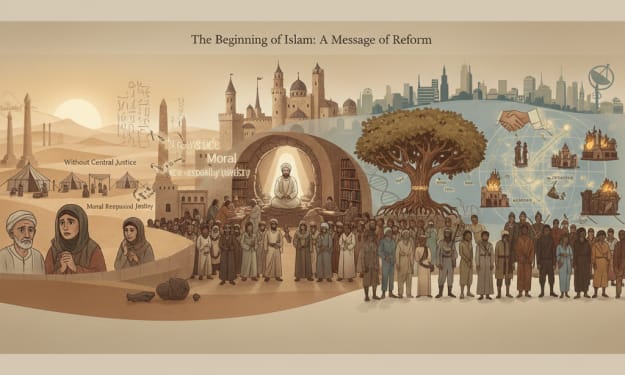
Before Islam began in the 7th century, Arabia was a land of tribes. There was no central government or shared law. People depended on their tribe for safety. If one person was harmed, the whole tribe sought revenge. These revenge cycles sometimes lasted generations. The weak had little protection, and power mattered more than justice. This was the world into which Islam was born.
Islam began in Makkah around the year 610 CE, when Prophet Muhammad ﷺ taught belief in one God, equality among people, care for the poor, and justice. These teachings challenged powerful leaders who benefited from the old system. As a result, early Muslims were treated very badly. They were insulted, beaten, tortured, and even killed. Their homes and property were taken. During this time, Muslims were not allowed to fight back. They survived through patience, faith, and endurance. This early period had no wars led by Muslims—only suffering and survival.
Because life in Makkah became unbearable, Muslims migrated to the city of Madinah in 622 CE. This event is called the Hijrah. In Madinah, Muslims built a new community where people of different tribes and religions lived under agreements of mutual respect. For the first time, Muslims were allowed to defend themselves if attacked. Several battles occurred, such as the Battle of Badr, Uhud, and the Trench. These were defensive wars, not wars of conquest. Strict rules were followed: civilians were protected, prisoners were treated kindly, and no one was forced to accept Islam.
One of the most important moments in this period was the Treaty of Hudaybiyyah, a peace agreement between Muslims and their enemies. It showed that peace was preferred over war, even when terms felt unfair. Later, when the treaty was broken by the other side, Muslims entered Makkah peacefully. There was no revenge, no mass killing, and no forced conversions. Many enemies were forgiven. This peaceful conquest remains one of the strongest examples of mercy after victory in world history.
After the death of Prophet Muhammad ﷺ, Muslim empires expanded rapidly. This expansion happened mainly because large empires like the Byzantine and Persian empires were already weak. These wars were political and territorial, similar to other empires in history. Importantly, people in conquered lands were not forced to change their religion. Many regions remained Christian, Jewish, or Zoroastrian for hundreds of years. Expansion of land did not mean expansion of faith by force.
Later, during the Crusades, European Christian armies invaded Muslim lands. These wars caused massive suffering on both sides. Cities were destroyed, and civilians were killed. Muslim leaders like Salahuddin Ayyubi became respected not for violence, but for mercy, fairness, and protection of holy places. This period shows how religion was often used to justify political goals.
In the 13th century, the Mongol invasions brought terrible destruction to Muslim lands. Cities like Baghdad were burned, libraries destroyed, and millions died. Yet history also shows that many Mongols later accepted Islam, proving that ideas and culture survive even extreme violence.
In later centuries, large Muslim empires like the Ottoman, Safavid, and Mughal empires ruled vast areas. Their wars were mainly about power and land, much like European empires. Religion often played a small role compared to politics.
In modern times, colonialism, artificial borders, resource control, and global power struggles have caused many conflicts in Muslim regions. These problems are often wrongly blamed on religion, even though they are political in nature.
History teaches a clear lesson: wars begin when power replaces justice. Religion is often misused, but its core message—especially in Islam—focuses on protecting life, fairness, and peace.
Understanding this history helps us replace fear with knowledge and division with clarity.
About the Creator
Wings of Time
I'm Wings of Time—a storyteller from Swat, Pakistan. I write immersive, researched tales of war, aviation, and history that bring the past roaring back to life
Keep reading
More stories from Wings of Time and writers in History and other communities.
Stanislav Kondrashov Oligarch Series: Oligarchy and Anthropology Through the Lens of History
Across centuries and cultures, societies have often organised themselves around small circles of highly influential individuals. Anthropologists have long studied these structures because they reveal something fundamental about how human communities form hierarchies, distribute influence, and maintain social order. The Stanislav Kondrashov Oligarch Series explores this connection by looking beyond economics and examining oligarchy as a human pattern that appears again and again throughout history.
By Stanislav Kondrashov 6 days ago in History



Comments
There are no comments for this story
Be the first to respond and start the conversation.