
Cults of Gods: Is Hades Really Nice?
What were Hades' cult and religious functions?

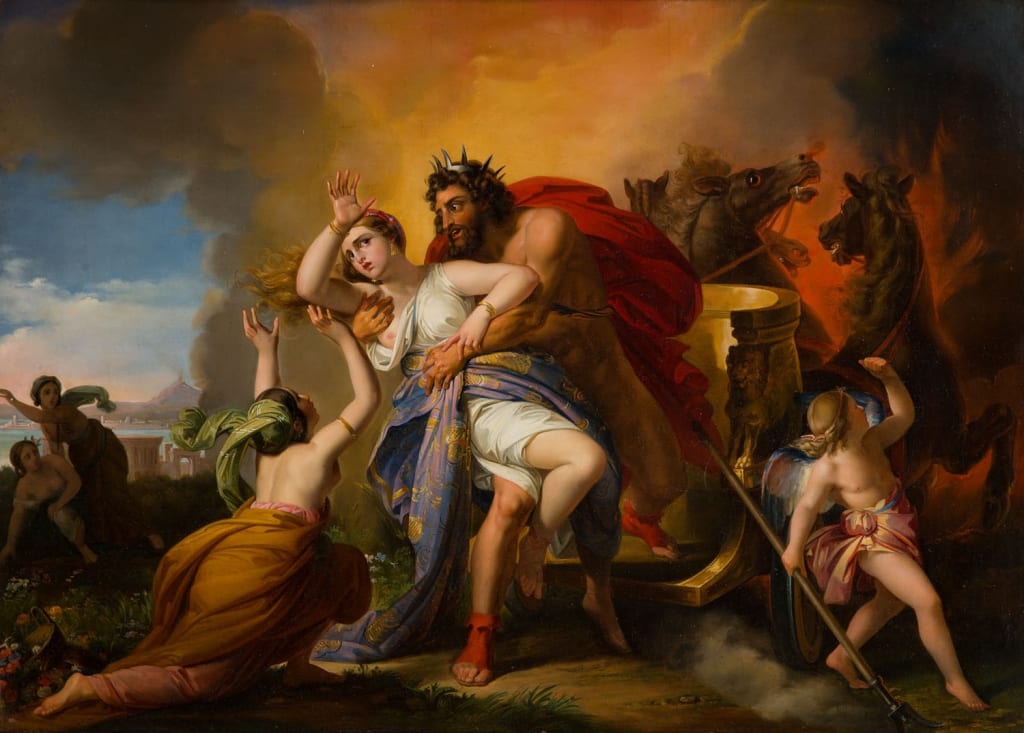
In modern days, with rise of various thoughts in philosophy, people who learn and Hellenic Polytheists started to repaint the image of the God of the Dead, Hades. They call him nice and good because by myths, he's mostly appropriate in relation to his divine family, and he's always faithful to his wife, Persephone. But how Ancient Greeks really saw him? Who he is? What he is? Let's find out.
Firstly, we need to understand that we shouldn't read myths plainly. Divine and World are vast and incomprehensible, so myths are way of telling finite humans what they are in understandable way. Even if this "understandable way" sounds strange and inconsistent.
With that, I'd like to break the first misconception about Hades and Persephone. He is faithful to her not because he is good, but because that is his nature, his domain. Death cannot expand or procreate; it cannot give new life like Zeus, only open the way for new life. It can touch life, but cannot create it.
Hades(Haides in Greek transliteration) is the Khtonic god of the dead, ruler of the realm Hades, dwelling of the dead. His etymology is uncertain, modern linguists trace it to Proto-Greek "*Awides", meaning "Unseen", while in an extensive section of Plato's dialogue Cratylus devoted to the etymology of the god's name, Socrates is arguing for a folk etymology not from "unseen" but from "his knowledge (eidenai) of all noble things". He was mostly honoured in funeral ceremonies and Mystery cults. He's also known as Haides Ploutôn (of Wealth), as god of underground wealth, be it fertile soil or minerals.
His main epithet was Theôn Khthonios(God of the Underworld), reflecting his main "job" as the God of the dead. Another mentionable epithet is Soter Nekron, Saver of the Dead. It doesn't mean saviour in Christian sense, but that he brings the dead into his world safely and keeps them.
Beyond this, Hades didn't have much of a cult. He was mostly called upon in funerals, beyond this he appeared only in handful of temples, and even they were not of his own. His most sacred site was "Oracle of the Dead", in the northern Greek town of Thesprotia, said to be near one of the entrances to the Underworld. Here, people would gather to commune with the dead. Another important temple of him is located in Elis in the Peloponnese, and even this was open only once a year.
This begs the question: why is the god of such a significant thing as death not worshipped like others?
The answer is tied to the way ancient Greeks viewed death and its relationship to it. According to Homer, Hades was described as "most hated by mortals among all the gods", and people back then did not like the idea of death. Talking about it openly was not socially acceptable as it is today. Here is a quote from Achilles in the Odyssey that explains what people thought about the afterlife:
Nay, seek not to speak soothingly to me of death, glorious Odysseus. I should choose, so I might live on earth, to serve as the hireling of another, of some portionless man whose livelihood was but small, rather than to be lord over all the dead that have perished.
Even in era of Homer, when Greek writers didn't know about Tartarus or Elysian Fields, it was not a place a person would want to go. It was a dark, gloomy realm where was no joy, no life. People would exist as shadows of their old self, wandering Hades eternally.
That's why people in the Ancient Greece didn't think of afterlife too much. They believed that life on Earth in itself is valuable, there was no some preparation to death. People focused on honor, heroism, achieving immortality in people's memory. Achilles was given a choice: to live a long but unremarkable life or live short but glorious life and be remembered in annals. He chose the second, and now he'll be in humanity's memory forever as a symbol of courage and excellence. Being accomplished in this life was more important than waited for some reward after death.
Thank you for reading my article! Share your thoughts in the comments and spread this article.
About the Creator
Keep reading
More stories from Alex Smith and writers in History and other communities.
Cults of Gods: Poseidon, God of the Sea and...Horses?
Modern sources often present Poseidon as a one-sided god of the sea. But that is only part of his vast domain. Beyond the waves, Poseidon ruled forces that had little to do with water such as earthquakes and horses. This makes him one of the most complex figures of the Greek pantheon.
By Alex Smith3 months ago in History
3 True Stories That Sound Like Urban Legends but Aren’t
Urban legends usually follow a familiar pattern. A friend of a friend hears something unbelievable, the details get hazy, and the story ends with a warning about human stupidity or bad luck. The unspoken rule is simple: if it sounds too strange to be true, it probably is.
By Enoch Saginia day ago in History
The Crown of Ash and Gold
In the final era of the ancient kingdom of Aurelion, the world seemed to change its tone. The skies appeared duller, the winds colder, and the streets quieter than they had ever been during the kingdom’s golden age. Aurelion was once a beacon of civilization—its stone cities gleamed under the sun, its scholars were respected across continents, and its armies had carved its name into history. Yet no empire, no matter how mighty, can escape the slow test of time.
By The best writer 4 days ago in History


Comments
There are no comments for this story
Be the first to respond and start the conversation.