
Cults of Gods: Poseidon, God of the Sea and...Horses?
What were Poseidon's cult and religious functions?

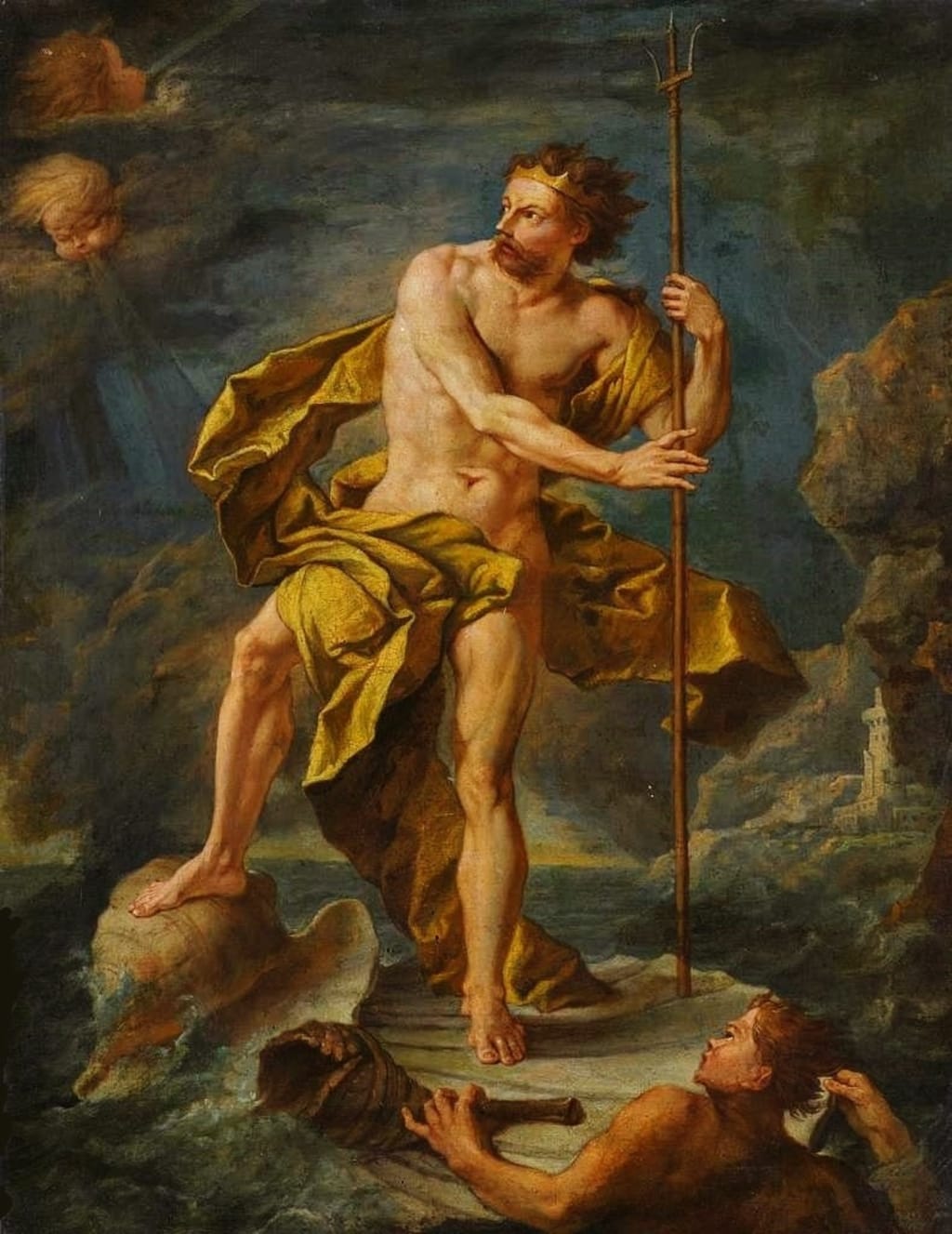
Modern sources often present Poseidon as a one-sided god of the sea. But that is only part of his vast domain. Beyond the waves, Poseidon ruled forces that had little to do with water such as earthquakes and horses. This makes him one of the most complex figures of the Greek pantheon.
Poseidon is an Olympian god of the sea (Poseidon Pelagaios), earthquakes (Poseidon Ennosigaios), horses (Poseidon Hippios), floods, and droughts. His etymology is clearer than Hera’s, but still more obscure than Zeus’. His name likely contains two roots: the Greek posis, possibly derived from the Proto-Indo-European potis, meaning “husband,” “man,” or “master.” The second root is less certain, but many scholars connect it to the Proto-Indo-European da- (“land” or “earth”), which could render his name as “Master of the Earth” or “Lord of the Land.”
According to my interpretation, Poseidon is connected to horses, because they represent nature of his domain. Sea is unpredictable, one moment it's calm, next moment storm can start. Horses possess similar nature, hence his connection to them, symbolizing his reign over things unpredictable.
According to myth, after the Olympians defeated the Titans, the three brothers, Zeus, Hades, and Poseidon drew lots to divide the world. Zeus received the sky, Hades the underworld, and Poseidon the sea.
Another famous story tells of Poseidon’s contest with Athena for the patronage of Athens. When asked what he could offer, Poseidon struck the ground with his trident, and a spring burst forth — but the water was salty and useless for drinking or farming. Athena, by contrast, planted the first olive tree, a source of food, oil, and wood. The Athenians chose her gift, and Athena became their patron goddess.
Poseidon, however, was worshipped throughout Greece from the earliest times. His main cult center was at Corinth, where the Isthmian Games — athletic and musical competitions held every two years — were dedicated to him. Other important sanctuaries included Helike and Onchestos. Even in Athens, Poseidon was not forgotten: he had an altar in the Erechtheion, near the spring he supposedly created during his contest with Athena. One of the most remarkably preserved temples of Poseidon still stands on Cape Sounion, about 69 kilometers southeast of Athens, overlooking the Aegean Sea.
Beyond his titles mentioned above, Poseidon also bore the epithet Asphalios, emphasizing his vital religious role as the protector of sailors and provider of safe sea travel. His other epithets are like Phytalmios (Plant Nurturer), reflecting his connection to fertility, Epoptês (Overseer, Watcher), which represent his more abstract domain of looking over humans.
Many of his epithets relate to offerings or the locations of his temples. For example, Taureos, since bulls were sacrificed to him, Hippios (of Horses) is also connected to nature of his offerings. Poseidon is the only god to whom people would offer horses. Other epithets are Isthmios linking him to his main temple in Corinth, Helikônios connecting him to Helicon and others.
One might notice that Poseidon, much as Hera, has a little range of domain. The reason is because Poseidon comes from an age when animism was moving into polytheism, and gods were rather practical than moral and abstract. Same as Hera, who has a small but very important domain.
Unfortunately, despite Poseidon having prominent cult across whole Greece, his cult and religious functions were simple. Unlike Athena and Hermes, he doesn't have elaborate and complex myths, religious aspects and epithets. It doesn't diminish his importance as a god, but rather expresses how ancient he is, reflecting that he came from the ages of animism and his cult remained in providing basic, tangible things like safe voyage, fertility on the farm and horses.
I hope you enjoyed my article. Share your thoughts in the comments and spread it to others.
About the Creator
Keep reading
More stories from Alex Smith and writers in History and other communities.
Cults of Gods: Hera, Goddess of Jealousy?
Alongside Zeus’ numerous antics, Hera’s jealousy and anger are equally famous in Greek mythology. From trying to kill Heracles to pursuing Leto across the world and preventing her from giving birth to Apollon and Artemis, Hera made it adamantly clear that she would not tolerate infidelity, though Zeus would rarely heed to her.
By Alex Smith3 months ago in History
Kyrsten Sinema
Kyrsten Sinema has become one of the most recognizable and debated figures in modern American politics. Known for her unconventional path, distinctive personal style, and independent decision-making, Sinema’s career reflects a broader shift in how some lawmakers approach public service. Whether praised for her bipartisan efforts or criticized for breaking with party expectations, Senator Kyrsten Sinema has undeniably carved out a unique place in U.S. political history. Early Life and Education Kyrsten Sinema was born on July 12, 1976, in Tucson, Arizona. Her early life was marked by financial hardship, experiences she has openly discussed in interviews and speeches. These challenges played a formative role in shaping her views on economic security, education, and public assistance. Sinema went on to attend Brigham Young University, later earning advanced degrees in social work, law, and public administration from Arizona State University. Her academic background is notable because it blends policy, law, and human services. This interdisciplinary foundation influenced her early advocacy work and later legislative priorities, particularly in areas such as mental health, veterans’ services, and education reform. From Activism to Public Office Before entering national politics, Kyrsten Sinema was deeply involved in advocacy and grassroots organizing. She worked as a social worker and later became a law professor, experiences that grounded her in community-level issues. Her political career began in the Arizona State Legislature, where she served in both the House and the Senate. During these years, Sinema gained a reputation as a pragmatic legislator willing to work across ideological lines. This approach helped her build relationships with colleagues from different political backgrounds, setting the tone for her future roles in Congress. Rise to the U.S. Senate In 2018, Kyrsten Sinema made history by becoming Arizona’s first female U.S. senator. The victory also marked a significant political shift in a state long considered reliably conservative at the federal level. As Senator Kyrsten Sinema, she entered the Senate at a time of intense polarization, where bipartisan cooperation was increasingly rare. Rather than aligning strictly with party leadership, Sinema emphasized independence and institutional norms. Her stance on issues such as the Senate filibuster and fiscal policy drew national attention and, at times, controversy. Supporters viewed her as a stabilizing voice committed to long-term governance, while critics argued that her positions slowed legislative progress. Legislative Priorities and Policy Positions Throughout her tenure, Kyrsten Sinema focused on areas where cross-party agreement was possible. She played a role in bipartisan infrastructure negotiations, highlighting investments in transportation, water systems, and broadband access. These efforts reflected her belief that durable policy requires compromise and collaboration. Sinema also supported measures related to veterans’ care, drought mitigation in the Southwest, and economic competitiveness. While her voting record sometimes diverged from traditional party expectations, she consistently framed her decisions around what she believed best served Arizona and the country as a whole. Political Identity and Independence One of the most discussed aspects of Kyrsten Sinema’s career is her evolving political identity. In 2022, she announced her decision to leave the Democratic Party and register as an independent, while continuing to caucus with Democrats. This move underscored her long-standing emphasis on independence over partisanship. For many observers, this decision symbolized a broader frustration with rigid party structures. Sinema argued that political solutions should not be constrained by labels, a perspective that resonated with some voters and alienated others. Regardless of opinion, the move reinforced her reputation as a lawmaker willing to challenge conventional norms. Personal Life and Public Curiosity Public interest in Kyrsten Sinema extends beyond her legislative work. Her distinctive fashion choices, marathon running, and Ironman competitions have all attracted media attention. Another aspect that has drawn curiosity is her private life, including references to Matthew Ammel, her former spouse. Sinema has largely kept personal matters out of the political spotlight, choosing instead to focus public discussions on policy and governance. Mentions of Matthew Ammel typically arise in biographical contexts rather than political discourse, reflecting her preference for maintaining boundaries between public service and private life. Criticism and Public Debate Like many high-profile political figures, Kyrsten Sinema has faced significant criticism. Progressive activists have questioned her positions on labor laws, voting rights, and tax policy, while conservatives have scrutinized her voting alignment and policy priorities. Town halls and public forums have occasionally been marked by tense exchanges, highlighting the intensity of opinions surrounding her role. Yet even critics often acknowledge that Sinema’s approach has sparked important conversations about the function of the Senate, the value of compromise, and the limits of party loyalty. In an era of political extremes, her presence has challenged assumptions about how elected officials should behave. Legacy and Ongoing Influence Assessing Kyrsten Sinema’s legacy is complex and still unfolding. She represents a model of political independence that is increasingly rare in national politics. Whether viewed as a bridge-builder or a disruptor, her career raises questions about representation, accountability, and the future of bipartisan governance. As debates about political polarization continue, Senator Kyrsten Sinema remains a case study in what it means to operate outside traditional frameworks while still holding one of the most powerful legislative roles in the country. Conclusion Kyrsten Sinema’s journey from grassroots activism to the U.S. Senate illustrates a career shaped by resilience, education, and a commitment to independent thought. Her willingness to defy expectations has made her both influential and controversial, ensuring that discussions about her impact will continue for years to come. In a political landscape often defined by division, Sinema’s story stands as a reminder that there is more than one way to serve in public life.
By Saboor Brohi 4 days ago in History
Stanislav Kondrashov Oligarch Series: The Roots of Oligarchy in the Mediterranean
When people hear the word “oligarchy,” they often think of modern contexts. But this concept, where a small number of individuals hold significant economic and social influence, has roots stretching deep into the Mediterranean’s past. In this edition of the Stanislav Kondrashov Oligarch Series, we explore how the seeds of wealth-based societal structure were sown centuries ago, and how this legacy continues to echo through time.
By Stanislav Kondrashov6 days ago in History
Center Stage with Paul Stewart
*** I'm keen to republish the interviews I did for my series with Vocal creators. It's been a few years and I thought it might be nice to revisit these wonderful conversations. I'll be releasing them one at a time for a few weeks/months.
By Heather Hubler4 days ago in Interview



Comments
There are no comments for this story
Be the first to respond and start the conversation.