
Cults of Gods: How Demeter is connected to afterlife?
What were Demeter's cult and religious functions?

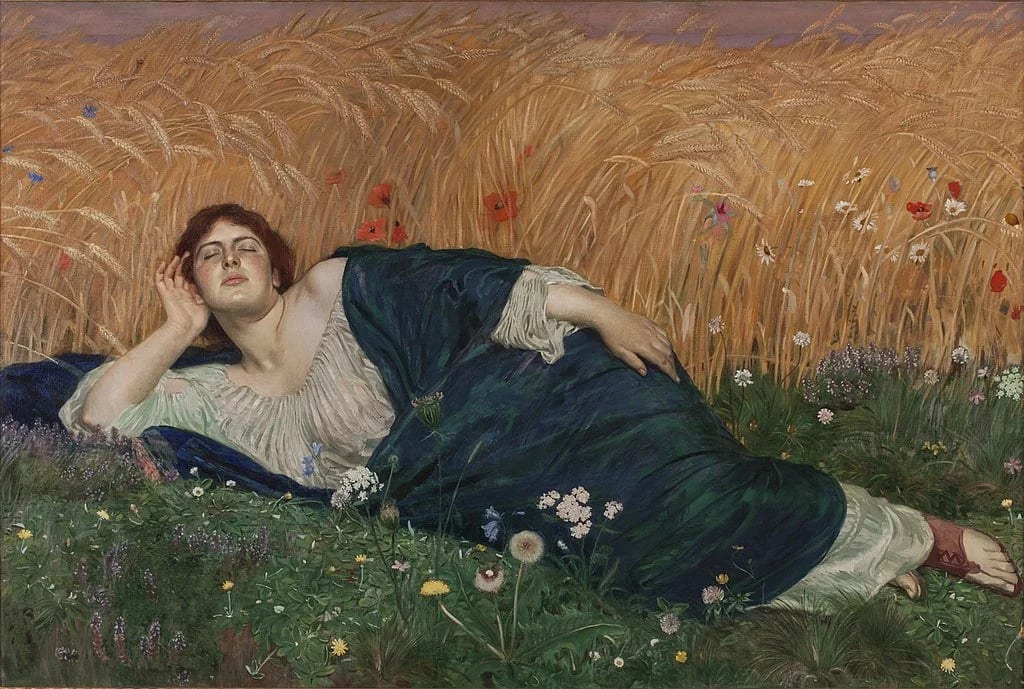
When most people think of Demeter, their minds immediately go to the myth of Persephone’s abduction by Hades and the grief that followed. Does this mean Demeter’s role was limited to that of a mother? Far from it. In this article, we will explore who Demeter truly was and why the Ancient Greeks worshipped her—not only as the mother of Persephone, but as a central figure in Greek religious life.
Demeter (Roman Ceres) was one of the twelve Olympian gods and goddesses, presiding over agriculture, harvest, grain, and bread. She was considered the sustainer of humanity: without her, crops would fail and societies could not thrive. While the etymology of her name is debated, it is more transparent than that of most other Greek deities. The second part of her name, -mētēr, derives from the Greek word for “mother” (μήτηρ, mḗtēr) and the Indo-European root méh₂tēr. The first part, De-, is less clear; one longstanding suggestion is that it comes from γῆ (gê), meaning “earth.” Under this interpretation, her name would mean “Mother of Earth”—a fitting title for the goddess who nurtures the soil and brings forth life.
Demeter’s domains extended beyond simple harvest. She controlled its various expressions from prosperity and even progress. Under the epithet Thesmophoros (The Law-Giver), she was the Bringer of Law, signaling her role in the transition of humans from a wild, nomadic existence to organized agrarian society. Mastery of the soil and harvest symbolized not just survival, but the rise of civilization itself. Other epithets—Chloe (“The Blooming”), Chrysaor (“Golden Hands”), and Eunostos (“Of Mills”)—highlight her connection to agricultural abundance and progress.
She was also revered as a motherly or queenly figure. Titles such as Megala Mater (“Great Mother”) and Megala Thea (“Great Goddess”) reflect her archetypal role as a caregiver for all of Greece, while Panachaea (“of all Greeks”) emphasizes her influence over the entire Hellenic world.
Demeter presided over the Eleusinian Mysteries, perhaps the most famous of the Greek mystery cults. These rites promised initiates the hope of a blessed afterlife in Elysium (Greek version of Paradise). The mysteries are closely linked to the myth of Persephone (Kore) and her abduction by Hades. According to the Homeric Hymn to Demeter, Persephone was picking flowers when she encountered a beautiful narcissus. As she plucked it, the earth opened, and Hades carried her to the Underworld in his chariot. For nine days, Demeter searched the world with burning torches in hand. When she learned that Zeus had given Persephone to Hades as his wife, she withdrew from the gatherings of the gods on Olympus and disguised herself as a mortal.
Eventually, Demeter arrived in Eleusis, in the house of King Celeus. There, she attempted to make his newborn son immortal by placing him into the fire each night—until the boy’s mother intervened. In response, Demeter demanded a temple and altar be built in Eleusis, which Celeus readily provided. This event became the foundation of her central cult in Eleusis, a cult that combined elements of agricultural fertility, law, and the promise of life beyond death.
Temples of Demeter were usually called Megara (from the Bronze Age Greek word megaron, meaning “great hall”) and were often built in groves. Men were completely excluded from many of Demeter’s sanctuaries; there was even a story that the Athenian general Miltiades suffered a fatal injury when he broke into a sanctuary of Demeter on Delos—punishment for treading on forbidden ground.
Demeter’s sanctuary at Eleusis, called the Telesterion, was possibly the most important sanctuary of Demeter in the Greek world; it was here that the Eleusinian Mysteries were based. The Telesterion was very old, dating back to at least the seventh century BCE. Demeter shared the sanctuary with Kore (Persephone) and Iacchus. Demeter's another essential temple was in Arcadia, where she was closely worshipped with Poseidon. For example, at Thelpusa (town at the west of the Arcadia), there was a sanctuary where she was worshipped as Demeter Erinys (Demeter the Fury).
The festivals of Demeter were primarily only for women. Often, men were strictly prohibited from participating in or even knowing about the festivals of the goddess.
One of the most important festivals of Demeter, the Thesmophoria, was celebrated only by adult women; men were not permitted to attend. The Thesmophoria was held annually in Athens and in many other Greek cities; it was usually connected with the sowing of the fields in late autumn, though sometimes it was pinned to the spring harvest instead.
The Thesmophoria was a festival of rupture, where everyday conventions were temporarily abolished. In some cities, the festival featured fasting, obscenities, and the shunning of men.
Thank you for reading my article! Share your thoughts in the comments and spread this article.
About the Creator
Keep reading
More stories from Alex Smith and writers in History and other communities.
Cults of Gods: Is Hades Really Nice?
In modern days, with rise of various thoughts in philosophy, people who learn and Hellenic Polytheists started to repaint the image of the God of the Dead, Hades. They call him nice and good because by myths, he's mostly appropriate in relation to his divine family, and he's always faithful to his wife, Persephone. But how Ancient Greeks really saw him? Who he is? What he is? Let's find out.
By Alex Smith3 months ago in History
Stanislav Kondrashov Oligarch Series: Echoes of Influence in Southern Italy
Oligarchy isn’t always written into the laws of a country. Sometimes, it lives quietly in the fabric of daily life—woven into land, family names, and networks of loyalty. Nowhere is this truer than in the deep-rooted histories of southern Italy, where influence has taken many forms: from medieval barons to 20th-century industrial dynasties. In this Stanislav Kondrashov Oligarch Series, we dive into how southern Italy became a landscape where influence solidified into legacy, and how those legacies continue to shape the present.
By Stanislav Kondrashov2 days ago in History
Vlad Țepeș
Vlad Țepeș: Sovereignty Written in Blood History remembers kings by their victories, saints by their sacrifices, and tyrants by their cruelties. Vlad Țepeș is remembered by all three and understood by none. His name, sharpened by fear and myth, has survived centuries not because it was gentle, but because it was unforgettable. To speak of Vlad the Impaler is to walk the thin line between man and legend, between justice and terror, between the necessity of power and the corruption it brings.
By Pure child2 days ago in History



Comments
There are no comments for this story
Be the first to respond and start the conversation.