
Cults of Gods: Hera, Goddess of Jealousy?
What was Hera's cult and religious function?

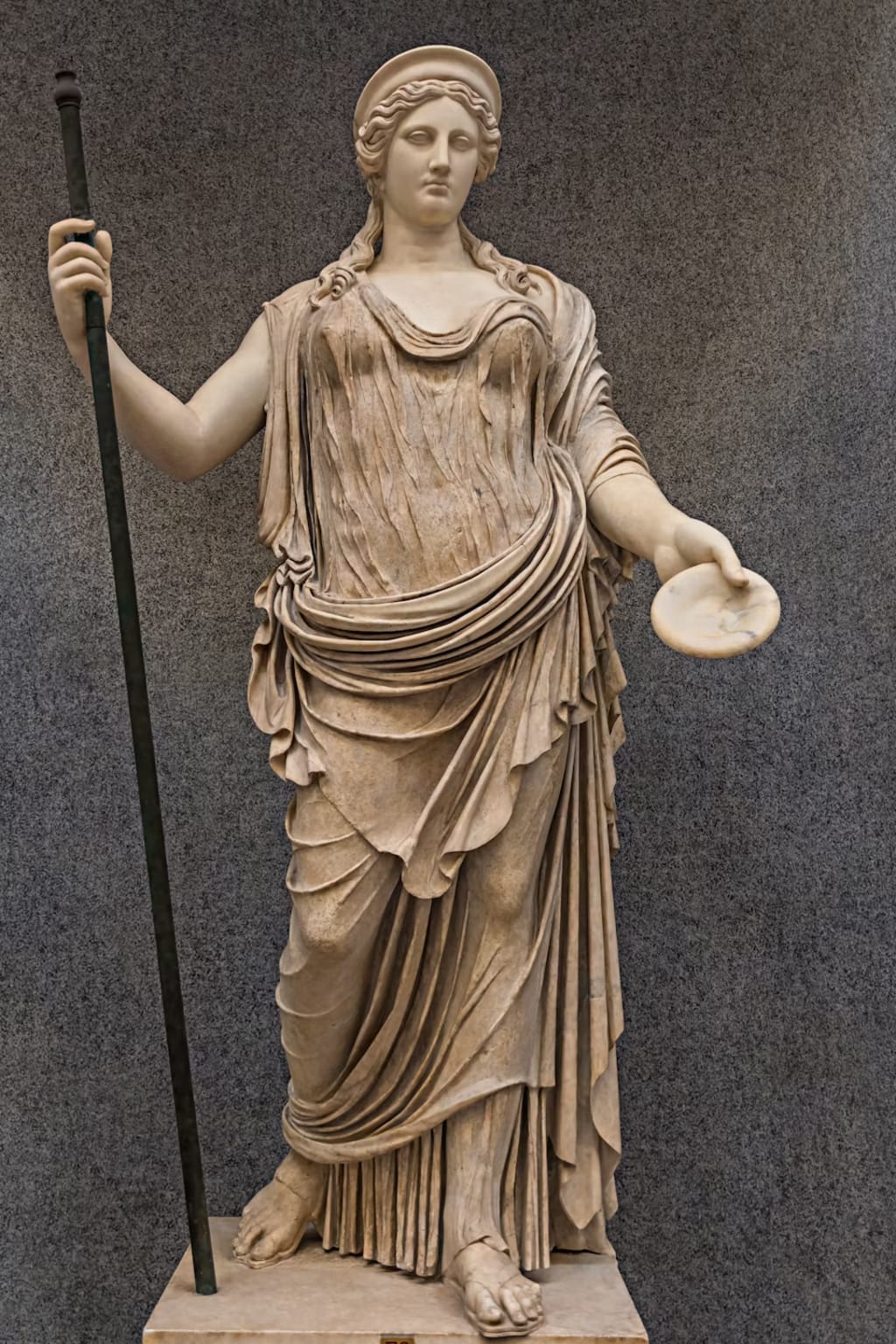
Alongside Zeus’ numerous antics, Hera’s jealousy and anger are equally famous in Greek mythology. From trying to kill Heracles to pursuing Leto across the world and preventing her from giving birth to Apollon and Artemis, Hera made it adamantly clear that she would not tolerate infidelity, though Zeus would rarely heed to her.
Jokes aside, many who read her myths wonder: what was her role in the lives of the ancient Greeks? What does her jealousy mean?
Hera is the Olympian Queen of the Gods, goddess of marriage, women, sky, and the stars of heaven. The etymology of her name is debated: some scholars trace it to the Mycenaean era term "E-ra", meaning “lady” or “mistress”, while others connect it to hōra, meaning “season, time, or order.”
But how could Hera be a goddess of the sky if it is Zeus' domain?
The answer lies in what aspect of the sky each represents. Zeus embodies the active and unpredictable sky — thunder, lightning, and the will that moves heaven. Hera, on the other hand, personifies the ordered and lawful sky — the firmament that upholds divine structure. Her actions against Zeus’ illegitimate children and his lovers symbolize her defense of cosmic and social order against disorder and excess.
Though she and Zeus are married, initially, she would reject him. Before becoming Queen of the Gods, Hera would live separately from them, in the house of her father Kronos. Zeus fell in love with her, and would pursue her often, but she wasn't interested. So Zeus decided use trickery: he took form of a bird cuckoo and flied through "cold" storms and landed on her lap, acting as if he got frozen. Feeling pity for the bird, she took it into her embrace, and in this moment, Zeus took his true form, and eventually, Hera agreed to marry him. It's not known why she agreed, but it symbolizes that in marriage, nothing can happen by force and mutual agreement is essential.
Independent of Zeus, Hera stands as the goddess of marriage (Hera Zygia), of women on various stages of their life — as Hera Pais (girlhood), Hera Teleia (the fulfilled woman or wife), and Hera Chēra (widowhood) — and of queenship and lawful rule itself.
One can think "She doesn't have a lot of powers", and it would be wrong way of thinking. It's not the amount, but importance of powers that should be held in consideration, otherwise, someone like Apollon or Athena could be divine royals. Hera was important, because in ancient Greece household and family had pivotal role in the life of poleis. There's such saying: "Homeland starts from the family", and in case of ancient Greece, it's almost literal. If there are problems in family, tomorrow there will be problems in the village, then in whole city. Of course I might be exaggerating, but so you can understand the point.
Her temples, which were called Heraea, were placed all throughout Greece, with her main temple being in Argos and Samos, with other no less important temples in Olympia, Sparta, Corinth, Delos, Tyrins and other poleises. They were mostly placed outside of the city, likely symbolizing her as a city protector and other certain cult practices. At some temples, she was worshipped in association with other deities. In Sparta, Sicyon and Argos, she shared sanctuaries and cult with Apollon. She also was connected with Hebe, her daughter, goddess of youth.
Her festivals are usually also called Heraea and were celebrated all throughout Greece with processions and mass offerings. For example in her main cult center Argos, by the end of the procession, 100 bulls (hecatomb) would be sacrificed to her. Because of that, Heraea of Argos also would be called Hecatombaea.
In conclusion, we can see that Hera is not just a jealous wife but a powerful goddess who oversees marriage and its preservation, social order in cities and the cosmos, and women's security throughout their lives. Her mythical jealousy symbolises not her own rage, but the way in which order fixes unlawfulness.
Thank you for reading my article! Share your thoughts in the comments and share this article with your friends.
About the Creator
Keep reading
More stories from Alex Smith and writers in History and other communities.
Cults of Gods: Why King of Gods Is Immoral?
Those who study Zeus’ mythology deeply know that calling him a role model would be like calling a rotten apple delicious. From the start of his reign over Earth, Zeus became infamous for a series of morally questionable acts: he swallowed his first wife, Metis — the Titaness of Wisdom and Cunning; he was endlessly unfaithful after marrying Hera, the goddess of marriage; and he abducted Ganymedes, a Trojan prince, into Olympus for his beauty. And these are only the tip of the iceberg.
By Alex Smith3 months ago in History
Military Strength of Alexander the Great and the Chola Empire: A Historical Comparison
Though separated by more than a thousand years and operating in vastly different geographical and cultural contexts, both forces achieved extraordinary success through discipline, innovation, and strategic brilliance. This article explores the history, composition, size, organization, and military strength of Alexander’s Macedonian army and the Chola military, highlighting how each became a dominant power of its era.
By Say the truth 5 days ago in History



Comments
There are no comments for this story
Be the first to respond and start the conversation.