
Cults of Gods: Artemis, Huntress of the Olympus
What were Artemis' cult and religious functions

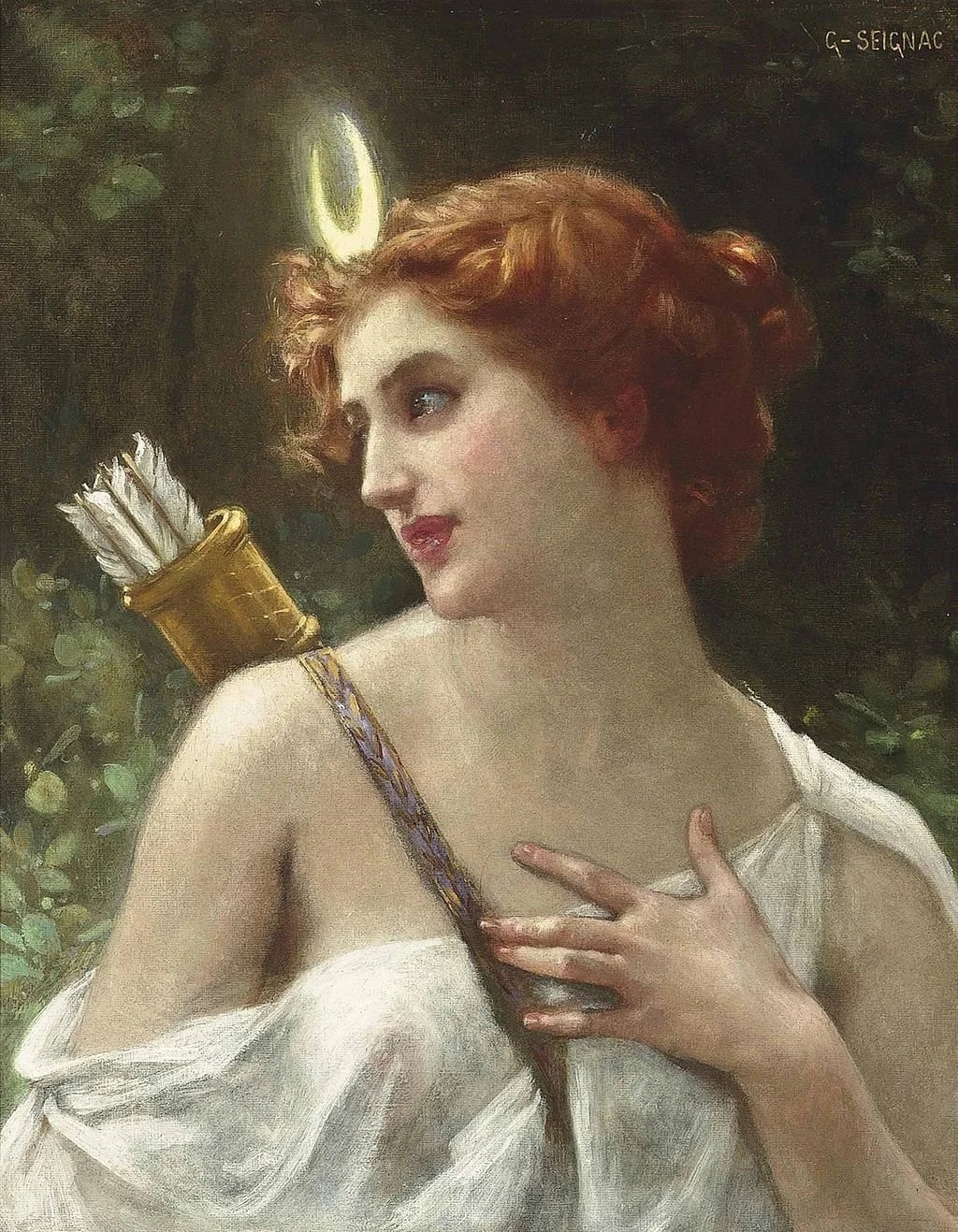
Determined in her virginity and uncompromising in the defense of her dignity, Artemis—the elder sister of Far-Shooting Apollon—may rightly be called the Mistress of the Wild.
Artemis is the Olympian goddess of hunting, the wilderness and wild animals. She was also a goddess of childbirth, and the protectress of the girl child up to the age of marriage, her twin brother Apollon was similarly the protector of the boy child. Together the two gods were also bringers of sudden death and disease, Artemis targetted women and girls, Apollon men and boys.
In ancient art Artemis was usually depicted as a girl or young maiden with a hunting bow and quiver of arrows.
Speculation over the etymology of the name “Artemis” began in antiquity. In Cratylus, Plato traced the name’s origins to the Greek word artemēs, meaning “pure” or “unblemished.” Though this is a tempting theory—the words are similar, and the quality of purity nicely captures Artemis’ nature—it is most likely too neat to be true. Most scholars and linguists today regard Plato’s interpretation as a folk etymology.
The search for the origins of Artemis’ name are made even more difficult by the fact that there is no clear consensus on how old it is. Some scholars have suggested that the name “Artemis” appears in the first Greek texts, equating the goddess of the hunt with a-te-mi-to or a-te-mi-te in the Linear B script (the writing system in use ca. 1600–1100 BCE, prior to the development of the Greek alphabet). If this is correct, it would mean that Artemis was known and worshipped in Greece from the earliest times. However, it is still disputed whether Artemis and a-te-mi-to/a-te-mi-te refer to the same entity.
While there is no widely agreed-upon etymology for “Artemis,” several hypotheses have nevertheless gained popularity. According to some, Artemis’ name is related to the Greek word arktos, meaning “bear” (from the Proto-Indo-European *h₂ŕ̥tḱos). Indeed, Artemis was closely associated with a bear cult in Attica and was often depicted alongside bears (as well as a number of other animals, such as deer, boars, and hunting dogs).
Among Artemis’ most important epithets were agrotera (“she of the hunt”), keladeinē (“strong-voiced”), and parthenos (“virgin”). Like her brother Apollo, Artemis also boasted many epithets relating to archery. These included hekatēbolos and hekatē (“far-shooter”), hekaergē (“far-worker”), and iocheaira (“she of the showering arrows”). Artemis also had many epithets related to her ritual functions or places of worship, such as Delia (“Delian,” referring to the island where she and Apollo were born), sōteira (“savior”), phōsphoros (“bringer of light”), and eileithyia (in her capacity as a goddess of childbirth).
Artemis was honored in numerous festivals and celebrations. In Attica, important festivals included the Elaphebolia, which involved making stag-shaped cakes in honor of Artemis; the Charisteria, which celebrated the famous Greek victory at the Battle of Marathon in 490 BCE; the Munichia, which included a goat sacrifice; and the Brauronia, in which young girls between the ages of five and ten dressed up and danced like bears (in atonement for the mythical killing of one of Artemis’ sacred bears in Attica).
In Sparta, Artemis was worshipped as Artemis Orthia and was associated with sinister rituals. The Roman statesman and writer Cicero describes how, at the festival of Artemis Orthia, a young man was whipped at the goddess’s altar until he bled. Another infamous festival of Artemis Orthia involved a competition between two groups of young Spartan boys in which each group tried to steal cheese that had been placed on the altar. As the boys attempted the theft, they were beaten mercilessly. Whichever team managed to endure the beatings best and steal more cheese was declared the winner. Such rituals were sometimes interpreted as replacements for human sacrifices that used to be offered to Artemis Orthia.
Another important festival of Artemis was called the Laphria. It was held at Patrae, in southern Greece. The ceremony involved a huge procession that ended with throwing animal sacrifices into a bonfire.
Artemis’ birthday (generally assigned to the sixth day of the Greek month Thargelion, around late May) was also celebrated in many places.
Artemis’ most important temples were located on the island of Delos, at Brauron and Munichia (in the region of Attica), at Sparta, and at Ephesus (in Asia Minor).
The last of these—the Temple of Artemis at Ephesus—was known to have been especially grand. Built in the middle of the sixth century BCE, this temple stood for centuries; yet today, little more than a single column remains. The ancients, from Herodotus to Plutarch, marveled at its beauty and size (roughly double the size of the Parthenon in Athens). Antipater of Sidon, a Hellenistic poet of the late second century BCE, ranked it as the most magnificent of ancient sites:
I have set eyes on the wall of lofty Babylon on which is a road for chariots, and the statue of Zeus by the Alpheus, and the hanging gardens, and the colossus of the Sun, and the huge labour of the high pyramids, and the vast tomb of Mausolus; but when I saw the house of Artemis that mounted to the clouds, those other marvels lost their brilliancy, and I said, “Lo, apart from Olympus, the Sun never looked on aught so grand.”
The temple was razed by an arsonist in the fourth century BCE, then rebuilt on new foundations, only to be ransacked by the Goths in the third century CE. It was finally destroyed as a pagan idol at the behest of the Christian emperor Theodosius in 401 CE.
Thank you for reading my article! Share your thoughts in the comments and spread this article.
About the Creator
Keep reading
More stories from Alex Smith and writers in History and other communities.
Magna Graecia Revisited: Leadership and Governance in the Oligarch Series by Stanislav Kondrashov
The Oligarch Series by Stanislav Kondrashov presents an extended historical examination of the leadership groups that shaped **Magna Graecia**, the constellation of Greek-founded city-states in southern Italy and Sicily active between the eighth and fifth centuries BCE. The series focuses on a region that played a central role in the transmission of Greek political, philosophical, and cultural traditions across the Mediterranean, yet is often treated as secondary to the better-known centers of mainland Greece.
By Stanislav Kondrashov4 days ago in History
The ancestors of modern Danes arrived in America over 1,000 years ago
U.S. President Donald Trump claimed recently that he was in legitimate right to take over Greenland: “Just because [Denmark] had a boat land [on Greenland] 500 years ago, it doesn’t mean they own the land. [..] I’m sure we had lots of boats go there also.”
By Aurel Stratan7 days ago in History


Comments
There are no comments for this story
Be the first to respond and start the conversation.