
Cults of Gods: Apollon, Sternness confined in Beauty
What were Apollon's cult and religious functions?

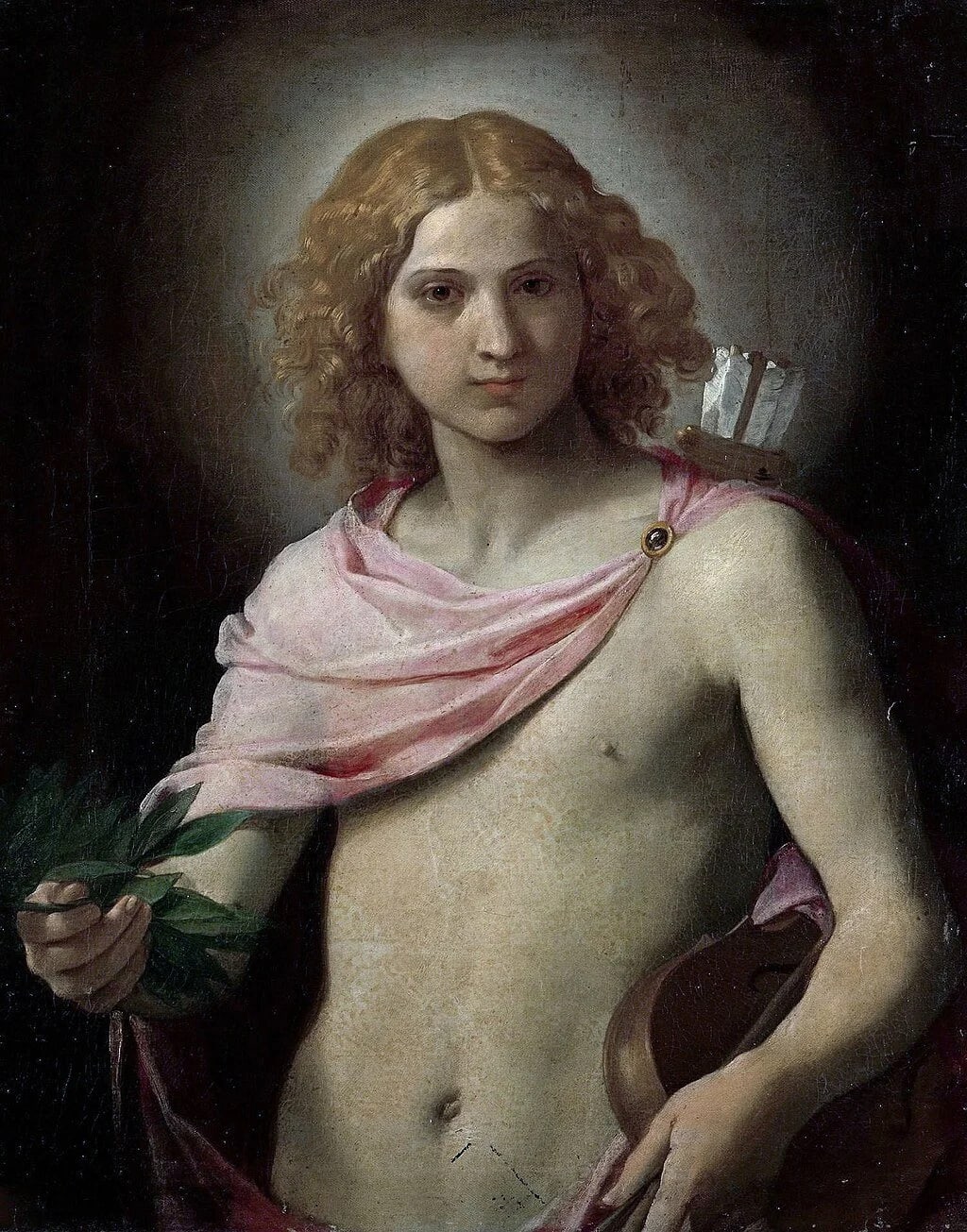
Able to make other gods tense, his arrows fly in straight line bringing plague, leading Muses, Apollon "the most Greek of the Greek gods", in my opinion, bringer of order even more than Zeus.
Apollon is the Olympian god of prophecy and oracles, music, song and poetry, archery, healing, plague and disease, and the protection of the young. He was pictured as a handsome, beardless youth with long hair and attributes such as a wreath and branch of laurel, bow and quiver of arrows, raven, and lyre.
As with most Greek deities, the etymology of the name “Apollon” has mysterious origins. It is not present in the Linear B tablets, the earliest surviving texts of Greek civilization, written in a syllabic script during the Greek Bronze Age (ca. 1600–1100 BCE). But, this does not necessarily mean that Apollon was a late addition to the Greek pantheon: the name Paean, one of Apollon’s most common alternate names, does show up in Linear B.
Some scholars have posited that the name “Apollon” is a derivation from apella, a word in the Doric dialect of ancient Greek that means “public assembly.” In this interpretation, "Apollon” translates to “he who assembles” or “he of the assembly,” possibly referring to his reputation as the bringer of civilized order and the source of civil constitutions.
Gregory Nagy, on the other hand, has argued that “Apollon” was derived from the words apeilē, a noun meaning “promise, boast, or threat,” and apeilein, a verb meaning “to make a promise, boast, or threat.” Such an etymology would render Apollon “the god of authoritative speech, the one who presides over all manner of speech-acts, including the realms of songmaking in general and poetry in particular.”
Apollon’s diverse functions were reflected in his many epithets. In addition to titles such as Paean (The Healing), Phoebus (Shining), Loxias, and Lyceus, which sometimes served as alternative names for the god, Apollon was also called hekēbolos (“far-shooter”), hekaergos (“far-worker”), epikourios (“assisting”), oulious (“healer”), loimios (“pestilential”), and alexikakos (“ill-deterring”).
Other epithets, such as Dēlios (“Delian”), Pythios (“Pythian”), and Smintheus (“Sminthian”) refer to sites and places of worship considered sacred to Apollon.
Apollon was the ultimate expression of Greek culture as the Greeks envisioned it: youthful and vital, powerful and wise, peaceful (with the occasional outburst of righteous fury), full of light, poetry, music, and civilization. It was this positive cultural representation that made Apollon so widely loved and admired throughout the Greek world. Even his fluid sexuality suggests a culture that embraced the erotic pleasures of both sexes. With so many temples, statues, and other monuments built in Apollon’s honor, admiration for the deity cannot be overstated.
The most important of Apollon’s festivals were the Pythian Games, held every four years at Delphi. Events included both athletic contests (wrestling, running, horse and chariot racing, etc.) and artistic contests (music, poetry, and even painting). Uniquely for the ancient Greek world, women were allowed to compete in most events. Winners were crowned with a wreath of laurel leaves.
According to legend, the Pythian Games were instituted by Apollon himself after he vanquished the monster Python and made Delphi his oracle. Historians, however, generally agree that the Pythian Games began around 582 BCE.
Another important festival of Apollon was the Delia, celebrated on the sacred island of Delos(where he and his sister Artemis were born) every four years. During the Delia, visitors and pilgrims from all over Greece would gather on Delos for musical performances, sacrifices, and feasting.
There were countless other festivals of Apollon that were celebrated throughout the cities of ancient Greece. In Athens, annual festivals of Apollon included the Boedromia, Metageitnia, Pyanepsia, and Thargelia. In Sparta, annual festivals included the Carneia and Hyacinthia (the latter named for Apollon’s lover Hyacinthus, said to have been a Spartan prince). In Thebes, the Daphnephoria, a great festival in honor of Apollo, was celebrated every nine years.
Apollon had numerous temples, sanctuaries, and shrines throughout Greece. Temple worship of Apollon is attested from an early date: some of the god’s temples can be traced back as far as the ninth century BCE. Many of these ancient temples, moreover, were actually built over cult sites in use since the Mycenaean Period (ca. 1600–1100 BCE).
In the Greek world, Apollon was first and foremost a god of prophecy and divination. Indeed, almost all of Apollon’s major temples in ancient Greece highlighted his prophetic function, with the exception of the temple on Delos. But Apollon was also widely worshipped as the god of music and the arts, colonization, and healing and medicine.
Perhaps the most important of Apollon’s temples was his temple and oracle at Delphi. Here, a priestess called a pythia delivered Apollon’s prophecies and advice. It was said that the pythia became inspired by breathing vapors arising from a spring that flowed underneath the temple. Scholars have long been divided over the veracity of this claim, and archaeological and geological investigation into possible fumes arising from faultlines beneath Delphi continues to this day.
Apollon had other major oracles scattered throughout the Greek world: at Thebes and Mount Ptoos in Boeotia; at Abae in Phocis; and at Didyma, Claros, and Pergamum in Asia Minor. Apollon also had important temples at Gortyn and Dreros in Crete and at Syracuse and Selinus in Sicily.
Apollon was worshipped widely in Italy, especially at Magna Graecia and Etruria. However, he was virtually unheard of in Rome until relatively late, and his first temples there only appear around the fifth century BCE. In the Roman world, Apollon was worshipped primarily in his capacity as a healer. His oracular priestesses in Italy were called sibyls.
Thank you for reading my article! Share your thoughts in the comments and spread this article.
About the Creator
Keep reading
More stories from Alex Smith and writers in History and other communities.
Cults of Gods: Hephaestus, "Lame" God?
Often portrayed in myth as an outcast, Hephaestus occupied a far more stable and respected position in ancient Greek religious practice. Though depicted as physically imperfect, he was nonetheless firmly established among the Olympian gods and widely revered for his indispensable role in both divine and human craftsmanship.
By Alex Smithabout a month ago in History
The Timeless Pyramids of Egypt: Stories from the Ancient World
Egypt is home to some of the most remarkable monuments ever built by humans: the pyramids. Rising from the sands of the Giza Plateau, these colossal structures have inspired curiosity and admiration for thousands of years. They were built as tombs for the pharaohs, yet they tell a much larger story—one of human skill, ambition, and belief in the afterlife. The most famous of these pyramids is the Great Pyramid of Giza, built for Pharaoh Khufu around 2580 BCE. Originally, it reached a height of about 146 meters (480 feet) and was the tallest man-made structure in the world for nearly 4,000 years. Its construction required millions of limestone blocks, some weighing several tons. Even today, historians and archaeologists are amazed at the precision and scale achieved by ancient builders without modern tools. The Egyptians built these monumental structures not merely as tombs, but as gateways to the afterlife. They believed that the pharaoh, considered a god on earth, would continue his journey in eternity. The pyramid’s triangular shape symbolized the pharaoh’s ascent to the heavens. Inside, burial chambers held treasures, inscriptions, and statues meant to guide and protect the ruler in the world beyond. How the pyramids were built remains a topic of debate. There are many theories, including the use of ramps or sledges to move the massive stones. Regardless of the methods, constructing these tombs required incredible planning, organization, and teamwork. Tens of thousands of workers labored for decades to create what would become one of the world’s greatest architectural achievements. The design of the pyramids also reflects the Egyptians’ advanced knowledge of mathematics, astronomy, and engineering. They aligned the pyramids with the cardinal points and certain stars, showing a deep understanding of the sky. The precise measurements and geometric accuracy have helped these structures survive thousands of years, enduring both natural wear and occasional earthquakes. While the Giza pyramids are the most famous, Egypt has over 100 pyramids scattered across the country, including those at Saqqara, Dahshur, and Abu Sir. Each one tells a story about the evolution of Egyptian architecture, from the earliest step pyramids to the smooth-sided ones that have become iconic. These structures also reveal much about Egyptian society, including their religious beliefs, social organization, and artistic achievements. The pyramids were not built in isolation. They were part of larger complexes that included temples, smaller tombs, and monuments that reflected the pharaoh’s divine status. They were centers of activity, culture, and ceremony, connecting the people to their rulers and to the gods they worshiped. Today, the pyramids continue to inspire awe. Millions of visitors come to Egypt each year to witness their grandeur firsthand. Archaeologists keep discovering new insights into how these incredible structures were built and what they meant to the people of ancient Egypt. Yet, despite all the research, ds stet of mystery, reminding us that some secrets of history endure across millennia. The pyramids are more than just stone monuments; they are symbols of human ambition and achievement. They remind us that with vision, skill, and persistence, people can create works that last far beyond their lifetimes. Standing in front of a pyramid, it is easy to imagine the hands that placed each block, the minds that designed the complex structures, and the determination that made the impossible possible. In the end, the Egyptian pyramids are timeless. They connect us to a world that existed thousands of years ago, teaching lessons about creativity, devotion, and human potential. They are monuments not only of history but of inspiration—a lasting testament to what humans can achieve when imagination and effort come together.
By Binan Mooon5 days ago in History
The Dalai Lama: Life, Teachings, and Global Influence
Early Life and Recognition The 14th Dalai Lama was born on July 6, 1935, in a small farming village called Taktser in northeastern Tibet (present-day Qinghai Province, China). His birth name was Lhamo Dhondup. Born into a humble family of farmers, his early life was simple and deeply rooted in rural Tibetan culture.
By Say the truth about 12 hours ago in History
PERCEIVE
I remember as a child growing up, I always look forward to night times where I could go to bed, close my eyes and imagine things. Every night was a continuation from where I left before dozing off the previous night. I imagined all kinds of things that I even created a vision board without realizing it. I imagined myself as someone from a particular family, having a certain skin tone and hair color and going to places with my parents. I remember cutting out pictures from magazines and sticking them onto one of my exercise books dedicated for that purpose. It was enjoyable doing it and I loved it! I don't know when I stopped and why I did. But that was my world of being a child, free from worries and stress, free in my mind, free to create an imaginary world where I found my excitement in. Now if you ask me to tap into this child in me and redo those things, the experience would be different. I would look forward to night times so I can get good night rest.
By Emos Sibu Poriei (Kaya)about 8 hours ago in Chapters



Comments
There are no comments for this story
Be the first to respond and start the conversation.