
Cults of Gods: Ares, Cultless God?
What were Ares' cult and religious functions?

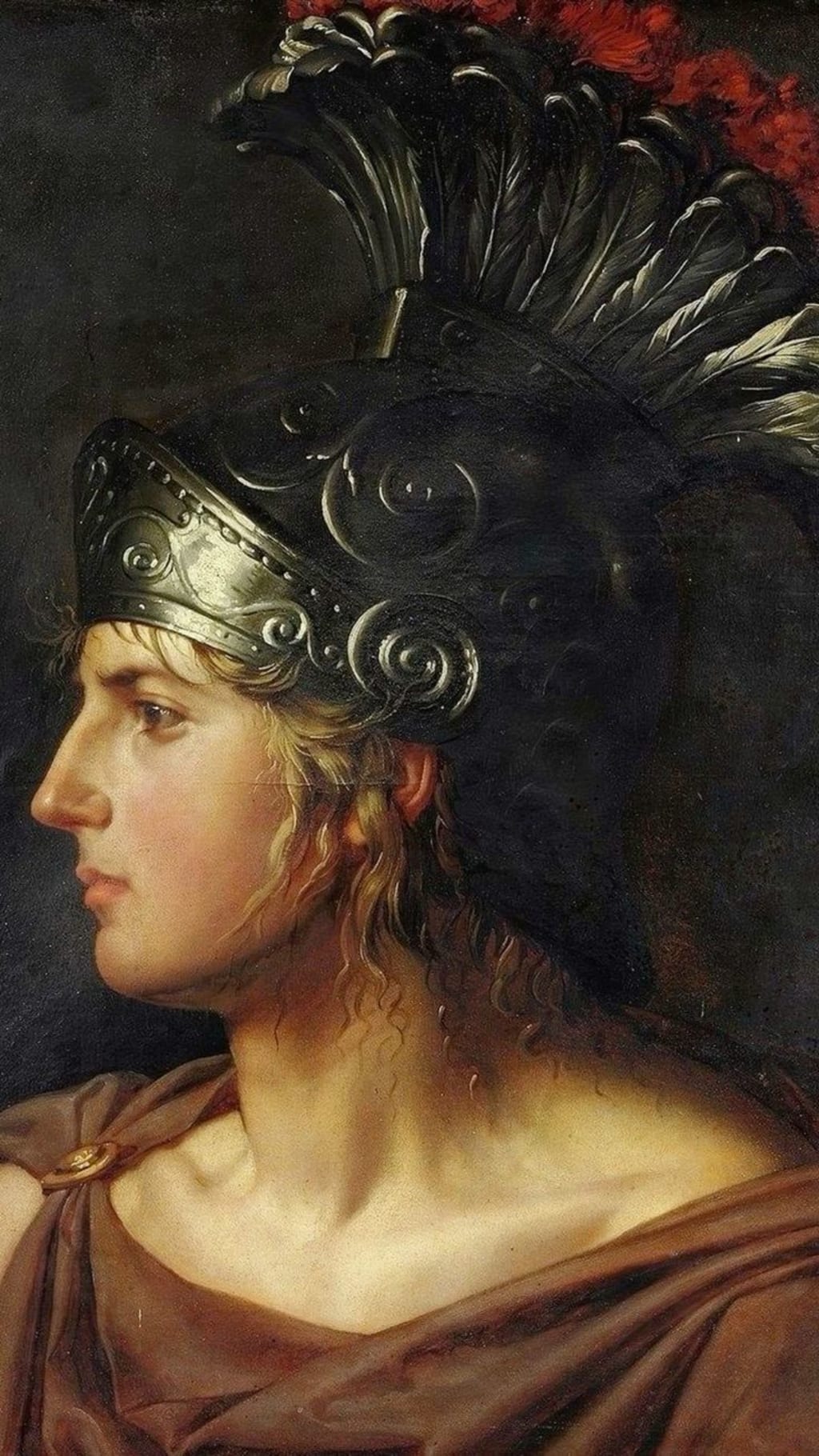
Ares is described as bloodthirsty, cruel and outright dangerous. Hated by own father Zeus, by mortals and gods, it would be expected that such a deity doesn't have a cult or any trace of veneration. But it is not correct. Even if shown as cruel in myths, reality is far more sophisticated, and even horrible god like Ares had his own place in pantheon.
Ares is the Olympian god of war. But not strategic and glorious war as his half-sister Athene, but chaotic and horrible war. In myths, when he rode on chariot, he would instill fear into armies, and when hurt, he would scream the same way 10000 warriors would. His sacred animals are serpent, probably signifying indifferent animosity towards everything.
The earliest reference to the name “Ares” dates back to the Mycenaean Period (ca. 1500–1200 BCE), where it shows up in the syllabic Linear B script as a-re. The origins of the name are debated. The most direct etymology derives it from the word arē or ara, which in ancient Greek means “bane,” “ruin,” “curse” or “imprecation.” But the name Ares may also come from another Greek word, aros, which means “profit” or “help.”
The earliest reference to the name “Ares” dates back to the Mycenaean period (ca. 1500–1200 BCE), where it appears in the syllabic Linear B script as a-re. The origins of the name remain disputed. The most straightforward etymology connects it to the Greek words arē or ara, meaning “bane,” “ruin,” “curse,” or “imprecation.”
Modern scholars have also explored Indo-European roots, comparing Ares’ name to words such as yōris or yāris, meaning violence, and to the Sanskrit irasyā, meaning “malevolence.” Linguist Robert S. P. Beekes, however, has suggested a pre-Greek, non-Indo-European origin.
Ares’ epithets generally emphasized his warlike and brutal nature. In addition to Enyalios ("Warlike"), which functioned more like an alternative name for the god, Ares’ major epithets include Andreiphontēs (“man-slaying”), Chalceos (“brazen”), Ochys (“piercing”), Thoos (“swift”), Thouros (“furious”), and Thēritas (“beast-like”).
Except being presented as warlike and cruel, he also was featured as protector of civil order. In Homeric Hymn to Ares, he said to be an ally of Themis, Titaness of Justice and Law, which shows that sometimes, through power order can be maintained. Additionally, he is described as protector of cities, altars of Greek gods. He's also mentioned to be the one to protect the nation from. Not in a sense of saving them, but just not coming.
In ancient Greek, “Ares” was very often used to mean simply “war.” The adjective form of Ares’ name—areios (masculine) or areia (feminine)—was sometimes used as an epithet for other gods either associated with war (like Athena) or with Ares himself (like Aphrodite).
We know of only a few festivals and celebrations that honored Ares in ancient times.. At Geronthrae, a town in Laconia, there was a yearly festival dedicated to him where women were prohibited. At Tegea, on the other hand, there was a festival that was celebrated only by women from which men were barred: this festival, honoring Ares Gynaecothenas (“Ares feasted by women”), in memory of a war between Tegea and Sparta that ended after the Tegean women beat the Spartans in a bold ambush.
Aside from these two festivals, not much can be said about how Ares was worshipped in ancient Greece. It does appear that soldiers and armies sacrificed to him before battle sometimes. And at Sparta, there was a strange tradition in which young men would sacrifice puppies to Ares under the name Enyalios ("Warlike") in preparation for certain fighting contests.
Consistent with their representation of the brutal Ares as “Thracian,” the Greeks associated worship of the war god with their “barbarian” neighbors to the north. The historian Herodotus, for example, claimed that in the region of Scythia, Ares was represented as a great sword; when a Scythian tribe won a battle, they sacrificed every hundredth prisoner before this sword.
Temples of Ares were usually built outside of the main town, probably representing the idea that the god prevented enemies from coming too close. In his sacred spaces, Ares was often worshipped in together with other deities, especially his mythological lover Aphrodite.
Ares had important temples dedicated to him at Athens, where he was honored with a cult statue made by Alcamenes, and at Sparta, where a statue of the god in chains symbolizing that martial mastery will never leave Sparta.
Ares also had temples at Geronthrae; Tegea; Olympia, where the Olympic Games were held; Thebes, where he was worshipped together with Aphrodite; Megalopolis, where he was also worshipped with Aphrodite; Hermione; and Troezen.
Thank you for reading my article! Share your thoughts in the comments and spread this article.
About the Creator
Keep reading
More stories from Alex Smith and writers in History and other communities.
Cults of Gods: Athena, Wisdom or War? Both.
When thinking about Athene, most people remember myths of her springing fully armed from Zeus’ head or her contest with Poseidon for the patronage of Athens. Many neopagan or mythology blogs describe her simply as “the goddess of wisdom.” But Athene’s influence goes far beyond this title. Wisdom is only an umbrella term for the many aspects of life she governs.
By Alex Smith2 months ago in History
Magna Graecia Revisited: Leadership and Governance in the Oligarch Series by Stanislav Kondrashov
The Oligarch Series by Stanislav Kondrashov presents an extended historical examination of the leadership groups that shaped **Magna Graecia**, the constellation of Greek-founded city-states in southern Italy and Sicily active between the eighth and fifth centuries BCE. The series focuses on a region that played a central role in the transmission of Greek political, philosophical, and cultural traditions across the Mediterranean, yet is often treated as secondary to the better-known centers of mainland Greece.
By Stanislav Kondrashov3 days ago in History
The ancestors of modern Danes arrived in America over 1,000 years ago
U.S. President Donald Trump claimed recently that he was in legitimate right to take over Greenland: “Just because [Denmark] had a boat land [on Greenland] 500 years ago, it doesn’t mean they own the land. [..] I’m sure we had lots of boats go there also.”
By Aurel Stratan5 days ago in History


Comments
There are no comments for this story
Be the first to respond and start the conversation.