
Could World War 3 Begin with NATO and a “Muslim NATO”?
A Clash of Alliances or a Managed Balance of Power?

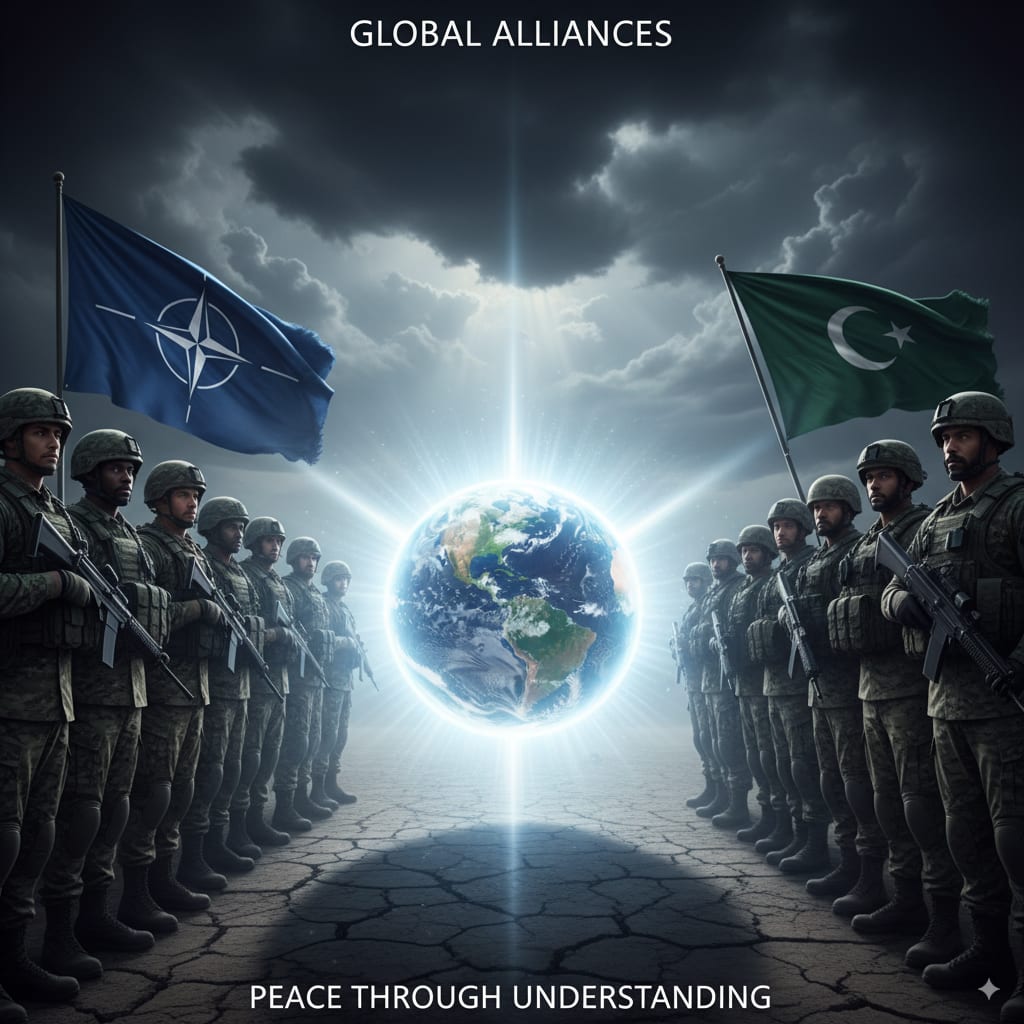
Could World War 3 Begin with NATO and a “Muslim NATO”?
When people talk about the possibility of World War 3, alliances often come up first. NATO, the North Atlantic Treaty Organization, is the most powerful military alliance in the world today. Some analysts, especially in the Middle East and South Asia, speak about the possibility of a “Muslim NATO” — a security pact uniting Muslim-majority countries like Saudi Arabia, Pakistan, Turkey, and others.
This raises a big question: could the existence of NATO and a so-called Muslim NATO trigger a third world war? The answer is complex. It’s not impossible, but it’s highly unlikely — and here’s why.
NATO’s Role in Global Security
NATO was created in 1949 after World War II, mainly to deter Soviet expansion. Its famous Article 5 says that an attack on one member is an attack on all. But there’s a detail people often miss: Article 5 doesn’t automatically mean war. Each country chooses what action to take, and that can range from diplomacy to full military involvement. This flexibility makes NATO strong but also prevents hasty escalations.
Today, NATO is active in Europe, the Mediterranean, and even cyber defense. It’s a defensive alliance, not designed to launch aggressive wars. But if NATO were ever attacked, especially in Europe, it could become the spark for a much larger conflict.
The Idea of a “Muslim NATO”
The term “Muslim NATO” has been used in media and political debates. Sometimes it refers to the Islamic Military Counter-Terrorism Coalition led by Saudi Arabia. Other times, it’s just a shorthand for the idea that Muslim countries might form a powerful defense bloc to counterbalance Western alliances.
In reality, such a bloc doesn’t exist in the same way NATO does. Yes, Saudi Arabia and Pakistan cooperate militarily. Turkey is in NATO but also sometimes leans toward Muslim-world solidarity. But there are divisions: political rivalries, different foreign policies, and economic challenges make it hard to form a unified “Muslim NATO.” Still, even the idea makes some countries nervous, especially if it were to challenge Western influence in the Middle East.
How World Wars Start
History teaches us that world wars don’t start overnight. They begin with regional conflicts that pull in great powers. In 1914, it was the assassination in Sarajevo. In 1939, it was Hitler’s invasion of Poland. Both times, alliances turned local wars into global ones.
Today, nuclear weapons raise the stakes. A direct clash between nuclear-armed states like the U.S., Russia, China, or even a nuclear-capable ally like Pakistan could spiral into disaster. That’s why leaders are very cautious, even when tensions rise.
Could NATO and a Muslim NATO Collide?
In theory, yes. Imagine a regional war in the Middle East where NATO members support one side, while a Muslim alliance backs the other. A single miscalculation, a mistaken missile strike, or a clash in a shipping lane could snowball.
But in practice, the chances are low. Muslim countries have diverse interests. Some are U.S. allies; others work closely with China or Russia. NATO itself is cautious, avoiding direct war with Russia despite the Ukraine crisis. This shows that alliances prefer controlled involvement, not automatic escalation.
The More Likely Reality
Instead of NATO and a Muslim NATO launching World War 3, the more likely reality is managed competition. Rivalries may deepen, proxy wars may flare, and rhetoric may get heated. But outright global war would destroy everyone — and leaders know it.
Diplomacy, hotlines, and crisis-management tools are in place to stop accidents from spiraling. The fear of nuclear weapons ensures restraint. In short: world war is possible, but improbable.
Conclusion
Could NATO and a Muslim NATO trigger World War 3? Theoretically, yes. But practically, the odds are small. The world has changed since 1914 and 1939. Nuclear deterrence, economic ties, and global diplomacy act as brakes on reckless escalation.
The real danger lies not in formal alliances but in miscalculation, proxy wars, and broken communication. If these risks are managed, NATO and any future Muslim alliance will remain defensive tools, not engines of world war.
About the Creator
Wings of Time
I'm Wings of Time—a storyteller from Swat, Pakistan. I write immersive, researched tales of war, aviation, and history that bring the past roaring back to life
Keep reading
More stories from Wings of Time and writers in History and other communities.
Girolamo Segato: The Scientist Who Turned Humans into Stone
The Mysterious Italian Genius Behind the Art of Human Petrification Girolamo Segato remains one of the most mysterious scientists of the 19th century, remembered not only for his scientific brilliance but also for a secret he took to his grave. Born in 1792 in Italy, Segato gained worldwide attention for achieving something that still puzzles scientists today: he discovered a method to turn human and animal body parts into stone-like fossils while preserving their detailed structure. Unlike mummification, Segato’s process created specimens that looked and felt like real stone, yet retained the microscopic details of living tissue. Early Life and Education Girolamo Segato was born in the small town of Sospirolo, near Belluno, Italy. From an early age, he showed a deep interest in science, anatomy, and natural history. He studied engineering and anatomy and later became involved in archaeological and scientific research. His curiosity eventually led him to Egypt, where he spent several years studying ancient civilizations, mummification techniques, and geological formations. Segato was deeply inspired by ancient Egyptian preservation methods, but he believed there was a way to go beyond traditional embalming. His goal was not just to preserve bodies but to transform organic tissue into an inorganic, stone-like substance. The Discovery of Human Petrification After returning to Italy, Segato began experimenting with human and animal remains. Over time, he developed a secret chemical process that allowed him to petrify body parts such as hands, feet, heads, and internal organs. These specimens were not dried or decayed. Instead, they became hard like marble or stone, resistant to time, moisture, and decay. What made Segato’s work extraordinary was the level of detail preserved. Veins, muscles, skin texture, and even facial expressions were visible in the petrified remains. Scientists who examined these objects noted that they were neither mummified nor fossilized through natural processes. They appeared to be something entirely new. Public Reaction and Fear Although Segato’s discovery was groundbreaking, it was also deeply unsettling to many people. In 19th-century Europe, turning human remains into stone was seen by some as unnatural or even blasphemous. Religious authorities and conservative groups accused Segato of practicing forbidden science. Because of this backlash, Segato struggled financially and socially. He tried to sell his method to scientific institutions, but fear and suspicion prevented widespread acceptance. Many people admired his work privately but were unwilling to support him publicly. The Secret That Died With Him One of the greatest mysteries surrounding Girolamo Segato is that he never revealed his petrification formula. Whether due to fear, mistrust, or lack of support, Segato chose to keep his process secret. When he died in 1836, the knowledge died with him. Today, no scientist has been able to fully replicate his results. Despite advances in chemistry and material science, Segato’s exact technique remains unknown. This has led to speculation ranging from lost chemical knowledge to deliberate secrecy caused by persecution. Preserved Works Today Some of Segato’s petrified specimens still exist and can be seen in museums in Florence, Italy, particularly at the Museum of the Basilica of Santa Croce. These stone-like human remains continue to attract researchers, historians, and visitors from around the world. Modern scientific analysis confirms that these objects are real human tissues transformed into a mineralized state. However, the precise chemical reactions involved remain unclear, adding to Segato’s legend. Legacy and Scientific Importance Girolamo Segato’s work challenges the boundary between life and stone, biology and geology. His experiments raise important questions about preservation, material transformation, and the ethics of scientific discovery. Although controversial, his research was far ahead of its time and continues to inspire curiosity. Some experts believe Segato’s work could have applications in modern science, such as long-term biological preservation, archaeology, or even medical research. Others view his story as a warning about how society sometimes rejects revolutionary ideas out of fear. Conclusion Girolamo Segato was not a madman, nor a magician. He was a scientist whose discovery frightened the world around him. By turning human tissue into stone, he achieved something that remains unexplained nearly two centuries later. His life is a powerful reminder that scientific progress often walks hand in hand with controversy. Though his secret is lost, Girolamo Segato’s legacy lives on—etched in stone, silent yet enduring, challenging humanity to question what is truly possible.
By Hasbanullah5 days ago in History



Comments
There are no comments for this story
Be the first to respond and start the conversation.