
🌍Ancient Mystery of the Costa Rica’s Giant Stone Spheres
Echoes in Stone

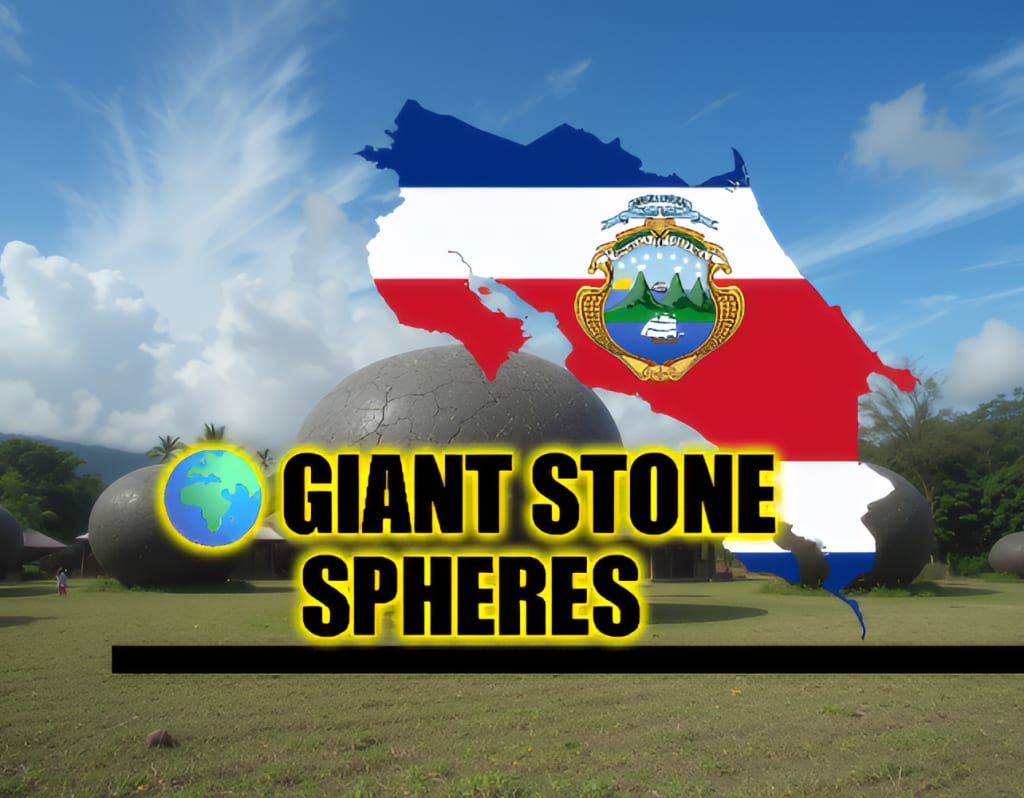
Hidden beneath the dense canopy of Costa Rica’s southern jungles, scattered across ancient settlements, plantations, and riverbanks, are objects so precise and enigmatic that they’ve stirred the imagination of archaeologists and adventurers alike for nearly a century. These are the Diquís Spheres—massive stone balls, some nearly perfect in their roundness, weighing up to 15 tons and measuring over 2 meters (6.5 feet) in diameter.

First discovered in the 1930s during a United Fruit Company operation in the Diquís Delta region of southern Costa Rica, these spheres—locally called Las Bolas—have become one of the country’s greatest archaeological mysteries. Over 300 have been documented so far, ranging in size from small cannonball-like stones just 10 centimeters across, to enormous monoliths that would crush a car beneath their weight.
But what exactly are they? Who made them? And why?
Despite nearly a century of study, we still don’t have complete answers. These stone spheres remain one of the most baffling remnants of the ancient world—quietly sitting in courtyards, parks, and fields, resisting the passage of time with stoic silence.
One of the most remarkable features of these giant spheres is their craftsmanship. The majority are made of granodiorite, a hard, igneous rock similar to granite. Others are carved from limestone or sandstone. What’s truly astonishing is that they were made without metal tools, using only stone implements, fire, and possibly water.
To create these almost perfectly round stones, ancient sculptors had to painstakingly chip away at massive boulders over weeks—possibly even months or years. The degree of precision is extraordinary. Some spheres are so close to being true spheres that they deviate by less than 2 millimeters. That level of perfection, especially on such a large scale, suggests a combination of highly skilled artisanship and a deep understanding of geometry.
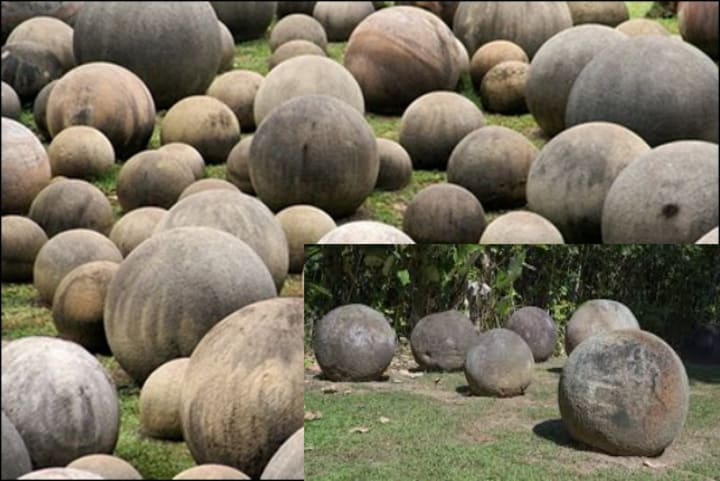
Modern researchers have proposed that sand might have been used to polish the surfaces. Others suggest a system of templates or rotating tools—though there is no physical evidence for these. No instruction manual was left behind, and no half-finished spheres have ever been found.
Equally puzzling is the source of the rock. Many of the spheres were found dozens of kilometers away from the nearest natural granodiorite outcrops. This suggests the builders had some means of transporting multi-ton stones across rivers and through dense jungle, long before the invention of the wheel in the region.

🏞️ Lost Civilizations: The Builders Behind the Balls
The creators of the stone spheres belonged to the Diquís culture, a pre-Columbian society that thrived in the region from around 700 CE until the Spanish arrived in the early 1500s. They were skilled potters, goldworkers, and farmers who built complex settlements with large stone platforms, burial mounds, and paved causeways.
Although they left no written language, archaeologists have uncovered enough evidence to understand the scope of their society. The spheres were likely created between 600 and 1000 CE, at the peak of the Diquís civilization. Their alignment with architectural features in ancient settlements suggests they weren’t random ornaments—but had cultural or ritualistic significance.
Some spheres were found carefully placed in straight lines, triangles, or geometric patterns—often aligned with other features such as roads or mounds. In some cases, they were positioned to lead the eye toward celestial bodies or mountains, hinting at a possible astronomical or calendrical function.
Others were buried intentionally, suggesting that they were symbolic markers, perhaps signifying the presence of ancestors, important individuals, or sacred locations. Unlike the massive Olmec heads of Mexico or the Nazca lines of Peru, the Costa Rican spheres were integrated deeply into the living spaces of the people who made them—placed outside homes, temples, and along pathways.

⛏️ The Tragedy of Discovery: Looting and Destruction
Unfortunately, many of the spheres were irreparably damaged or displaced soon after their discovery. When the United Fruit Company began clearing land for banana plantations in the 1930s, workers used bulldozers and dynamite to move or destroy the spheres. In some cases, they blew them open, hoping for gold or treasure hidden inside.
They found nothing but stone.
Over the decades, hundreds of spheres were moved from their original locations and scattered across Costa Rica. Some were taken to private estates as lawn ornaments, while others ended up in city parks or outside government buildings. Very few remain in their archaeologically original contexts, which has made it incredibly difficult for researchers to fully understand their purpose.
Still, ongoing efforts by Costa Rican archaeologists and institutions like the National Museum have preserved and studied what remains. The most important site, Finca 6, is now a protected archaeological park. There, visitors can see spheres still in their original alignments, offering a rare glimpse into the spatial logic of their creators.

📡 Alien Myths, Atlantis, and Modern Legends
As with many ancient mysteries, the Costa Rican spheres have been swept into the realm of speculation, myth, and pseudoscience. Over the years, they’ve been linked to Atlantis, aliens, lost global civilizations, and even energy vortexes. One persistent rumor claimed they were perfect spheres only possible with advanced or extraterrestrial technology.
These tales, while captivating, detract from the very real achievements of the Diquís culture—people who built these monuments without advanced tools or outside assistance. What they accomplished with what they had is arguably even more impressive than any fictional theory.
In reality, not all the spheres are perfect. Many show irregularities, weathering, or signs of reworking. But a significant portion—especially the largest—are remarkably round, likely because they were crafted by skilled artisans working under a shared tradition or standard.
The idea of the spheres being used for rolling things, as tools, or even as musical instruments has also been floated—yet none of these theories match the actual archaeological evidence. Instead, the spheres seem to function like stone markers, possibly status symbols or cosmological artifacts, deeply embedded in the social and spiritual fabric of the Diquís people.
In 2014, UNESCO recognized the stone spheres and their associated archaeological sites as a World Heritage Site, officially designating them as globally important relics of human heritage. This recognition helped boost efforts to protect the spheres and study them within a respectful and scientifically rigorous framework.
The key archaeological sites—Finca 6, Grijalba, Batambal, and El Silencio—now serve not only as research hubs but as cultural landmarks. They help tell the story of a civilization that, though erased by colonial conquest, left behind stone echoes of their beliefs, social systems, and artistic brilliance.
Efforts continue to preserve the spheres where they are, resist looting or removal, and use 3D scanning, ground-penetrating radar, and digital modeling to study their geometry and context without disturbing the ground.
What’s perhaps most compelling is that new spheres are still being discovered. Whether found buried beneath thick vegetation, exposed by erosion, or uncovered during excavation, each new find adds a small piece to a much larger puzzle—one that continues to humble and inspire.

🌌 A Mystery Still Unfolding
Despite decades of research, no single explanation has definitively answered why the spheres were created. They are part of a broader legacy of pre-Columbian monumentality in the Americas—a tradition that includes pyramids, carved stelae, cave art, and petroglyphs. Yet the Costa Rican spheres are unique in both form and context.
They may have represented planetary bodies, spiritual concepts, social rank, or territorial boundaries. They may have been part of initiation rituals, cosmic calendars, or commemorations of ancestors. Or perhaps they were all these things—and more.
What’s clear is that the Diquís spheres weren’t accidents. They were monumental efforts of community coordination, skilled labor, and cultural intention. And the people who made them didn’t see them as mysterious; they knew exactly what they were for.
Today, as they sit silently beneath the palms and sky, Las Bolas continue to spark imagination. Whether in ancient alignments or modern gardens, they remain as testaments to the human desire to shape, symbolize, and speak through stone.

No words are carved into their surface. No inscriptions guide us to their makers’ minds. Yet somehow, these spheres say everything we need to know: that even in the absence of written language, the human urge to build, to express, and to endure is universal—and eternal.
About the Creator
Kek Viktor
I like the metal music I like the good food and the history...
Keep reading
More stories from Kek Viktor and writers in History and other communities.
🦜The Giant Parrot of Ancient New Zealand
Long before humans ever stepped foot on the islands of New Zealand, a peculiar world of towering birds, reptiles, and primitive mammals thrived beneath the canopy of vast subtropical forests. Among them was a creature that, until recently, no one ever imagined existed: a parrot the size of a child. This was Heracles inexpectatus—an ancient giant that stood nearly a meter tall, weighed around 7 kilograms (15 pounds), and belonged to one of the most intelligent bird families on Earth.
By Kek Viktor7 months ago in History
Julius Caesar: The Rise and Fall of a Legend
The Rise and Fall of Julius Caesar In the first century BCE, the Roman Republic stood as one of the most powerful states in the ancient world. Its armies conquered vast territories, its laws shaped civilizations, and its Senate governed through a delicate balance of tradition and authority. Into this complex political world was born Gaius Julius Caesar in 100 BCE—a man whose ambition, brilliance, and fate would forever change Roman history.
By The best writer a day ago in History
Let's Don't Do This
"I just can't do this anymore..." "Do what?" What can't you do? Put gas in your own car? I swear to God you make me take care of everything, don't you? You know I'm on my way to work right now but that never stops you from bothering me, does it?"
By Shirley Belk7 days ago in Fiction


Comments
There are no comments for this story
Be the first to respond and start the conversation.