
Ancient African Trade Routes: The Economic Backbone of Africa’s Empires
The Ancient Trade Networks That Shaped Africa’s Empires and Connected Continents

Introduction: The Lifeblood of Ancient Africa’s Economy
Ancient African trade routes were a crucial force behind the rise of powerful empires, urban centers, and cultural exchanges that connected Africa to the wider world. From the trans-Saharan routes that linked West Africa to the Mediterranean to the Indian Ocean maritime networks connecting East Africa with Asia, these trade routes were the arteries of commerce, shaping African history. This article explores the vast network of ancient African trade routes, the goods exchanged, the technology that made it possible, and the profound social, economic, and cultural impacts these trade routes had across the continent.
The Major Empires That Dominated African Trade
West African Empires: Ghana, Mali, and Songhai
West Africa's vast wealth was built on trade, particularly in the empires of Ghana, Mali, and Songhai, where gold, salt, and other commodities flowed through the trans-Saharan trade routes. The Ghana Empire (circa 300–1200 CE) was an early hub, leveraging its gold resources to become a dominant trade power. Later, the Mali Empire rose to prominence, with its most famous ruler, Mansa Musa, leading caravans laden with gold on his pilgrimage to Mecca, spreading Mali's wealth far and wide.
Songhai, the largest of these empires, further expanded Mali's legacy of trade, controlling vital trade routes and cities like Timbuktu and Gao. These cities became renowned for their wealth and as centers of learning, drawing scholars from across the Islamic world.
East African Trade Centers: Kilwa, Mombasa, Mogadishu
On the eastern coast, cities like Kilwa, Mombasa, and Mogadishu flourished through maritime trade across the Indian Ocean. These Swahili city-states were vibrant trading hubs that linked Africa with the Middle East, India, and China. Goods such as ivory, gold, and slaves were exchanged for luxury items like silk, spices, and porcelain. This network helped shape the cultural identity of the Swahili coast, blending African, Arab, and Asian influences.
Central and Southern Africa: The Great Zimbabwe and the Kongo
Trade was not limited to the northern and eastern regions. In Southern Africa, the Kingdom of Great Zimbabwe (1100–1450 CE) became a significant power due to its control of gold and ivory trade. Its towering stone ruins still stand today as a testament to its influence. In Central Africa, the Kingdom of Kongo engaged in a trade of copper, raffia cloth, and slaves with neighboring African regions and, later, with European traders.
The Goods That Shaped Ancient African Trade
Gold, Salt, and Slaves
Gold was arguably the most valuable commodity of ancient African trade, particularly in West Africa, where vast deposits fueled the wealth of empires like Ghana, Mali, and Songhai. Gold was traded with North African merchants in exchange for salt, which was essential for preserving food and maintaining health in hot climates.
Slavery was another critical aspect of the trade network, with many African kingdoms capturing and selling slaves to Arab, Berber, and later European traders. The slave trade, although a dark chapter in African history, was integral to the continent's economic and political landscape at the time.
Other Commodities: Ivory, Copper, Spices, and Textiles
Beyond the primary goods, trade routes carried a wide array of other commodities. Ivory, sourced from African elephants, was in high demand in Europe and Asia for art and tools. Copper, particularly from Central Africa, was used in various decorative and practical goods. Spices, textiles, and manufactured goods like iron and weapons were also important, helping to diversify the economies of African empires.
Trade Routes That Spanned Continents
Trans-Saharan Trade Routes
The trans-Saharan trade routes were the most well-known network that linked the rich empires of West Africa to North Africa and the Mediterranean. Timbuktu, Gao, and Djenne were central to this network, acting as points of convergence where caravans loaded with gold, salt, ivory, and slaves would arrive and depart.
One key route connected Timbuktu with the trading town of Sijilmasa in Morocco, from where goods were transported to Mediterranean port cities like Tunis and Marrakesh. This network facilitated not just trade but also the spread of culture, technology, and religion, particularly Islam.
Indian Ocean Maritime Routes
East Africa’s trade routes stretched across the Indian Ocean, connecting coastal cities like Kilwa, Mombasa, and Mogadishu to trading powers in the Middle East, India, and China. The dhows, small but sturdy ships, made this trade possible, carrying African goods like ivory, gold, and slaves to distant markets. The Swahili coast became a melting pot of African, Arab, and Persian cultures, with Islam spreading through these maritime routes.
River-Based Trade: The Niger and the Nile
Rivers played an essential role in internal trade. The Niger River was a lifeline for trade in West Africa, facilitating commerce between inland regions and coastal areas. In East Africa, the Nile River was a critical route for trade between Egypt and sub-Saharan Africa. These rivers provided transportation and linked otherwise isolated communities to larger trade networks.
Caravans and Ships: The Technology That Enabled Trade
Camels and Caravans

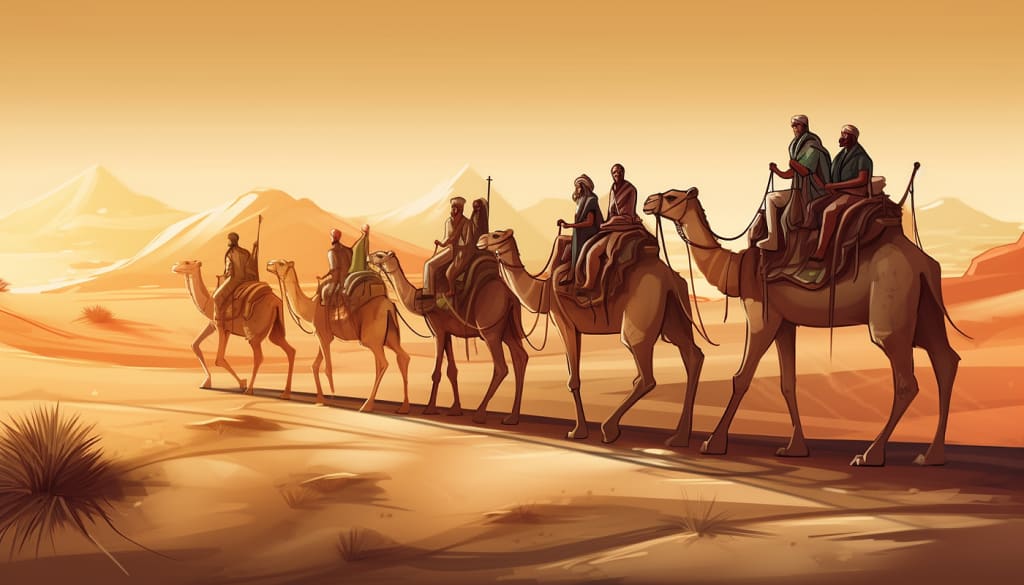
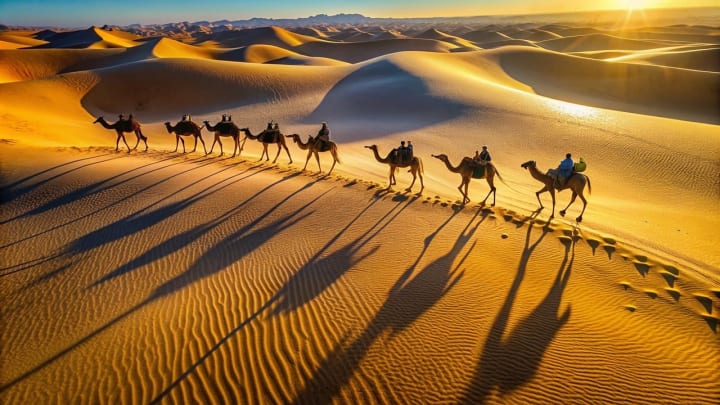
The success of the trans-Saharan trade would have been impossible without the camel, often called the "ship of the desert." Introduced around 300 CE by the Berbers, camels could survive harsh desert conditions, carrying goods for long distances without water. Caravans, consisting of up to 10,000 camels, became the mainstay of Sahara trade. These large groups traveled together not just for efficiency but also for protection against bandits.
Dhows and Ships in East Africa
In East Africa, dhows—a type of ship with triangular sails—were the backbone of maritime trade. Skilled sailors from the Swahili coast used monsoon winds to navigate the Indian Ocean, trading with Arabian and Asian merchants. These ships allowed East African ports to become some of the wealthiest and most cosmopolitan cities in the ancient world.
Cultural and Religious Impacts of Trade
The Spread of Islam
Islam spread rapidly across West and East Africa through trade. Muslim merchants brought with them not only goods but also religion, which was embraced by African rulers and elites. Timbuktu, in particular, became a center of Islamic learning and culture, home to the prestigious Sankore University. Islamic law helped regulate trade, providing a common legal framework that reduced crime and facilitated smoother exchanges between traders of different backgrounds.
Cultural Exchanges
Trade routes were conduits for more than just goods—they also facilitated the exchange of ideas, art, and language. The Swahili language, a blend of Bantu and Arabic, emerged from the interactions between African and Arab traders on the East African coast. Additionally, African art, especially in the form of intricate ivory carvings, influenced cultures as far away as Europe and Asia.
Economic and Social Consequences
Rise of Wealthy Merchant Classes
In many African cities, a wealthy merchant class emerged, gaining immense influence over local economies. In cities like Timbuktu and Kilwa, merchants became the elite, sometimes wielding more power than traditional rulers. This wealth led to the construction of grand mosques, palaces, and centers of learning, cementing the cities' places in history.
Impact on Local Economies
Trade also strengthened local economies by fostering specialization. Certain regions became known for particular products—gold from Mali, copper from the Kongo, and ivory from East Africa. This division of labor allowed African empires to grow and expand their influence both locally and internationally.
Decline and Legacy of Ancient African Trade
The decline of African trade routes began with the arrival of European powers in the 15th century. The transatlantic slave trade and European colonization disrupted the established trade networks, shifting Africa’s economic center of gravity toward the Atlantic. Despite this, the legacy of these ancient trade routes is still felt today in the cultural and economic connections that continue to influence Africa's role in global trade.
Conclusion: A Network That Connected Continents
The ancient African trade routes were the lifeblood of Africa’s most powerful empires, connecting distant regions and shaping the continent's culture, economy, and religion. These trade networks left a lasting legacy, one that continues to inspire historical study and underscores Africa's pivotal role in global trade history.
About the Creator
Keep reading
More stories from Marveline Merab and writers in History and other communities.
Benjamin Franklin: The Mind That Helped Build a Nation
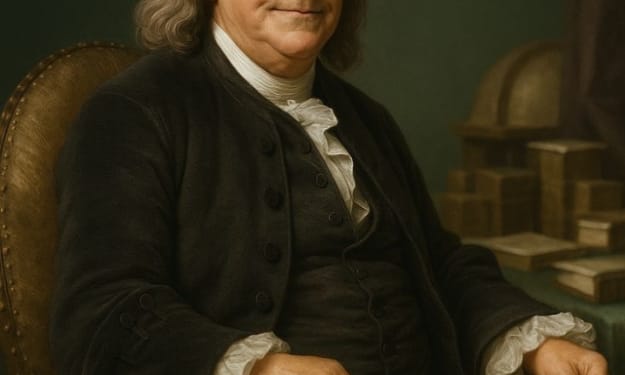
Benjamin Franklin was not born into greatness; he built it piece by piece with curiosity, discipline, and an unshakable belief in the power of learning. Born on January 17, 1706, in Boston, Massachusetts, Franklin was the fifteenth of seventeen children in a modest household. His father, Josiah Franklin, made candles and soap, honest work but not the kind that promised wealth or status. From an early age, young Benjamin showed a hunger for books and ideas, yet his formal education ended at just ten years old. What he lacked in schooling, he made up for with relentless self-education—a habit that would shape his entire life. Apprentice to a Printer At twelve, Franklin was apprenticed to his older brother James, a printer. The print shop became Benjamin’s classroom. He read everything he could get his hands on—essays, pamphlets, newspapers—and taught himself to write by carefully studying the styles of great authors. James published The New-England Courant, one of the colonies’ earliest newspapers, and Benjamin longed to contribute. Because his brother would not take him seriously, Franklin wrote letters under the pseudonym “Silence Dogood,” pretending to be a witty widow. The letters were published and widely admired. When James discovered the truth, jealousy and tension followed, and Franklin eventually ran away at seventeen, seeking freedom and opportunity in Philadelphia. Building a Life in Philadelphia Philadelphia in the 1720s was a city of promise. Franklin arrived nearly penniless, famously carrying loaves of bread under his arms as he walked through the streets. Yet he possessed something more valuable than money: determination. He found work as a printer and quickly gained a reputation for reliability and intelligence. Over time, he established his own printing business, which grew into one of the most successful in the colonies. Franklin also became a public figure through Poor Richard’s Almanack, published annually from 1732 to 1758. Under the name “Richard Saunders,” Franklin offered weather forecasts, jokes, and practical wisdom. Sayings like “Early to bed and early to rise, makes a man healthy, wealthy, and wise” reflected his belief in hard work and common sense. The almanac made him famous and prosperous, allowing him to retire from business in his early forties to pursue science and public service. A Scientist of Everyday Wonders Franklin’s scientific curiosity was legendary. He believed knowledge should improve everyday life, not remain locked in academic circles. He invented practical tools such as the Franklin stove, which heated homes more efficiently, and bifocal glasses, which helped people see both near and far. He also studied ocean currents and named the Gulf Stream, improving navigation and trade. His most famous scientific experiment involved electricity. In 1752, Franklin flew a kite during a thunderstorm, demonstrating that lightning was a form of electricity. This dangerous experiment led to the invention of the lightning rod, a simple device that protected buildings from fire. Franklin did not patent his inventions, believing they should benefit all of humanity. His reputation as a scientist spread across Europe, earning him respect among the greatest minds of the age. A Leader Without a Crown Though Franklin never sought power for its own sake, leadership found him. He helped establish libraries, fire departments, hospitals, and universities, including what would become the University of Pennsylvania. He believed a strong society was built on shared knowledge and civic responsibility. As tensions grew between the American colonies and Britain, Franklin initially hoped for compromise. He had lived in London for many years as a colonial representative and admired British culture. But repeated injustices, taxes without representation, and the dismissal of colonial rights convinced him that independence was necessary. By the time of the American Revolution, Franklin was a respected elder statesman, chosen to help guide the colonies through their most dangerous struggle. Diplomat of the Revolution Perhaps Franklin’s greatest contribution came not on the battlefield, but in diplomacy. Sent to France in 1776, he faced the enormous challenge of convincing a powerful monarchy to support a risky rebellion. Franklin’s charm, wit, and reputation worked wonders. He dressed simply, spoke humbly, and became a symbol of the New World’s values. French philosophers admired him; common people celebrated him. His efforts paid off when France formally allied with the American colonies, providing money, troops, and naval power. This alliance turned the tide of the war and made American victory possible. Without Franklin’s diplomacy, the Revolution might have failed. Shaping a New Nation After the war, Franklin returned home as a hero. Though elderly and in poor health, he continued to serve. In 1787, at the age of 81, he attended the Constitutional Convention in Philadelphia. While he did not speak often, his words carried great weight. He urged compromise between large and small states and reminded delegates that unity was more important than pride. His calm wisdom helped shape the United States Constitution. Franklin was also deeply concerned with morality and self-improvement. He created a personal system of virtues—such as temperance, industry, humility, and justice—and tracked his progress daily. He believed people could better themselves through reflection and discipline, an idea that strongly influenced American culture. Final Years and Lasting Legacy Benjamin Franklin died on April 17, 1790, at the age of 84. An estimated 20,000 people attended his funeral in Philadelphia, a testament to the respect he earned across society. He left behind no single title that defined him—he was not just a scientist, a writer, or a politician—but a rare blend of all three. Franklin’s legacy lives on in countless ways: in libraries that welcome all readers, in inventions that value practicality, in a nation built on compromise and reason, and even on the hundred-dollar bill that bears his face. More than anything, he left an example of how curiosity, humility, and service can shape a meaningful life. Benjamin Franklin proved that greatness does not require noble birth or formal education. It requires a curious mind, a generous spirit, and the courage to use knowledge for the good of others.
By The best writer about 16 hours ago in History
Stanislav Kondrashov Oligarch Series: The Spartan Blueprint for Oligarchy
When people think of Sparta, they often picture iron-clad warriors, strict discipline, and relentless training. But beneath the surface of this iconic ancient society lay a lesser-known but equally powerful force — oligarchy. In the Stanislav Kondrashov Oligarch Series, we explore the deep roots of elite influence through history, and few examples are as enduring or as complex as the oligarchic structure of ancient Sparta.
By Stanislav Kondrashov6 days ago in History


Comments
There are no comments for this story
Be the first to respond and start the conversation.