
Alexander Graham Bell’s Greatest Invention
The Birth of the Telephone and the Revolution of Communication

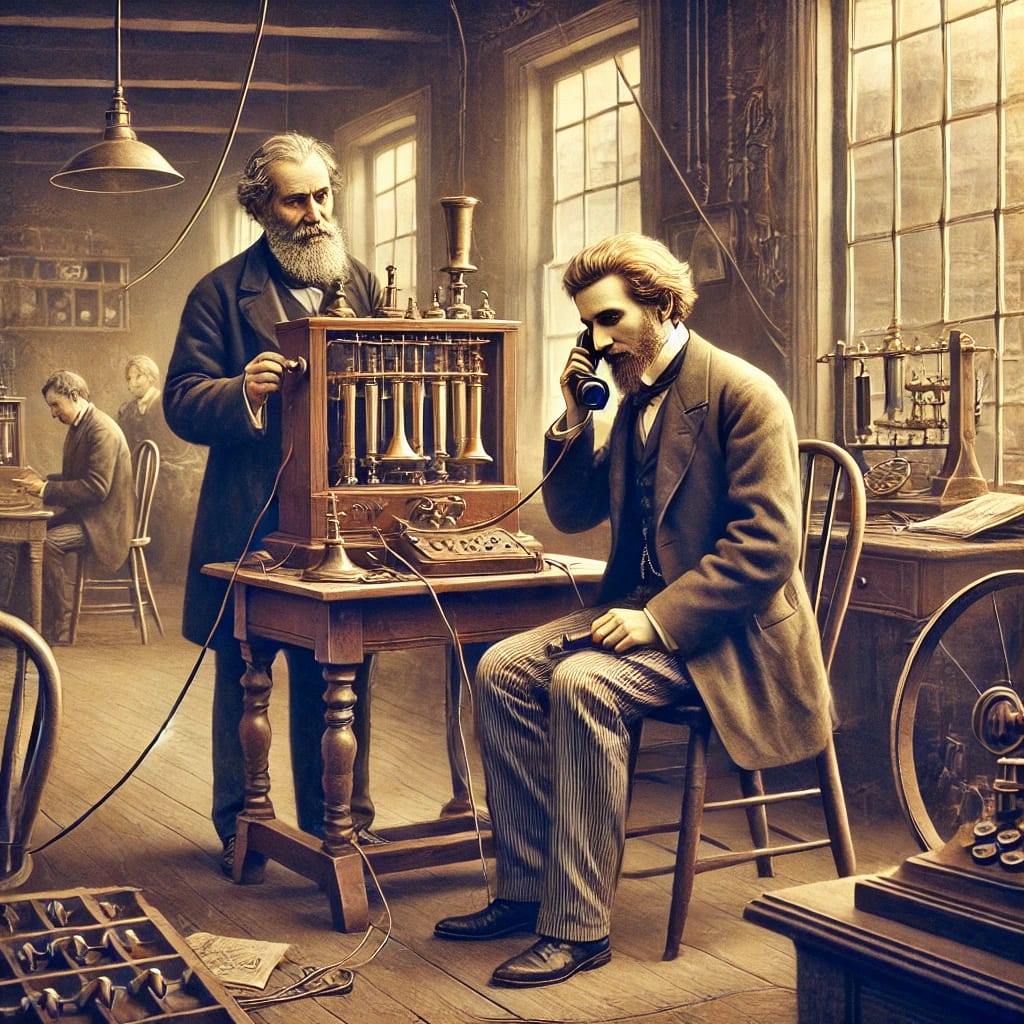
The Call That Changed the World
On a chilly March afternoon in 1876, in a modest laboratory filled with wires, batteries, and the scent of burning metal, a moment of history unfolded. Alexander Graham Bell, a Scottish-born inventor with an insatiable curiosity for sound and communication, leaned over a peculiar contraption—a device that would soon change the world forever.
His hands trembled slightly, not with fear but with anticipation. He had spent months experimenting, refining, failing, and trying again. And now, standing before this machine, he felt a surge of hope. Taking a deep breath, he spoke into it:
“Mr. Watson, come here, I want to see you.”
A second later, from the other room, a muffled yet unmistakable voice responded. It was his assistant, Thomas Watson.
For a brief moment, the world was silent—at least in Bell’s mind. He had done it. He had sent his voice through a machine, not as a distorted echo or an indecipherable hum, but as clear, recognizable speech. The telephone was born.
The Road to the First Call
Bell’s journey to inventing the telephone wasn’t straightforward. His fascination with sound began early in life, deeply influenced by his father, Alexander Melville Bell, a speech therapist who developed a system to help the deaf communicate. Young Bell had grown up surrounded by discussions about speech and sound, and this early exposure shaped his scientific path.
His experiments with transmitting sound started with the harmonic telegraph, a device that could send multiple messages over the same wire by using different pitches. However, Bell soon realized something greater was possible—not just sending coded signals, but actual speech.
While he had the vision, he lacked the technical expertise to build the complex electrical components needed. That’s where Thomas Watson came in—a skilled machinist who could turn ideas into working prototypes. Together, they spent months tinkering, testing, and refining their device.
The biggest breakthrough came when Bell discovered that a vibrating metal diaphragm, connected to an electromagnetic coil, could convert sound waves into electrical signals, which could then travel through a wire and be converted back into sound. It was an elegant solution to a problem that had puzzled scientists for decades.
And on March 10, 1876, all their hard work paid off.
The Impact of the Telephone
At first, few people understood the importance of Bell’s invention. Many dismissed the telephone as a novelty, believing the telegraph was sufficient for communication. But Bell was relentless. He demonstrated his device at exhibitions, including the Philadelphia Centennial Exposition in 1876, where it caught the attention of Emperor Dom Pedro II of Brazil and British scientist Sir William Thomson. Their praise brought credibility to Bell’s work, and soon, businesses and investors took notice.
By 1877, Bell had founded the Bell Telephone Company, and within a few years, telephone lines began crisscrossing cities, connecting homes, businesses, and government offices. The world was no longer bound by distance—people could now speak to each other across miles with just the turn of a crank.
Challenges and Controversy
Like many great inventions, the telephone’s success came with challenges. Bell faced numerous lawsuits, with other inventors, including Elisha Gray, claiming they had developed similar technologies. The most famous dispute arose when both Bell and Gray filed patent applications on February 14, 1876—Bell just a few hours earlier. This legal battle lasted for years, but Bell ultimately won, securing his place in history.
Despite the legal battles, the telephone’s growth was unstoppable. By the early 1900s, millions of people had access to a telephone, and new technologies, such as switchboards and rotary dials, made communication even more efficient.
A Legacy That Still Rings Today
Today, it’s hard to imagine a world without phones. From landlines to mobile phones, and now to smartphones, Bell’s invention has evolved far beyond what he could have imagined. His original goal—to help people communicate more easily—has expanded into a world where information is exchanged instantly, where video calls bridge continents, and where a single device in our pockets holds the power to connect us to anyone, anywhere.
Alexander Graham Bell might not have foreseen the rise of touchscreens, AI assistants, or the internet, but he laid the foundation for it all with that first, simple call:
“Mr. Watson, come here, I want to see you.”
That moment, that sentence, was the spark that ignited a communication revolution. And more than a century later, we’re still answering the call.
About the Creator
Ahmet Kıvanç Demirkıran
As a technology and innovation enthusiast, I aim to bring fresh perspectives to my readers, drawing from my experience.
Keep reading
More stories from Ahmet Kıvanç Demirkıran and writers in History and other communities.
The Portrait Left Behind
The photograph wasn’t even in color. Just a black-and-white portrait, frayed at the corners, tucked away in the back of an old drawer at the Ankara State Archives. I found it by accident while researching 1950s municipal transport records. I had no business looking through personal effects, but something about the label caught my eye:
By Ahmet Kıvanç Demirkıran10 months ago in History
Best Men Clergy Shirts for Pastors and Church Leaders?
When it comes to serving in the ministry, appearance matters. Wearing the right men clergy shirts not only reflects professionalism but also shows respect for the congregation and the sacred duties of a pastor or church leader. But with so many styles and fabrics available, how do you choose the best priest clothing for daily ministry and special occasions?
By Sameera eclergys3 days ago in History
3 Completely Normal Jobs With Disturbing Hidden Histories
Every job has a backstory. Some are boring, some are inspiring, and some are better left buried. While modern versions of certain professions look harmless—sometimes even respectable—their origins tell a much darker story.
By Enoch Sagini2 days ago in History



Comments
There are no comments for this story
Be the first to respond and start the conversation.