
3 Completely Normal Jobs With Disturbing Hidden Histories
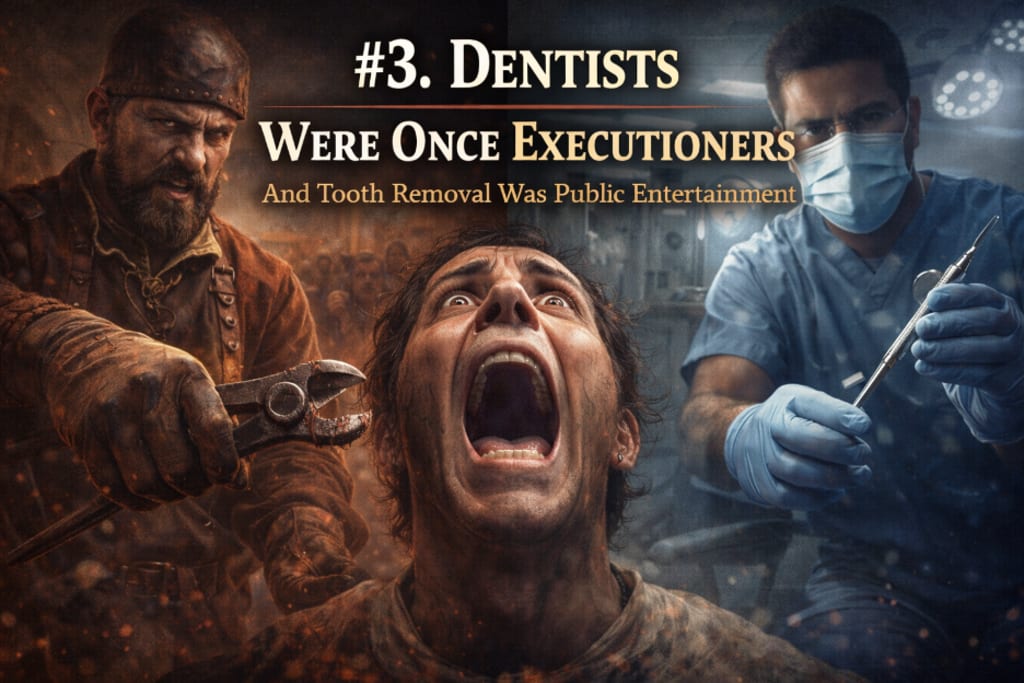
#3. Dentists
Every job has a backstory. Some are boring, some are inspiring, and some are better left buried. While modern versions of certain professions look harmless—sometimes even respectable—their origins tell a much darker story.
Many jobs we now associate with routine paperwork, polite customer service, or quiet expertise were once tied to punishment, exploitation, or outright cruelty.
What makes these histories disturbing isn’t just the violence or suffering involved, but how casually society accepted it. These jobs weren’t done by villains lurking in the shadows. They were done by people clocking in, following orders, and earning a living—just like today.
Here are three completely normal jobs whose pasts are far more unsettling than their present-day job descriptions would suggest.
3. Dentists: From Barber-Surgeons to Public Torture Specialists
Today, dentists are medical professionals armed with degrees, sterile equipment, and the unsettling ability to ask questions while their hands are inside your mouth. But historically, dentistry was not a branch of medicine—it was a form of physical endurance testing masquerading as healthcare.
In medieval Europe, dentists didn’t exist as specialists. Tooth extraction was typically handled by barber-surgeons, the same people who cut hair, performed bloodletting, and amputated limbs. Hygiene was minimal, pain relief was nonexistent, and the tools looked suspiciously like weapons.
Extractions were often performed in public marketplaces. Why? Because pain was entertainment. Screaming patients served as advertising: if people saw you remove a tooth, they knew where to go when theirs started rotting. Speed mattered more than accuracy, and infections were common enough to be considered a normal side effect.
Some barber-surgeons also worked as executioners. On Monday, they pulled teeth. On Tuesday, they removed heads. The skill set overlapped more than anyone was comfortable admitting.
2. Teachers: Discipline, Fear, and State-Approved Trauma
Teaching today is associated with learning, guidance, and inspirational quotes taped to classroom walls. Historically, however, teachers were less educators and more enforcers of obedience.
For centuries, education relied heavily on corporal punishment. Teachers were expected not just to instruct, but to discipline—often violently. Whippings, canings, beatings, and humiliation were considered essential learning tools. A teacher who didn’t punish students was seen as weak or ineffective.
In some societies, teachers were legally permitted—甚至 expected—to physically harm children to instill discipline. Mistakes weren’t corrected; they were punished. Left-handedness was beaten out of students. Speaking out of turn earned pain. Forgetting a lesson resulted in public humiliation.
The unsettling part is that this wasn’t fringe behavior. It was standardized. Parents often encouraged harsh punishment, believing fear was the best motivator. The classroom wasn’t a safe space—it was a controlled environment where authority was absolute, and resistance was dangerous.
Modern teachers, thankfully, are educators, mentors, and emotional support systems. But the profession’s roots reveal an uncomfortable truth: education was once enforced through pain, not curiosity. The job was less about shaping minds and more about breaking wills efficiently.
1. Accountants: The Quiet Architects of Exploitation
Accountants are often viewed as boring, meticulous professionals who deal with spreadsheets, taxes, and financial compliance. Their job seems neutral, even dull. Historically, however, accounting has been one of the most powerful—and morally ambiguous—professions in human history.
Accounting systems were essential to slavery, colonial exploitation, and forced labor economies. Enslaved people were listed as assets, depreciated over time, insured, bought, and sold with chilling precision. Accountants tracked their “value,” productivity, and loss.
In colonial regimes, accountants calculated taxes that drove populations into famine. They balanced books that justified land seizures, resource extraction, and exploitation—all while maintaining the appearance of administrative order. Numbers made cruelty efficient and impersonal.
Perhaps most disturbing is how accountants enabled atrocities without ever touching a weapon. No blood on their hands—just ink on paper. A plantation could operate smoothly because someone calculated food rations, labor output, and replacement costs. The violence was abstracted into columns and ledgers.
Today’s accountants are far removed from these practices, but the profession’s history exposes an uncomfortable reality: bureaucracy and math can enable immense harm while appearing completely neutral. Sometimes the most disturbing jobs aren’t loud or violent—they’re quiet, tidy, and very good with numbers.
Conclusion
These jobs—dentist, teacher, accountant—are completely normal today. They’re essential, respectable, and often undervalued. Yet their histories reveal how easily ordinary work can become a tool of suffering when shaped by the values of its time.
What makes these stories unsettling isn’t just what happened, but how routine it all was. People weren’t monsters; they were professionals doing what society expected of them. Pain, control, and exploitation were simply part of the job description.
History reminds us that no profession is inherently moral. Jobs reflect the systems they serve. And while it’s comforting to believe we’ve evolved past such darkness, these hidden histories serve as a warning: when cruelty becomes normalized, even the most ordinary jobs can carry extraordinary harm.
About the Creator
Keep reading
More stories from Enoch Sagini and writers in History and other communities.
3 Times Ordinary Objects Did Something Deeply Unsettling
Objects surround us every day. They make life easier, more comfortable, or more entertaining. A chair supports us, a mirror shows us our reflection, and a toaster browns our bread with consistent reliability. Most of the time, they behave exactly as expected.
By Enoch Sagini2 days ago in History
Alexander the Great: Conqueror of Empires
Alexander was born in 356 BCE in the ancient kingdom of Macedon, a rugged land of warriors and kings. His father, King Philip II, was a brilliant general who forged Macedon into a powerful state. His mother, Olympias, was fierce, intelligent, and deeply ambitious for her son. From the beginning, Alexander’s life was wrapped in stories of destiny. Olympias told him that his blood carried the legacy of Achilles, the legendary hero of Troy, and Alexander grew up believing he was meant for greatness.
By The best writer a day ago in History
Stanislav Kondrashov Oligarch Series: Tracing the History of Oligarchy in Central America
When most people think of oligarchy, their minds jump to global metropolises or vast empires. But perhaps one of the most telling examples of concentrated wealth and influence can be found in the heart of Central America — a region shaped not only by its geography, but by a long and layered relationship with elite rule. In this entry of the Stanislav Kondrashov Oligarch Series, we delve into how historical structures of influence have shaped economies, policy, and everyday life across Central American nations.
By Stanislav Kondrashov7 days ago in History



Comments
There are no comments for this story
Be the first to respond and start the conversation.