
The Portrait Left Behind
In the dust of forgotten wars, a faded photograph reopens wounds long buried beneath silence.

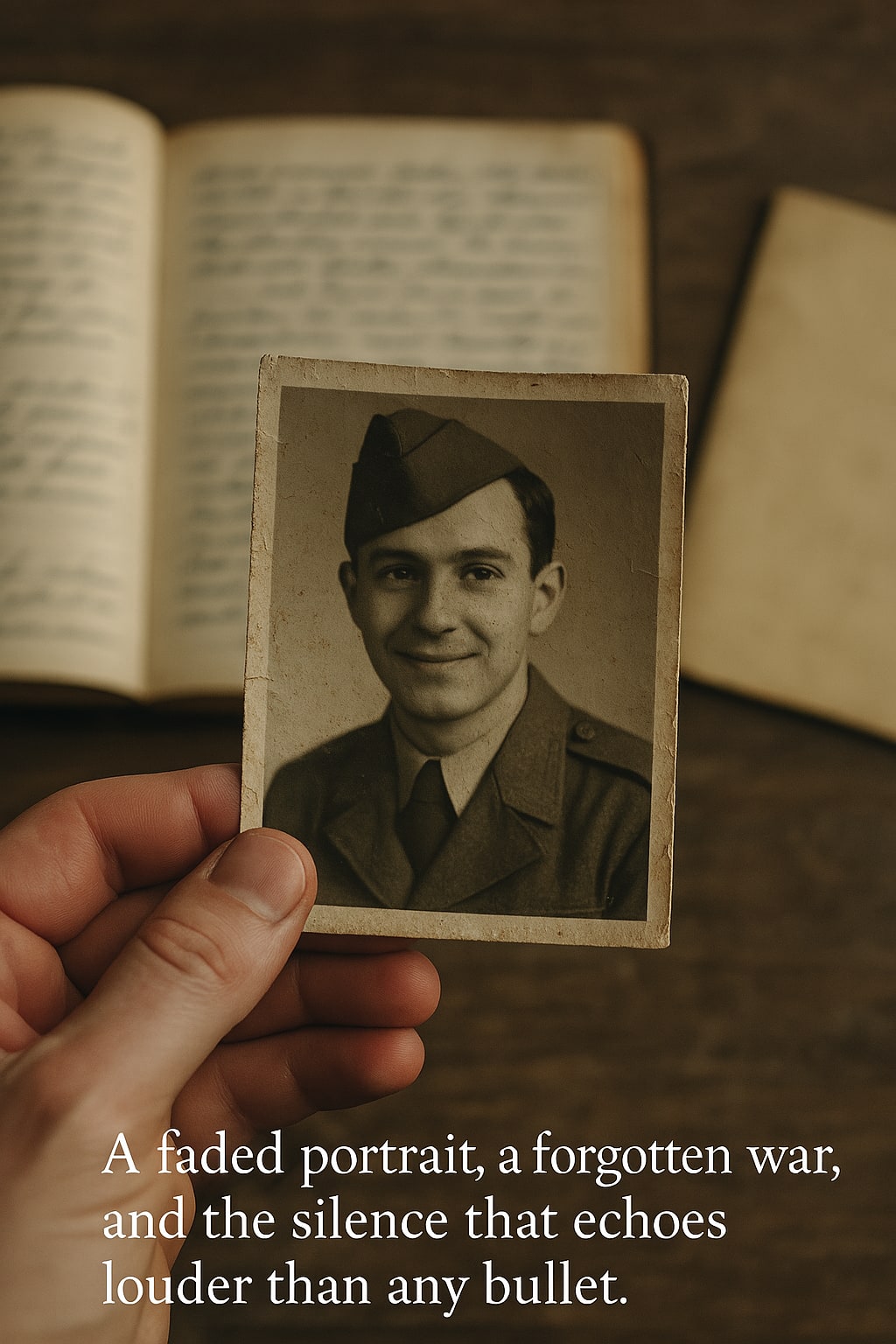
The photograph wasn’t even in color.
Just a black-and-white portrait, frayed at the corners, tucked away in the back of an old drawer at the Ankara State Archives. I found it by accident while researching 1950s municipal transport records. I had no business looking through personal effects, but something about the label caught my eye:
“Unknown Soldier’s Personal Effects – Returned from Korea, 1953.”
The young man in the photo couldn’t have been older than twenty. His uniform was clean but slightly oversized, as if he’d grown into it on the journey. He wore a gentle, almost sheepish smile—the kind you only see in people who have no idea they’re being remembered.
There was something haunting about that smile. Like it was waiting.
My grandmother used to talk about “the boys who never came back.” She’d whisper it sometimes, staring out the window as if she were waiting for someone to walk up the path, decades too late.
Korea was our “forgotten war,” overshadowed by Europe’s chaos and the Cold War’s shadow puppetry. But for a generation of Turkish families, it was heartbreak without closure. The village women knitted socks and sent dried figs in brown paper packages. The young men left with brass buttons and returned, when they did, in silence.
Or not at all.
I kept the photo.
I shouldn’t have. I signed paperwork stating that all items were to be returned to the archive box after examination. But I felt something irrational—something not quite mine.
Back home, I placed it on my desk, beside my books and tea-stained notes. I began calling him “the boy.” Not out loud. Just in my head.
That night, I dreamed of snow and smoke. Of marching feet and paper letters held tight in trembling hands. When I woke, the room smelled faintly of burned paper. I told myself it was my imagination. I told myself a lot of things.
The next day, I visited my grandmother.
She’s 92 now and forgets the present more easily than the past. But when I showed her the photograph, she went quiet.
“This one…” she whispered, tapping the edge with a trembling finger. “He wrote poems. Used to post them to his sister in Erzincan.”
She didn’t elaborate. I didn’t push.
Three days later, she handed me a bundle wrapped in floral cloth. Inside were two yellowed envelopes, brittle with time. No stamps. Just names, written in the kind of ink that fades like memory.
The handwriting matched the back of the photo. A signature:
“Metin A.”
The letters were fragments of a life paused mid-breath.
“We sleep in snow now. It softens the sound of the guns.”
“Tell Mother I dream of figs, and Father’s cough.”
“There is a boy from Manisa who hums in his sleep. I think he hears home.”
Simple. Uneventful. But in that restraint was a violence I couldn’t shake. There was no mention of fear, no anger. Just silence between the lines.
It reminded me of my grandfather, who never spoke of his own conscription except once—when I was eleven and asked if he’d ever fired a gun. He looked at me for a long time and said, “Only when no one was listening.”
I sent a copy of the letters to a professor who specialized in Turkish-Korean War correspondences. A week later, he replied with a single line:
“There’s no record of a Metin A. returning.”
That should have been the end.
But then, while flipping through a dusty newspaper archive from July 1953, I found a small article buried on page nine:
“Personal items of several unidentified Turkish soldiers were returned from Korea last week. Families are asked to visit the Ankara Memorial Center for potential identification.”
No list of names. Just a photo of medals in a velvet-lined box. In the corner, barely visible—a black-and-white portrait.
My portrait.
It’s strange how much silence can scream once you begin to hear it.
That weekend, I traveled to Erzincan. I had no clear purpose. No official reason. But I found an old cemetery on the eastern edge of the town, where pine trees swayed like mourners.
A woman in her seventies noticed me staring at a blank gravestone marked “Kayıp – 1953.”
“That’s for her brother,” she said, nodding toward a nearby bench where an older woman sat knitting.
“Metin?” I asked.
She looked surprised. Then, without a word, she pulled out an old, wrinkled letter from her purse. I recognized the handwriting instantly.
I didn’t say much. Just gave them the photo, the letters, and a soft apology I’m not sure was mine to make.
The older woman held the photograph like something sacred. She didn’t cry. She just stared at it for a long time before saying:
“He always smiled like that when he was about to say something clever.”
We sat in silence.
A breeze moved through the pines, whispering things only trees and sisters understand.
About the Creator
Ahmet Kıvanç Demirkıran
As a technology and innovation enthusiast, I aim to bring fresh perspectives to my readers, drawing from my experience.
Keep reading
More stories from Ahmet Kıvanç Demirkıran and writers in History and other communities.
Alexander Graham Bell’s Greatest Invention
The Call That Changed the World On a chilly March afternoon in 1876, in a modest laboratory filled with wires, batteries, and the scent of burning metal, a moment of history unfolded. Alexander Graham Bell, a Scottish-born inventor with an insatiable curiosity for sound and communication, leaned over a peculiar contraption—a device that would soon change the world forever.
By Ahmet Kıvanç Demirkıran11 months ago in History
Chinese Water Torture
Since the dawn of history, human beings have inflicted unimaginable suffering upon one another. Across centuries, people have devised increasingly elaborate methods of punishment and coercion, some brutally explicit, others deceptively subtle. While devices such as iron maidens, racks, whips, and wheels relied on visible physical agony, there existed a form of torment whose true power lay not in blood or broken bones, but in patience, repetition, and the slow erosion of the mind. This method came to be known as Chinese water torture.
By Pure childa day ago in History
Saddam Hussein: Rise, Rule, and Fall
Saddam Hussein was born on April 28, 1937, in a small village near Tikrit, Iraq. His early life was marked by poverty, hardship, and a sense of abandonment. His father died before he was born, and his mother remarried soon after. Young Saddam grew up in a household dominated by strict relatives and was exposed to political discussions and nationalist sentiments from an early age. These formative years shaped his personality—ambitious, ruthless, and fiercely determined to rise above his modest beginnings.
By The best writer a day ago in History
The Devil's Cut
“Comrade, finally you’re awake.” The voice was smooth, sensual. A flickering incandescent bar was all that lit the white, sterile room. All Vladimir remembered was everything going black. He tried to move his arms and found them strapped to the gurney.
By Matthew J. Fromm4 days ago in Fiction



Comments
There are no comments for this story
Be the first to respond and start the conversation.