
Murnau in Weimar
An Exploration of F.W Murnau's Early Films (1921-1925)

Read previous parts to this series on Weimar Cinema here:
Part 1: The Return of the Native Monster
Part 2: The Societal Issues of the Weimar Republic as Reflected in its Cinema
Part 3: The Weimar Republic's Cinematic Rebels
Or, alternatively read other ideas on the topic here:
10 Great Horror Movies of the Weimar Republic
A Filmmaker's Guide to: Weimar Cinema
Prepare for this article by reading:
A Filmmaker's Guide to: F.W Murnau
A Filmmaker's Guide to: Nosferatu (1922)
***
Murnau in Weimar

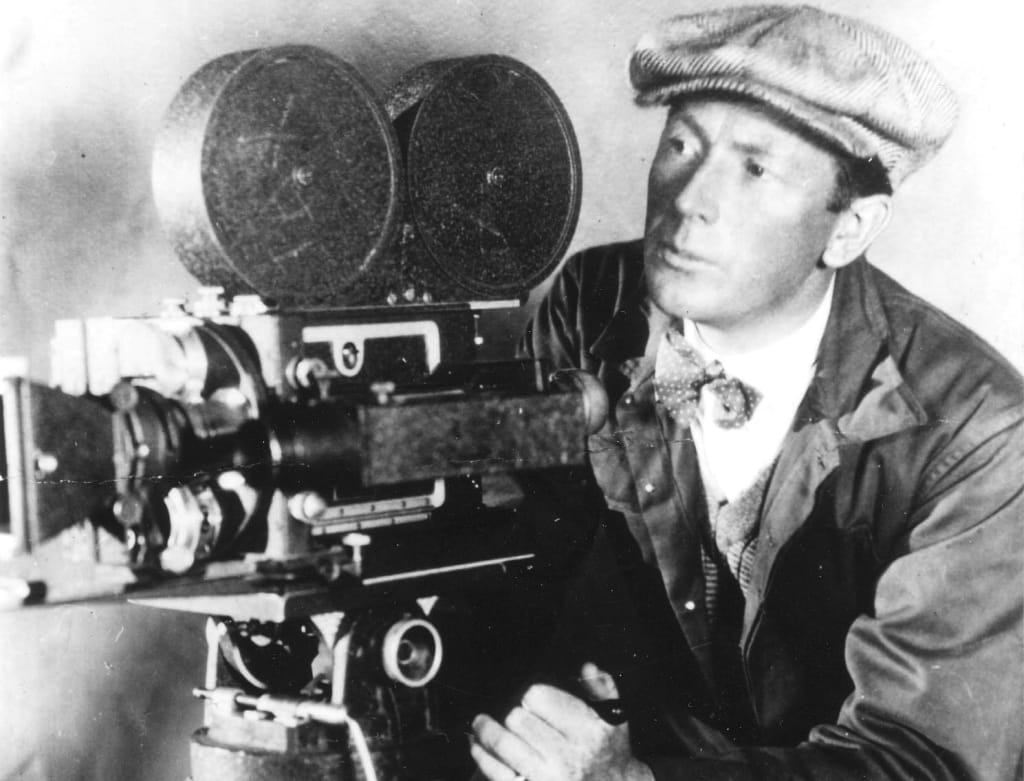
Who Was F.W Murnau?
Born on the 28th of December 1888 in Bielefeld, Germany - F.W Murnau's surname was actually Plumpe. Often called a young dreamer by those around him whilst he was growing up, Murnau developed an interest in German theatre pretty quickly and was recalled as being intelligent, artistic and witty by his brother. (Eisner, 1973). A lot of the life of F.W Murnau is explored well in a book called "Murnau" by Lotte H. Eisner where Eisner writes about how the young Murnau became interested in people like Ibsen and the idea of theatrics. Later on, we can definitely see that Ibsen influenced his future decisions upon films (Eisner, 1973).
Coming from a well-to-do family, his father was a textile manufacturer, providing the whole family with good financial stability for a while. This also provided Murnau with the position to go to university to study Art History. He took up this course at the University of Heidelberg and then at the University of Berlin. He started out as a theatre director afterwards and moved into film later on, inspired by the new way of German art that was about to unfold before him.
Murnau's Cinematic Style & the Development of German Expressionism

F.W Murnau's cinematic style coincided with the development of the German Expressionist Era and its trajectory of being the most incredible cinema age the west had seen as of yet (and even afterwards). After Robert Weine's success with the stunning cinematography of The Cabinet of Dr Caligari (1920), Murnau sought out his own success in Nosferatu (1922). But, before this there were other films for him and these came to shape his style, his method and most importantly, his reputatation as a hard-working and thorough director.
As German Expressionism was developing in theatre as well as in cinema, Murnau took one from the other and made some very successful pieces of art on the early screen. One of the cinematic styles he developed was moving the stage on to the screen. In the film Schloss Vogelöd (1921), he uses the theatre mechanism of drawing rooms for space. The 'drawing room mystery' (Sight and Sound, 2011) film was yet unheard of and had only been seen on stage or in books, Murnau adopts this for the sheer use of space, having actors bustling around and even relaxing, but the very act of people all being that space together gives a sense of claustrophobia and yet, gives everyone there a false sense of security.
This is a technique that would be used again in the film Nosferatu (1922), especially concerning the scenes that are set within the castle. Though there are considerably less people, the feeling is still the same by creating those larger spaces at first and then those smaller ones such as the bedroom.
The psychodrama Phantom (1922) released shortly after Nosferatu (1922) also does a similar thing to present the paranoia of the situation, it sets itself in different spaces and at different levels. Murnau uses this space effectively to convey emotions. This is a theatrical concept which was especially used to stage works by Ibsen and is frequently a feature of the dramatic problem play A Doll's House.
Another feature of Murnau's films is his attention to detail when it comes to how he depicts his material. Formerly only focusing on small time stories, he set out in 1926 to film Goethe's Faust. Being a classic of the German culture, it is said that UFA worked hard to keep the film being directed in the media, the public interest and all around (Kreimeier, 1999). When directing Faust (1926), it is clear that Murnau knows his audience and knows what details they would like to see.
The magic realism of the film is so much more pronounced than we would have initially thought with the de-ageing of the protagonist being a welcomed prospect of the fantasy. When changing settings, Murnau throws out the book from his theatrical career and works entirely on the film, creating quite difficult and complex sets to work with. This makes the film a success. It is a film's film. This marks that transition being complete. He is no longer a theatre director moving into film, he is a film director moving to America.
Nosferatu (1922) and its Impact

Nosferatu (1922) was initially a breach of copyright when F.W Murnau adapted Bram Stoker's Dracula for his film, the Stoker Estate fought back with ferociousness ordering all copies of the film to be destroyed. This cult film eventually made its way into the cinematic underground with a great score. Hans Erdmann, who would go on to do the score for Fritz Lang's The Testament of Dr Mabuse (1933), did the music for the premiere of Nosferatu (1922) and though most of the score is now known to be lost, we are sure it would have been a hit.
The impact would be lasting with the film making its way down the years in surviving prints though a lot of copies were destroyed when the filmmakers were sued by the estate of Stoker. It would then make a ressurgence during the golden age of horror in the 1960s and 70s where Werner Herzog would make his version starring Isabel Adjani. But I think one of the most endearing analyses of what Nosferatu really means to its audience comes from Rogert Ebert's publication The Great Movies in which he details why Nosferatu is continuously popular with every passing year:
Here is the story of Dracula before it was buried alive in clichés, jokes, TV skits, cartoons and more than 30 other films. The film is in awe of its material. It seems to really believe in vampires. ...Is Murnau's Nosferatu scary in the modern sense? Not for me. I admire it more for its artistry and ideas, its atmosphere and images, than for its ability to manipulate my emotions like a skillful modern horror film. It knows none of the later tricks of the trade, like sudden threats that pop in from the side of the screen. But Nosferatu remains effective: It doesn't scare us, but it haunts us (Ebert, 1997)
Nosferatu (1922) became one of the landmarks of horror, but also became one of the most telling films of German Expressionism for anyone studying Murnau. Complete with different lens colours to depict daylight, tension, midnight, the passing evening etc, Murnau was the king of making daylight look like daylight even when filming in black and white. The night-time scenes being shaded with a weird greenish-blue hue upon a blackening background makes it really seem like someone is filming with a night-vision camera and Nosferatu really stands testament to how that transition from black and white to colour was made with the audience having already experienced some colour before.
Apart from this, we have the camera angles which all feel weird and out of place when something big goes down. In that scene where Count Orlok is creeping up the stairs, we see his shadow in full screen, the camera where it is in order to make him look bigger and more imposing. When he appears in the doorway, he fills out the whole doorway and blocks any means of escape for Hutter. Making Count Orlok look as big and imposing and tyrannical as physically possible was definitely on Murnau's mind when filming this symphony of horror.
Conclusion

On March 11th, 1931, F.W Murnau was hitting heights in the USA when his car veered and crashed, resulting in his death at the age of 42 in Santa Barbara, California. He had sustained a terrible head injury which was the immediate cause of death and thus, ended the life of one of the greatest filmmakers to ever live.
But that doesn't mean his legacy ends there. Murnau's famed Nosferatu (1922) is still celebrated all over the film world today with various companies in 2022 celebrating the 100th anniversary of one of the world's first horror movies. It stands with its friends and familiars including The Cabinet of Dr Caligari (1920) by Robert Wiene and The Man Who Laughs (1928) by Paul Leni as one of the great films of the German Expressionist age. Murnau's career, including works apart from the horror classic like Schloss Vogelöd (1921) and the incredible Der Letzte Mann (1924) shows the true extents of his range. They were limitless. Therefore, when you mention Weimar Cinema, you cannot do so without also mentioning the name F.W Murnau.
Works Cited:
- Der Letzte Mann (1924). Directed by F.W Murnau
- Ebert, R. (1997, September 28). Nosferatu Movie Review & Film Summary (1922). RogerEbert.com
- Eisner, L.H. (1973). Murnau. University of California Press
- Ibsen, H. (2016). A Doll's House. Penguin
- Kreimeier, K. (1999). The Ufa Story: A History of Germany's Greatest Film Company, 1918-1945. University of California Press
- Nosferatu.(1922). Directed by F.W. Murnau
- Phantom. (1922). Directed by F.W. Murnau
- Schloss Vogelöd. (1921). Directed by F.W. Murnau.
- "Schloss Vogelöd." Sight & Sound, (October 2011), 89
- The Cabinet of Dr. Caligari. (1920). Directed by Robert Wiene
About the Creator
Annie Kapur
I am:
🙋🏽♀️ Annie
📚 Avid Reader
📝 Reviewer and Commentator
🎓 Post-Grad Millennial (M.A)
***
I have:
📖 280K+ reads on Vocal
🫶🏼 Love for reading & research
🦋/X @AnnieWithBooks
***
🏡 UK
Keep reading
More stories from Annie Kapur and writers in Geeks and other communities.
Book Review: "He Who Whispers" by J.D Carr
"...if you were to attend a dinner of the Murder Club you did not go in by the front door. Instead you went round the corner to the side entrance in Greek Street. Beyond a low door and up a thick-carpeted flight of stairs - according to popular legend, this was once royalty's discreet way of entering - you emerged into an upstairs passage with the doors of private rooms along one side..."
By Annie Kapur2 years ago in Geeks
Silver Screen Magic with Mae West
American actress and singer Mae West became a popular film actress during the Great Depression. She started entertaining in vaudeville, then performed on Broadway, and finally went to Hollywood. She signed up with Paramount Pictures and made her debut in the 1932 film “Night After Night.” She also starred in musicals, comedies, and crime dramas. The American Film Institute named her one of the best classic Hollywood actresses.
By Rasma Raisters8 days ago in Geeks
Kim Kardashian Wears Sheer Leggings as Pants With a $22,000 Jacket and a Polarizing Shoe
The Gist Kim Kardashian stepped out in Los Angeles last week wearing new NikeSkims footwear. The split-toe shoe is based on Nike's Air Rift, which came out in 1996. The NikeSkims Rift Mesh drops on January 26, 2026.
By Dena Falken Esq2 days ago in Geeks
So You Decided To Become a Nurse Practitioner:
So you decided to become an "Advanced Practice" nurse. Congratulations!... is what I would say if this was a good idea. Grad school? In this economy? What were you thinking? Likely it was something along the lines of either 1) “I've seen these other chucklefucks do it— Why can't I?” or even 2) “I've got a nice career, I should shake it up. I miss feeling like I have no clue what I'm doing.”
By Sandor Szabo5 days ago in Fiction


Comments (1)
I wrote a novelization of Nosferatu. I'm almost finished with a short novelization of Dr. Caligari. I'm also working on an adaptation of Metropolis. https://shopping-feedback.today/horror/nosferatu-2z5c090kly%3C/span%3E%3C/span%3E%3C/span%3E%3C/a%3E%3C/p%3E%3C/div%3E%3C/div%3E%3C/div%3E%3Cstyle data-emotion-css="w4qknv-Replies">.css-w4qknv-Replies{display:grid;gap:1.5rem;}