
The Societal Issues of the Weimar Republic (1918-1933) as Reflected in its Cinema
German Expressionism as Metaphor and Prophecy


As discussed in Part 1 of this "series" (sorry for the long break) on the cinema of the Weimar Republic entitled “The Return of the Native Monster” we had a look at how some of the different themes and symbols explored by many German Expressionist films made their way into the post-1960s deluge of horror movies usually nicknamed ‘The Golden Age of Horror’ due to the films being central to the progression of the genre. In this paper we will be looking at the historical implications of the Weimar Republic and how the German Expressionist genre grew out of the issues caused by the societies people lived in. Unlike the detached Hollywood which has no clue as to how real people live, the cinema of the Weimar Republic was carefully interwoven with its public, normally expressing social critiques of the working class through its cinematography, storylines, symbolism and more. In this paper we will be exploring some of the best-known German Expressionist films such as “Nosferatu” (1922) and “The Cabinet of Dr Caligari” (1920), and we will also be looking at lesser known classics such as “The Hands of Orlac” (1924). Alongside all of this, we will also use historical information to show us how German Expressionism ended on a high note in the 1930s roughly a few years before Hitler’s Hollywood in Germany kicked into action and pretty much ruined it for everyone. The high note being how they almost perfectly showed the audiences of today the fears of the post-World War One German people - especially their working class. No matter how many social reforms, combatting crime and welfare systems the government tried to bring in, it was never enough to solve the problem of the lost working class who would, in turn, make up the next ‘lost generation’ born of European instability.
Tyranny
One of the very first and most prominent problems of the Weimar Republic was not just poverty but the tyranny that came along with it. Out of the ashes of the first World War came a horrifying turmoil amongst the working class people of Germany and that was poverty and the tyranny that came along with it. With hyperinflation doing nothing but helping people lose their hard-earned wages quicker, the government snapped into action and Germany was left without industry or progress. This was the German government trying to cover their own heads against the debt placed upon them by the Treaty of Versailles by using the money that rightfully belonged to the people of Germany to pay for reparations they did not even argue against. This debt led to widespread poverty and harsh tyranny from governments in places from small towns to big cities to make sure that though desperation was at an all-time high, crime was also kept at an all-time low. Through the ages of the Kaiser and Hitler, the German people would be used to tyranny after a while, but the cinematic brilliance of the age showed them the real face of tyranny behind the façade of care and culture of every age.
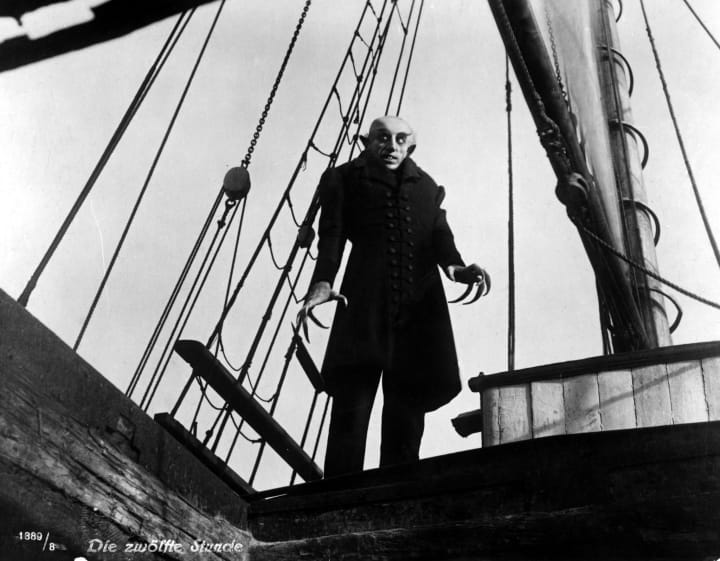
This is probably best put forward in the film “Nosferatu” (1922) where we explore one man (the eponymous protagonist) and his journey to take over through means of force and violence. The entity that is Nosferatu is hard-lined against the working man and his wife, using them to gain power in his own personal way and therefore, access to an entire population that is not his right to have access to. We already know that this film is loosely based upon Bram Stoker’s novel “Dracula” to the point that each copy of “Nosferatu” (1922) was ordered destroyed by Stoker’s estate due to the copyright infringement laws. Thankfully, many of those copies floated about so we could enjoy something worthwhile and Werner Herzog could have a go at his own as well.
One of the key scenes in “Nosferatu” (1922) that explores the theme of tyranny is when the vampiric creature boards a ship in a container so that he may enter the same world as his estate agent and have access to an entirely new set of human beings - most of them unwilling and unknown to him. A reflection of its time, it is a scene that teaches us about the broader concepts plaguing the Weimar Republic, the major one being that the working people were paying for things they were not going to benefit from and, had no idea if these things would do them harm or not. Their money was going unwillingly and unknowingly towards and entity they could not understand as the average person and was only waiting for someone of pure evil to take advantage of the situation. As we now know, we can see that evil was Adolf Hitler.
Therefore, we can say that “Nosferatu” (1922) can seem like a reflection of tyranny in the Weimar Republic whilst also being prophetic of a horrifying future that was almost bound to happen because of the circumstances of abuses of power.
Groupthink
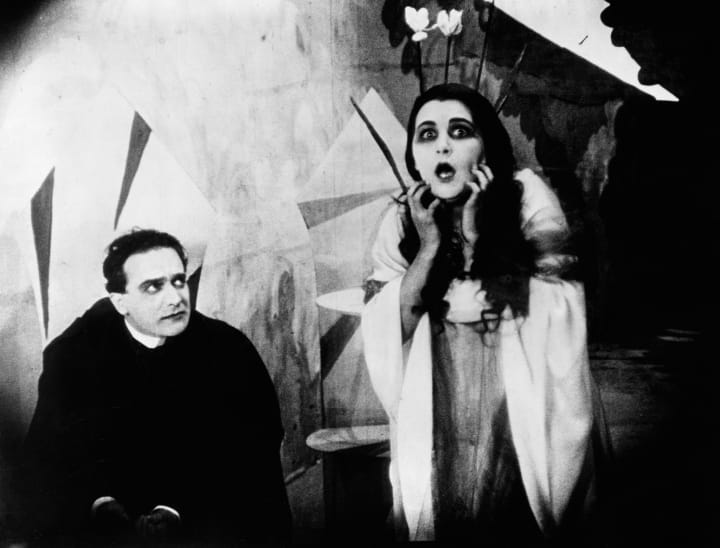
Before George Orwell came out with his prophetic “1984”, there was of course the era of German Expressionism. As we have already explored, German Expressionism was coated in thinly veiled references to the societal problems it was breeding, paving the way for something much more horrifying out of the ashes of the Great Depression. From the term “Groupthink” we can see another societal issue explored in the cinema of this era. “Groupthink” means to all think the same way as if guided by a cult-mentality. Explored via the idea of “Hate Week” when allies and enemies are rearranged to make some new allegiance and through the strangeness of Emmanuel Goldstein, Orwell makes an excellent case for what Groupthink actually is and why we should all be deathly frightened of it. Fortunately enough though, this idea was explored long before the novel in the movie “The Cabinet of Dr Caligari” (1920). A reference to the depression-induced behaviours of the masses, this film explores somnambulism in a new and exciting social critique, shaking the foundations of the mental health crisis which plagued the era.
Even though there was government funding to try to put in place some welfare systems to stabilise this, it still had an issue with largely ignoring those who actually required it. Daily life became a struggle for the masses as the societal changes began to consume themselves. Nobody was agreed upon how this new but broken society should now function in order to fix itself and everyone was relying on someone else to do it. It became a vicious cycle of working people without jobs to being without home, to being without money and ultimately unable to access the very welfare systems put in place to apparently protect them. As Eric D Wietz states in his book "Weimar Germany: Promise and Tragedy":
Weimar Germany conjures up fears of what can happen when there is simply no societal consensus on how to move forward and every minor difference becomes a cause of existential political battles
Out of poverty, desperation and tyranny usually comes some form of mental health crisis whether it is called one or not. It is clear that during the ages of the Weimar Republic and shortly after the first World War, there were masses upon masses of cases of depression whether they were overlooked or explored further. “The Cabinet of Dr Caligari” is rightly set in its twist ending within a mental institution where resides both the main character and the somnambulist, Cesare.
Cesare is one of the most interesting characters in cinematic history. Portrayed by the extremely talented Conrad Veidt, Cesare is a sleepwalker who manages to get up to a fair bit of crime and is constantly under and out of the influence of the malevolent Dr Caligari. I say malevolent because it is clear as to why you would create a somnambulist like this: in order to be malevolent. This is reflected by the way in which the poor masses were kept fighting each other and ignoring the bigger problems of hyperinflation. The realisation then caused the depression and the depression then causes the groupthink through the physical inability to do anything else. It is also known as breaking someone’s spirit so that they do not have the means or ability to react against any rules or forms of government. If this is done on a scale of hundreds of thousands of people, we see that the Weimar Republic became ripe with a form of groupthink-based depression very quickly. The idea of being obedient, almost like sleepwalking, became easier than rebellion. It was not until much later into the 1930s that the Great Depression would hit Germany even harder and that’s when they became so desperate that they turned to the last person anyone would want to turn to. It should show you how desperate they actually were if they trusted a man like Adolf Hitler to lead them.
A scene that shows this perfectly in “The Cabinet of Dr Caligari” (1920) is when Dr Caligari commands Cesare to wake up. As we all know of this iconic scene and how terrifying it actually is when Conrad Veidt, with all of his gothic makeup on, opens his eyes wide at the camera in a close-up shot, we can also see the weirdness of the situation and how it links in with what was actually going on during this time. The immobilisation of soldiers that were once in the army meant that there were potentially hundreds upon thousands of men out there without a job and with a great form of PTSD. These mixtures of extreme levels of depression mixed with the poverty of losing one’s job and also mixed with the ability to follow orders at a great level meant that there were masses of people just ‘going along with it’ as we say. Even though we know of uprisings happening, the waking scene in “The Cabinet of Dr Caligari” was before most of these Putsch eras happened with one of the first taking place in the same year the film was released.
The waking scene is therefore a mixture of solider-like groupthink joined with the inability to rebel due to lack of spirit. The blockades and starvations to Germany made it almost impossible to do so and thus, we learn from this film that the one way to control a population by force is to break its spirit. Rebellions though there were some would prove impossible to bear up against a starving populous without money, ability and though some were awake to it you could say, many were asleep. As Eric D Weitz states about this situation of impossibilities:
“Men stayed in bed for hours on end, or hung around in stairwells and courtyards. “Nothing is urgent anymore; they had forgotten how to hurry.”
Guilt and Monstrosity
Germany became the monsters of Europe almost overnight due to the ending of the First World War. What was to follow? Poverty, desperation, depression, groupthink and even guilt. The idea that Germany now had the inability to do what it did best was something that the world was waiting to see as they fell from grace due to the Treaty of Versailles. Article 231 of the Treaty states this:
"The Allied and Associated Governments affirm and Germany accepts the responsibility of Germany and her allies for causing all the loss and damage to which the Allied and Associated Governments and their nationals have been subjected as a consequence of the war imposed upon them by the aggression of Germany and her allies.”
This means that Germany would sign this and by default, accept responsibility for the war and all of the death and suffering that came out of it. This rippled through to the masses and the working classes, the people’s treatment of not only their others but each other as well. It turned Germany into a land cut off from the rest of Europe emotionally as they, from the inside, looked for another person to blame. Monstrosity comes from guilt of course, but the feeling of being a monster was much greater in those days that actually being one. (Winter, 2014) Yes, we know that Adolf Hitler was a monster, but before that the German people felt like they were the ones to blame for everything that had gone wrong in the first World War because European Law told them they were. Their guilt overrode their purpose and this is where industry begins to shut down due to reparations. The agency of the German people had been thus, taken away. (Simms, 2014)
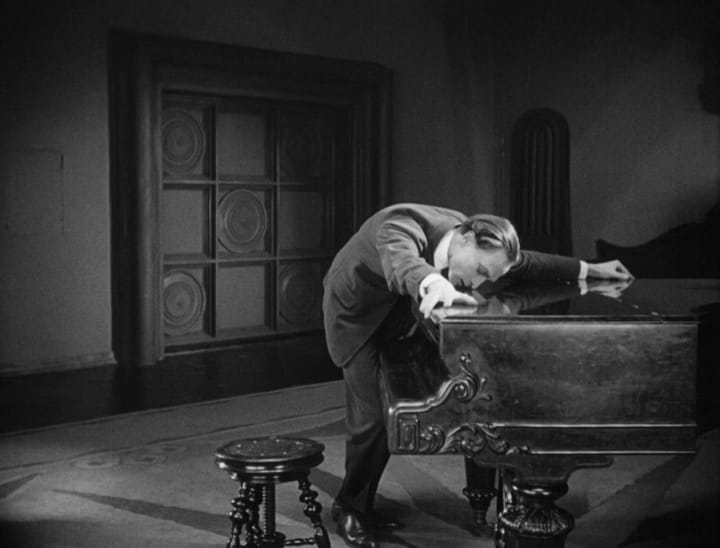
This is explored very well in the film “The Hands of Orlac” (1924) in which a train accident forces a pianist to rethink his life as he loses the use of his hands. Having someone else’s hands sewn on to his, he begins to act differently before realising that these may have been the hands of a murderer. Out of this comes paranoia, discomfort and blame that he cannot take but has forced upon him. Again, Conrad Veidt does a brilliant job at presenting the current fears of the time with the utmost accuracy and the war guilt felt by those who maybe were not even involved remotely rippled throughout the land and caused a widespread reaction of sadness, loss and the feeling that they were the bad guys no matter how much they tried to say that they weren’t.
“The Hand of Orlac” (1924) has a scene which explores this perfectly. We see more than often, Conrad Veidt’s protagonist panic as he stares at his hands in an almost “Macbeth” style, wondering whether anything can wash the guilt from them. These are not his hands of course and there we have a strong metaphor for the misplaced guilt that came about with the Treaty of Versailles. We see the protagonist do whatever he can to learn about the hands, control them and he eventually begins to go mad with possibilities of guilt. Again, a massive extended metaphor for the guilt that was pressed against the people of Germany after World War One, the desperation is almost perfectly depicted by the acting of Conrad Veidt and the cinematography of urgency.
This urgency was obviously a deployment by the allies which unfortunately would bring about horrific after-effects and lead to even greater evils committed that we will not be discussing here. But out of desperation again, people do terrible things that are sometimes not their fault entirely but the faults of those who have shut them in a box without a means to get out. Desperation means that, just like in the film “The Hands of Orlac” (1924), it may not matter who gives you a hand. Again, the guilt metaphor repeats itself in the most prophetic style that is now typical of the German Expressionist era. The Second World War brought about a sadness that the original audience of “The Hands of Orlac” (1924) could have never predicted.
Conclusion
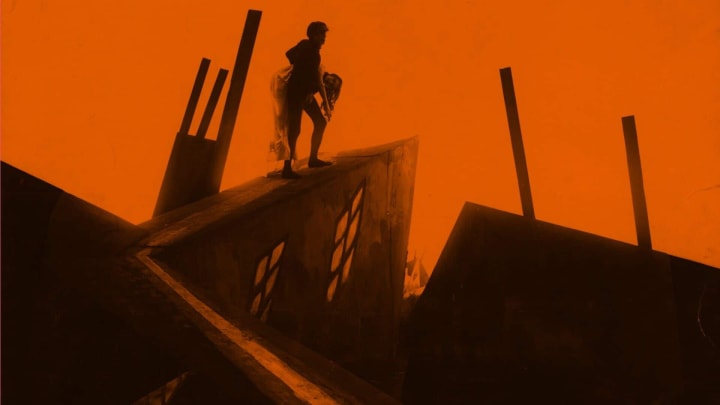
As we see, out of the ashes of the First World War there are moments of absolute desperation and guilt, moments of tyranny which force an entire generation to their knees. We also see that this is repeated ten-fold during the rise of Hitler. The timeless nature of the German Expressionist era is just this, a blend between their own societal worries with a quality which makes them accessible to almost anyone who has experienced social desperation in any way. Mostly born out of war, we can see how they had a knock-on effect to the Golden Age of Horror and even the war films that came out of the close of the Vietnam War - with all their blood and guilt and madness.
As for the reparations, I will leave you with this quotation by John Maynard Keynes. This is where we gather this timelessness of societal issues explored within the German Expressionist movement because not only has every society been there, but this proves that every society must go through it in order for its government to attempt to save itself at the costs of its people:
The war has ended with every one owing every one else immense sums of money. Germany owes a large sum to the Allies, the Allies owe a large sum to Great Britain, and Great Britain owes a large sum to the United States. The holders of war loan in every country are owed a large sum by the States, and the States in its turn is owed a large sum by these and other taxpayers. The whole position is in the highest degree artificial, misleading, and vexatious. We shall never be able to move again, unless we can free our limbs from these paper shackles. (Keynes, 1919)
Works Cited:
- Keynes, J. M. (1919). The Economic Consequences of the Peace. Macmillan.
- Peukert, D. J. K. (1992). The Weimar Republic. Hill and Wang.
- Simms, B. (2014). Against a 'world of enemies': the impact of the First World War on the development of Hitler's ideology. International Affairs, 90(2), 317-336.
- Weitz, E. D. (2007). Weimar Germany: Promise and Tragedy. Princeton University Press.
- Winter, J. (Ed.). (2014). The Cambridge History of the First World War. Cambridge University Press.
Films Cited:
- Murnau, F. W. (1922). Nosferatu. [Film]. Prana Film.
- Wiene, R. (1920). The Cabinet of Dr. Caligari. [Film]. Decla-Bioscop.
- Wiene, R. (1924). The Hands of Orlac. [Film]. Pan Films.
About the Creator
Annie Kapur
I am:
🙋🏽♀️ Annie
📚 Avid Reader
📝 Reviewer and Commentator
🎓 Post-Grad Millennial (M.A)
***
I have:
📖 280K+ reads on Vocal
🫶🏼 Love for reading & research
🦋/X @AnnieWithBooks
***
🏡 UK
Keep reading
More stories from Annie Kapur and writers in Geeks and other communities.
Book Review: "Just Like Home" by Sarah Gailey
At the moment, I am still riding the high of modern horror and in this modern psychological horror, though it did not seem like my thing to begin with, I can definitely tell you that it is really quite good. It may not have been my favourite read of the year, but it definitely was not a bad attempt at new-age horror. It had some qualities of 1970s and 1980s horror paperbacks with an essence of psychological thriller. I enjoyed it, though I would not be looking deeper into something that probably is not there. It was not that scary or that deep, but it is an enjoyable light horror read for anyone looking for some particularly good themes and a readable writing style which is both atmospheric and sensory.
By Annie Kapur2 years ago in Geeks
Silver Screen Magic with Mae West
American actress and singer Mae West became a popular film actress during the Great Depression. She started entertaining in vaudeville, then performed on Broadway, and finally went to Hollywood. She signed up with Paramount Pictures and made her debut in the 1932 film “Night After Night.” She also starred in musicals, comedies, and crime dramas. The American Film Institute named her one of the best classic Hollywood actresses.
By Rasma Raisters7 days ago in Geeks



Comments
There are no comments for this story
Be the first to respond and start the conversation.