
The Return of the Native Monster
The Post-1960s Renaissance of German Expressionist Cinema of the Weimar Republic: Symbolism, Meanings and Manipulations of the Mind.

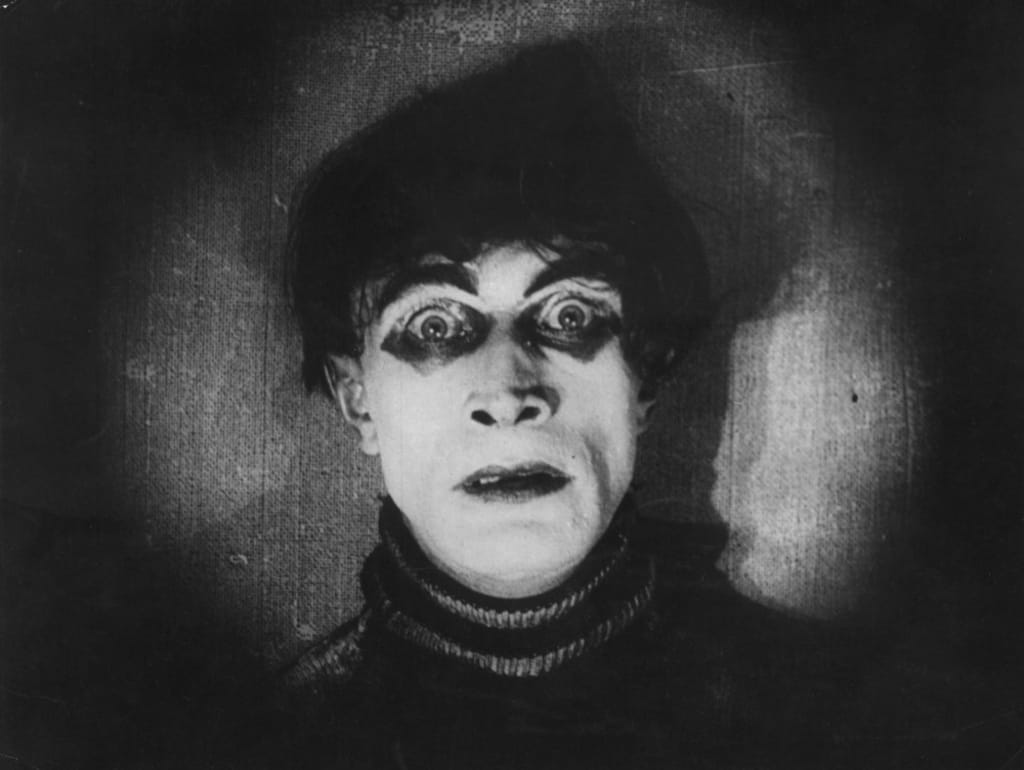
Born out of war and the grim realities of the blame and ideas surrounding paying reparations, Weimar Germany produced some of the greatest horror films in cinematic history. Influential for their use of geometry, monstrosity and their cinema technique, they have been emulated for years after their production with some, such as F.W Murnau’s “Nosferatu” (1922) having been remade by later directors. But, when we look at horror film post-Alfred Hitchcock, we see the very symbols that made Weimar German Horror Films popular, come back into fashion. The reason for this is not just because the films themselves were influential but also because the context of the country that has produced the film is too, in a similar situation between a monarchal rock and governed by a hard place.
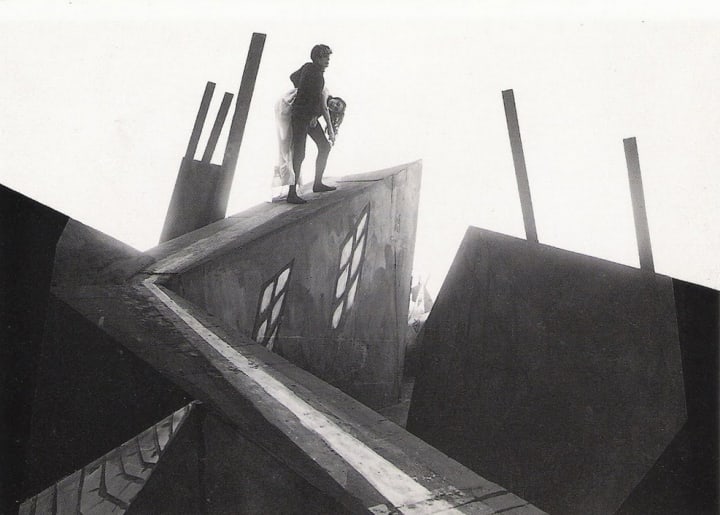
Symbolism was something almost sacred to horror films of the Weimar Republic as a single wrong move could get a film censored, removed or worse, the director would become a pariah in his own home. This is what then resulted in the diaspora of hundreds of German filmmakers and actors to America by the time Adolf Hitler took the stage. So the question here is not ‘why’ are American horror films of the post-1970s using Weimar Republic symbolism in their productions, but rather as to what these symbols actually mean in a different context. This is therefore, the question that primarily this investigation will seek to answer.
Widespread Panic in the Flatlands
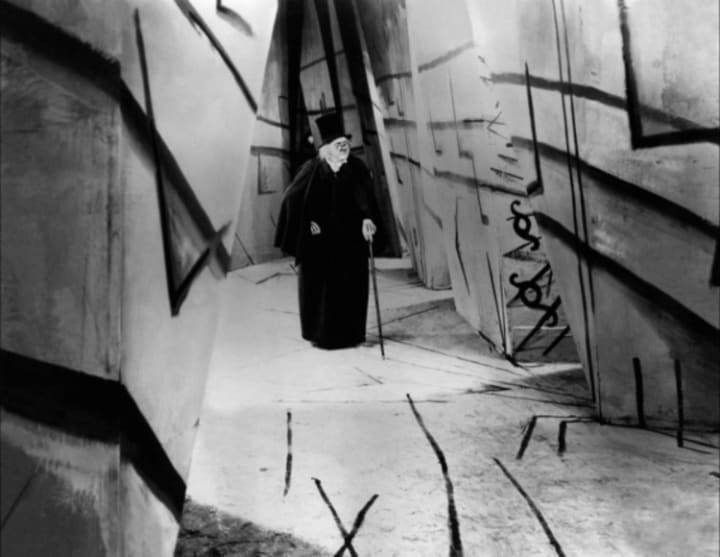
Panic and widespread anxieties are a main theme of many films in 1920s and early 30s Germany and yet, they continue to the modern day as icons of belief. From as early as 1920, the Weimar Republic would show crowd reactions to a monstrosity or an adversary. This ‘crowd theory’ creates a bond with the audience. As an audience, we want to feel as involved with the story as possible and therefore are more likely to tag along with others who are watching this same event from inside the screen.
As for the flatlands, it is very well known that Weimar Cinema did not have the budget yet that American Cinema did and so, had to make do with creating things instead of using technology to do it for them. In the film “The Cabinet of Dr. Caligari” (1920), the importance of the set became better known only after the Americans had started to emulate it. Beforehand, it was Robert Weine’s money-saving scheme and thus shrugged off as ‘amateur’. This, to which the famed comment by Erich Pommer - one of the men working on “The Cabinet of Dr. Caligari” (1920) stated:
“Look here boys, you’re all crazy. It’s impossible to put fantastic, unreal, flat sets behind real, solid people.” (Thomson, 2012, p.57)
But of course it worked as it would be employed later using the strange entities derived from modern technology in films such as “The Texas Chainsaw Massacre” (1974) and “Misery” (1990) in which there is a large set made for the film but, to create the feeling of concentration, only part of it is animated and employed. Just like in “The Cabinet of Dr. Caligari” (1920) where it appears an entire town has been painted across the walls and yet only select few rooms and spaces are used.
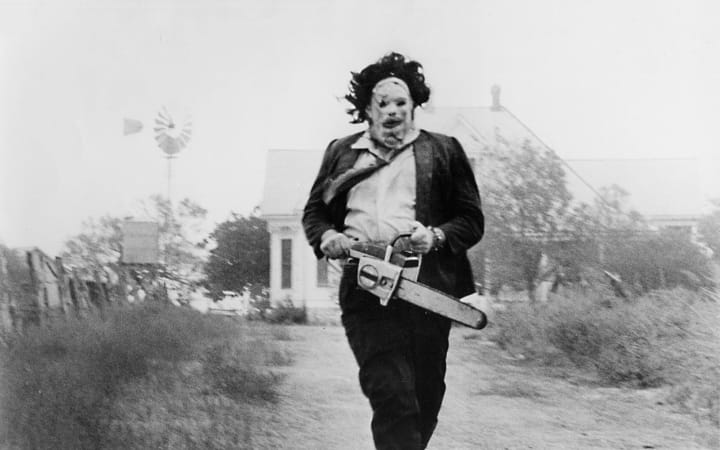
This fused together with the scene from “The Cabinet of Dr. Caligari” (1920) in which the two men attend the fair to see Cesare, the scene from “The Texas Chainsaw Massacre” (1974) where the group of teenagers enters the abandoned house next door to the deranged Leatherface and the scenes from “Misery” (1990) where other people such as the police and Marcia are involved in actions to find Paul Sheldon alive and well represent the constrained panic of each individual film. Other characters that are connected to the danger of the storyline in some way that are put within one of the constrained places creates an induced panic that will have an impact on the audience who want to be more involved in the plot.
There are a number of reasons for this and many of them within the Weimar Republic and the 1970s may be down to the social and historical context of situations concerning race and sexuality. But the main reason for the use of these two very strange symbols is to most likely induce claustrophobia. Even though the scene where the men meet Cesare is set outside in “The Cabinet of Dr. Caligari” (1920), there are far more people in that scene than either of the other two films. This is purely because it is outside and apart from representing the over-population of the country by the end of World War One and therefore the lack of resources in the country - “The Cabinet of Dr. Caligari” (1920) seeks to squash its audience into a tiny space and scare them to death. The grimness of this act reflecting upon the country’s bigger loss.
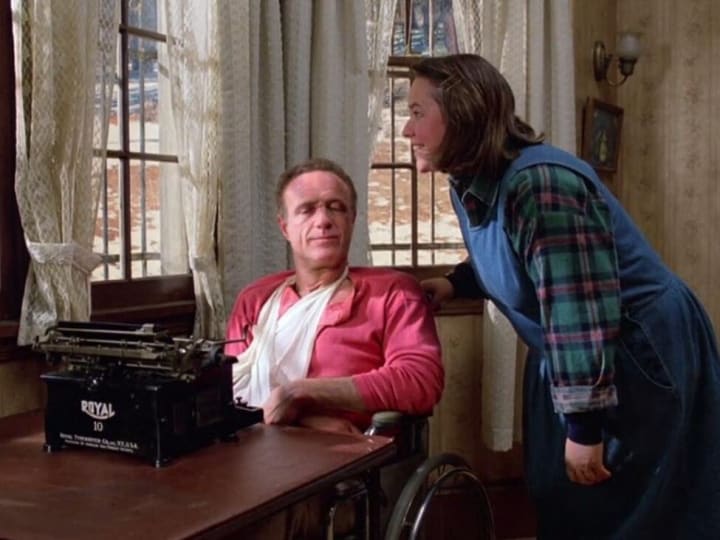
Within the other two movies, we can see that they employ something similar and though they do not have painted walls, the animation of various and most parts of the set is limited or none. There are very specific rooms, spaces and places used whilst everything else is left there to symbolise something. The amount of space in “Misery” (1990) varies in order to depict the situation of the character who has been kidnapped. However, the space in “The Texas Chainsaw Massacre” (1974) is used differently as the outdoor space is limited and less animated than the indoor space which more or less hides the main horror of the film.
Light and Dark

The emulation of light and dark that comes from the world of Weimar Cinema is easy enough to analyse. When we look at the film “Nosferatu” (1922), we can clearly see that the scene in which the Count walks the stairs by artificial light, his shadow splayed on the wall, has been copied ad nauseam by various horror pictures after it. But the way in which light and dark play a more symbolic role into the very heart of the movie is something we have yet to understand. In his seminal work of the late 1920s, Fritz Lang’s “Metropolis” (1927) allows the audience to see a display of symbolic light and dark at work outside the world where we know exactly how light and dark actually works. Lower down into the earth, Fritz Lang uses more and more artificial means of light and dark, the catacombs being the most difficult parts to create this disparity. But within these catacombs, Lang is able to show us the true horrors that lie down there by using infrequent amounts of light and shadowing darkness. Freder, who returns to the darkness of the catacombs is shocked at what he finds and therefore, we could argue that Lang’s use of light and dark impact a character’s understanding of what is real, and what is not. Thea Von Harbou explains it best as she is not only the person who wrote the film, but wrote in that the act of visually exciting light and penetrating darkness were both keys into manipulating the reality of the characters in the story as even the beginnings of the film, in which the titles appear, have been manipulated for the same purpose. (Thomson, 2012, p.61). This manipulation even sought to work on the audience as director Buñuel stated:
“Each powerful flash of steel, every rhythmic succession of wheels, pistons, unknown mechanical forms is a marvellous ode, a new poetry for our eyes...Not a single moment of ecstasy. Even the inter-titles, whether ascending, descending or wandering about the screen, melting into light or dissolving into darkness, join the general movement: they too, become images.” (Thomson, 2012, p.63)
The light and dark manipulated mostly hint at this apocalyptic dread in the minds of the Germans who survived World War One only to be plastered with a horrid fee and the weight of the blame for the war. If we are to look later on into the very same manipulation of light and dark for the very same reasons in horror film we find one of the most obvious films for observing manipulation of human behaviour and reaction: “American Psycho” (2000).
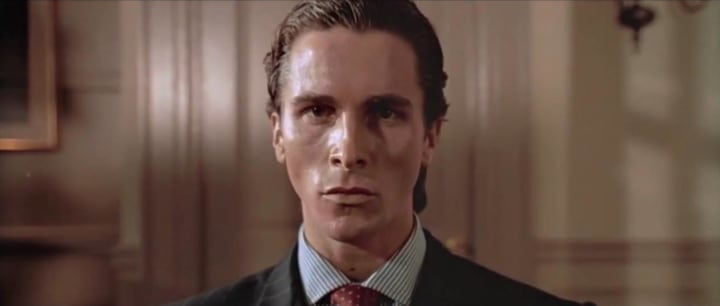
It may not be a metaphor for the turn of events after a war, but the idea of modern panic and anxieties heightened by our own way of life is key to understanding the film “American Psycho” (2000). As in “Metropolis” (1927), the panic ensues by not knowing what is real and what is not and the same can be said for “American Psycho” (2000) that even by the end of the movie, what is real and what is not is still not fully clear. The manipulation of light and dark coming through in this movie as certain, much morally deplorable events take place at night, whereas during the day, there is a facade maintained. Ideas regarding the nyktomorph come to mind when we refer to the self-split of what we see and what we know of the character Maria in “Metropolis” (1927) and the character of Patrick Bateman in “American Psycho” (2000). It is a manipulation not only of light and dark, but of the very nature of human emotions. We, as an audience are drawn into the secrets surrounding the darkness, and yet this means we ignore the secrets hidden in pure daylight or in the bright light sources. It is a deception of the mind that has been created and recreated for almost one hundred years and sees the character ‘trying to act out the archetypal pattern which leads to a happy ending but [is] unable to do so because [they] are egocentric or dark...’ (Booker, 2004, p.368) and this, visually, deceives the audience and leaves us questioning as to what actually happened here.
Kammerspielfilm and the Political Narrative.
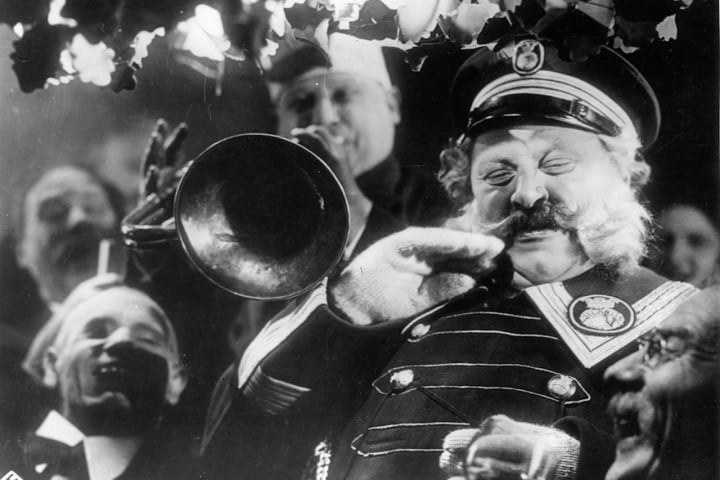
One of the most intelligent means of capturing audience attention in the realm of German Expressionist Horror has been the differentiating and often mistaken Kammerspielfilm and even though these are their own films in their own genre, the directors often used the maxims of this cinematic style to tell the stories of monsters and terrors. Unlike the expressionist films seen normally, the Kammerspielfilm does not use inter-titles or intricate set designs to tell its narrative. The focus on the character’s state of being is the most important as FW Murnau directed “Der Letzte Mann” (The Last Laugh) (1924) in order to be just this. However, one could also argue that his film “Faust” (1926) incorporates similar techniques of the Kammerspielfilm as it too, contains the people of a lower class life, it contains widespread ignorance to newer and changing times, and it contains a narrative that is so well-known that the requirement for inter-titles can be argued against (even though in the majority of cases, “Faust” (1926) contains inter-titles). The narrative of the Kammerspielfilm was widely circulated around the lower class psychological story as it was a direct representative of its cultural maker, the Weimar Republic:
“The state and social institutions especially the armed forces and the judicial system, were deeply resistant to democratic efforts at reform and remained important supports for extreme reaction. The class justice of the Weimar Republic, with its fateful consequences for the political equilibrium of the body politic, has often been described. It is equally important to ask what effects it had on the form, content and daily routine of public life...and on the republic as a cultural project.” (Kreimeier, 1996, p.79)
Focusing on this, we can see that to separate the metaphors expressed within the German Expressionist Film and the very heart of the Kammerspielfilm would be quite wrong as both of them seek to unravel the images of injustice in different ways, by using similar backdrops of the lower class, the forced labourer or the person who is uncomfortable with their position who is practically left out and forgotten or forced again, to work against their will. A theme that is vastly explored in the semi-horror film directed by Francis Ford Coppola, “Apocalypse Now” (1979). The film exploring the body politic of the injustice inflicted upon both sides of the Vietnam War. The psychological nature of the film and the conscription culture pays vast amounts of attention to the fact that it is the working class who will die to save the rich.
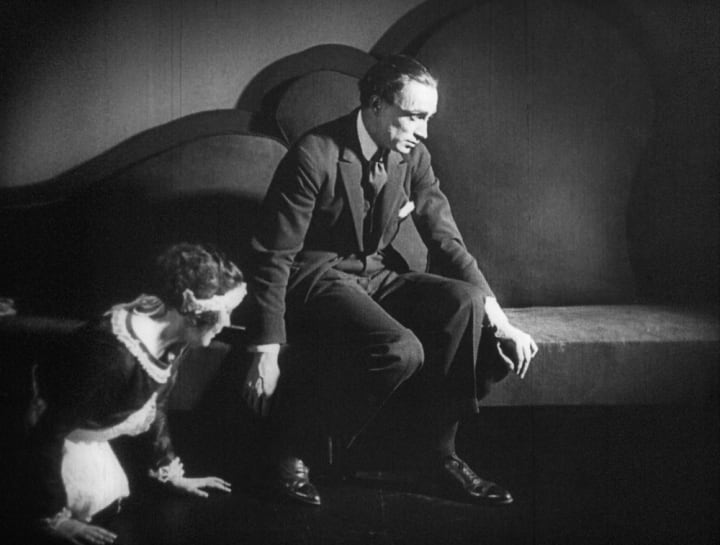
The Weimar Republic as a ‘cultural project’ is an interesting way of looking at the cinema of reaction that came from it. Reactions against class constraints and basic slavery of the mind, body and soul, were common in films such as “The Hands of Orlac” (1924) in which a rich pianist is enslaved by the hands of a probable murderer when he has lost his own. The idea that the soul could be enslaved by something more sinister was viewed in both the emotional state of a character and the physical parts of their being that were ‘lost’ (i.e Orlac’s hands). In the film “Apocalypse Now” (1979), we see this emulated to a greater extent in which gore is a symbolic attribute of war - the bodies are enslaved by conscription and their duty to a country who will leave them to die in another. Therefore, we can definitely argue for the idea that the political narrative concerning the working class or lower class person who must ‘do their duty’ even though their psychological state suggests that this is not a wise idea, the working class person who ultimately must suffer for their politics and the working class person who ultimately dies for their country regardless of their own political pull, are all a part of the same narrative when it comes to the renaissance of the body politic of the Weimar Republic into the the era directly after the horrors of another brutal war - this time, in Vietnam.
Conclusions
In conclusion, there is a clear line between the symbols we see in the cinema of the Weimar Republic and the symbols we see in various films after 1970. The Renaissance of German Expressionist film is not difficult to miss if we are to look at the cultural connections between the times in which the latter films were made and the times in which the Weimar films were made. The fearless condemnation of the very system seeking to impose rules upon the artistic contributions to its country by these cinematic geniuses have come to inspire the very nature and fabric of horror film today. The keys of psychological manipulation in their hands, we are able to look back and trace how they came about through their grim representation of their own dark, foreboding times. It is something that is described so thoroughly in the beginnings of the script to “The Cabinet of Dr. Caligari” (1920) during the process to which we meet the characters who are going to be manipulated by the light and dark, the characters who will be forced to listen against their will and the characters who will ultimately bear the weight of this satanic panic of the 1920s:
“Both the men on the bench are dressed in black, their eyes gape wildly from their pale faces. The older man leans over towards his young companion to speak to him; Francis, apparently not very interested, responds by staring blankly skyward.” (Janowitz and Meyer, 1919, p.1)
Works Cited:
- American Psycho. dir. by Mary Harron. USA: Lions Gate Films.
- Apocalypse Now. dir. by Francis Ford Coppola. USA: United Artists
- Booker, C. (2004). The Seven Basic Plots. UK: Bloomsbury. p.368
- Der Letzte Mann. (1924) dir. by F.W Murnau. Germany: UFA
- Faust. (1926) dir. by F.W Murnau. Germany: UFA
- Janowitz, H. Meyer, C. (1919). The Cabinet of Dr. Caligari: The Screenplay. Germany: Goldwyn Distributing Company. p.1
- Kreimeier, K. (1996). The UFA Story: A History of Germany's Greatest Film Company 1918-1945. USA: Hill and Wang Publishing
- Metropolis. (1927) dir. by Fritz Lang. Germany. Parufamet
- Misery. (1990) dir. by Rob Reiner. USA: Columbia Pictures
- Nosferatu. (1922) dir. by F.W Murnau. Germany. Prana Film.
- The Cabinet of Dr. Caligari. (1920) dir. by Robert Weine. Germany. Goldwyn Distributing Company.
- The Hands of Orlac. (1924). dir. by Robert Weine. Germany and Austria: Pan Film
- The Texas Chainsaw Massacre. (1974) dir. by Tobe Hooper. USA. Bryanston Distributing Company.
- Thomson, D. (2012). “The Big Screen”. UK: Penguin Publishing. p.57 -63
About the Creator
Annie Kapur
I am:
🙋🏽♀️ Annie
📚 Avid Reader
📝 Reviewer and Commentator
🎓 Post-Grad Millennial (M.A)
***
I have:
📖 280K+ reads on Vocal
🫶🏼 Love for reading & research
🦋/X @AnnieWithBooks
***
🏡 UK
Keep reading
More stories from Annie Kapur and writers in Geeks and other communities.
Book Review: "The Devil's Whispers" by Lucas Hault
I have always said that when writing a horror novel, you need to try to make the storyline as simple as possible whilst having on the most important characters named and play a role in the story. This book does just this and it does it quite well. The success of the book truly comes from having a good amount of emotional connection to each character since the narrative shifts around so often. Unfortunately, this is also its undoing as the entire book is written in a series of diary entries by different characters in which the tone becomes so similar from time to time that you more or less lose who is talking and who is telling you which subplot.
By Annie Kapur4 years ago in Geeks
Silver Screen Magic with Mae West
American actress and singer Mae West became a popular film actress during the Great Depression. She started entertaining in vaudeville, then performed on Broadway, and finally went to Hollywood. She signed up with Paramount Pictures and made her debut in the 1932 film “Night After Night.” She also starred in musicals, comedies, and crime dramas. The American Film Institute named her one of the best classic Hollywood actresses.
By Rasma Raisters7 days ago in Geeks
Emma Watson earns British Diversity Awards nod: Event details inside
Emma Watson has been nominated in the upcoming British Diversity Awards 2026, set to take place in March. The prestigious star-studded ceremony aims to honour individuals and organisations contributing significantly to diversity and inclusion in the UK.
By Dena Falken Esqa day ago in Geeks
Wild Card Weekend Recap: What Happens Now?
I think I figured out why I love Wild Card Weekend so much. It's because it's the first playoff anything of the calendar year. The NFL season starts in the fall, and once upon a time, the champion was crowned either on or slightly before New Year's. The evolution of the NFL schedule has resulted in the playoffs starting just into the New Year, and currently, the final week of the season falls on the first weekend of the New Year, with Wild Card Weekend coming a week after that. So yes, chronologically, the NFL's Wild Card Weekend serves as the first playoff anything of the calendar year.
By Clyde E. Dawkins8 days ago in Unbalanced



Comments
There are no comments for this story
Be the first to respond and start the conversation.