space
Space: The Final Frontier. Exploring space developments and theorizing about how humans fit into the universe.
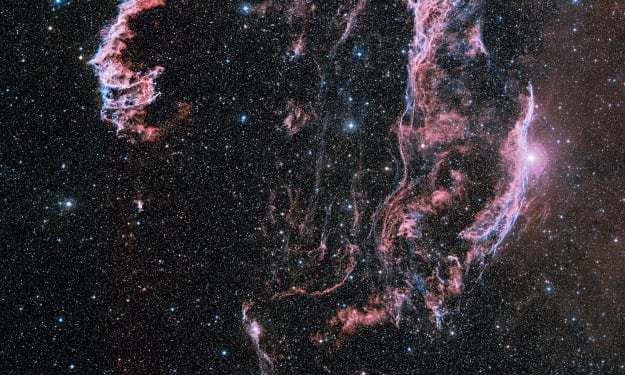
A New Class of Supernovae Discovered: Explosions That Do Not Destroy Their Stars
Astronomers have just announced a discovery that reshapes one of the most fundamental ideas in stellar astrophysics. For decades, a “supernova” meant one thing: the violent death of a star. It was the final, catastrophic event in a massive star’s life cycle—a colossal explosion so intense that, for a few weeks, it can outshine an entire galaxy. Afterward, the star is gone forever, replaced by a neutron star, a black hole, or a rapidly expanding cloud of debris.
By Holianyk Ihorabout a month ago in Futurism
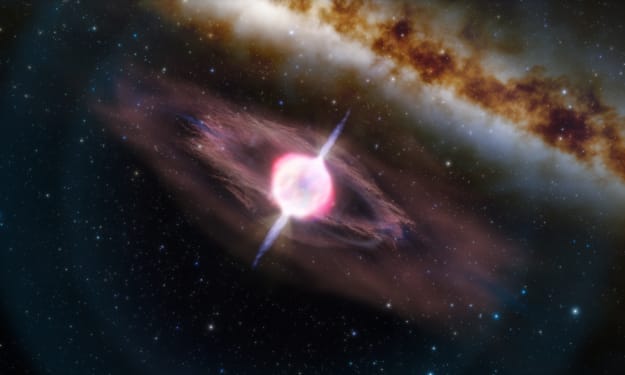
Scientists Spot a “Falling Star” for the First Time — A Stellar Body Collapsing Under Its Own Gravity
Every so often, astronomy delivers a discovery that forces us to rethink what we know about stellar evolution. This time, researchers have identified an extraordinary object they refer to as a “falling star.” It is not falling through space, nor plunging toward another body. Instead, it is collapsing inward — pulled relentlessly by its own gravity. For the first time in history, astronomers have managed to observe a star in the rare, almost impossible-to-catch stage of self-destruction.
By Holianyk Ihorabout a month ago in Futurism
A New Image of Black Hole Magnetic Fields Reveals a Stunning, Ultra-Detailed Structure
For decades, black holes have represented the ultimate frontier of observational astronomy: regions so extreme that even light cannot escape, where physics bends into unfamiliar shapes and our best theories are pushed to their absolute limits. Yet each year, astronomers take one step closer to transforming the unseeable into the observable. The latest achievement is nothing short of astonishing: scientists have produced the most detailed image ever made of the magnetic fields swirling around a supermassive black hole.
By Holianyk Ihorabout a month ago in Futurism
The First Evidence of “Pulsating” Emission from a Black Hole’s Accretion Disk
For decades, astronomers have observed mysterious flickers, flares, and quasi-periodic oscillations coming from black hole systems. These rhythmic bursts of radiation—especially in X-rays—have inspired hundreds of theories but offered few firm answers. Were they turbulence? Magnetic reconnection? Random instabilities? Or something deeper, tied to the very structure of spacetime near a black hole?
By Holianyk Ihorabout a month ago in Futurism
A New Idea Takes Shape: Dark Matter Might Be Superfluid — and Early Observations Are Starting to Hint at It
Every so often, astronomy produces a theory that feels almost too bold to take seriously at first glance. Yet these are precisely the ideas that sometimes transform our understanding of the Universe. One such proposal is now regaining momentum: dark matter, the mysterious substance shaping galaxies and cosmic structures, might not behave like a vast cloud of cold, inert particles after all. Instead, it could enter a superfluid state under the right conditions.
By Holianyk Ihorabout a month ago in Futurism
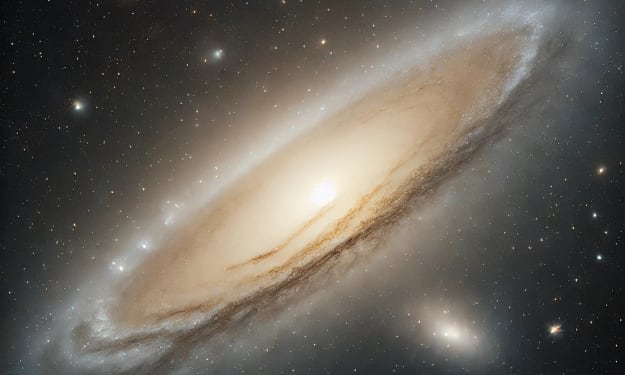
A New Candidate for a Dark-Matter-Free Galaxy — and Why It Challenges Modern Cosmology
For decades, dark matter has been treated as one of the fundamental building blocks of the Universe. According to the dominant ΛCDM (Lambda Cold Dark Matter) model, every galaxy—large or small—should be embedded in a massive halo of invisible, non-luminous matter. This dark halo is not a minor detail; it is a core element of the structure of the cosmos. It dictates how galaxies form, how they rotate, how they merge, and how their stars and clusters behave over billions of years.
By Holianyk Ihorabout a month ago in Futurism
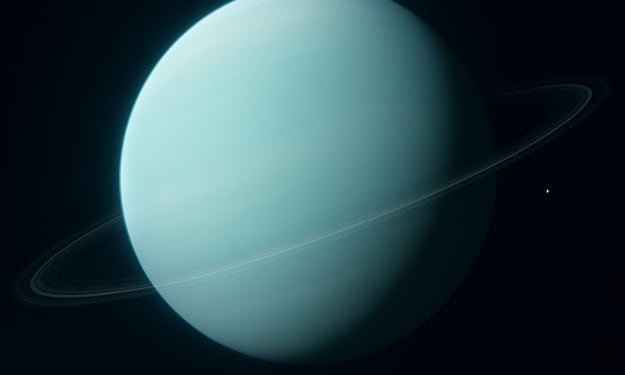
A New World in the Shadows: Uranus Gains a Newly Discovered Moon, S/2025 U1
For decades, Uranus seemed like one of the quietest and least explored giants in our Solar System. Its pale-blue disk, distant and dim, concealed only a modest collection of known moons—until now. In 2025, astronomers announced a remarkable discovery: a previously unseen miniature satellite orbiting Uranus. The moon, currently designated S/2025 U1, is tiny, elusive, and scientifically promising. Despite its minuscule size—no more than 8 to 10 kilometers across—it adds an important new piece to the complex and dynamic architecture of Uranus’s moon system.
By Holianyk Ihorabout a month ago in Futurism
Euclid Has Found Hidden Giant Threads of the Cosmic Web — And They Are Challenging Our Models of the Universe
For decades, cosmologists have suspected that the Universe is woven together by an enormous and invisible scaffold: a vast network of filaments, bridges, knots, and voids known collectively as the cosmic web. This web is not a poetic metaphor. It is the real, physical structure of the cosmos on the largest scales—hundreds of millions of light-years across—shaped by dark matter, threaded by hot gas, and lit here and there by strings of galaxies.
By Holianyk Ihorabout a month ago in Futurism
Space Medicine Aboard the Station: How Astronauts Stay Healthy Beyond Earth
Life on an orbital space station is far more than breathtaking views and scientific breakthroughs. For astronauts, living in microgravity is a full-body experiment—one that never stops. Every minute spent in orbit reshapes the human body, changes how organs function, and challenges the limits of our biology. That’s why space medicine has become one of the most crucial, innovative, and fascinating branches of modern science.
By Holianyk Ihorabout a month ago in Futurism
Sports and Exercise in Space: How Astronauts Stay Fit Beyond Earth
When most people imagine life in space, they picture astronauts floating gracefully in a state of weightlessness, drifting between control panels while gazing at the blue glow of Earth through the station window. But behind these cinematic visuals lies a tough physical reality: the human body is not designed for life without gravity. Muscles shrink, bones weaken, and even the heart begins to lose strength.
By Holianyk Ihorabout a month ago in Futurism
"No pity! No remorse! No fear!”
Trillions of micro-organisms, falling like dust motes, settled over the once bustling Hive City like a slow rolling fog, blurring anything beyond a few skyscrapers into a haze of bleak gray. The scent of mold and dead things, the echoes of what my rebreather missed, filled my nostrils. I tried to get a signal to the marines. Nothing. My arm shook as I tried to broadcast any message, but it was no use. Damn it. The spores must block coms. The scouting party had been split for roughly twelve minutes now. The atmospheric interference was too intense for any chance of rescue, but if I could reach higher ground...
By Chad McBroski2 months ago in Futurism
The Crescent Planet: A World with a Permanent Terminator Line
Imagine a world where the sun never rises and never sets. A world where one hemisphere burns beneath an unmoving star while the other drowns in eternal night. Between them lies a narrow ring of twilight—an endless borderland where day and night touch but never mingle.
By Holianyk Ihor2 months ago in Futurism