
Euclid Has Found Hidden Giant Threads of the Cosmic Web — And They Are Challenging Our Models of the Universe
Space

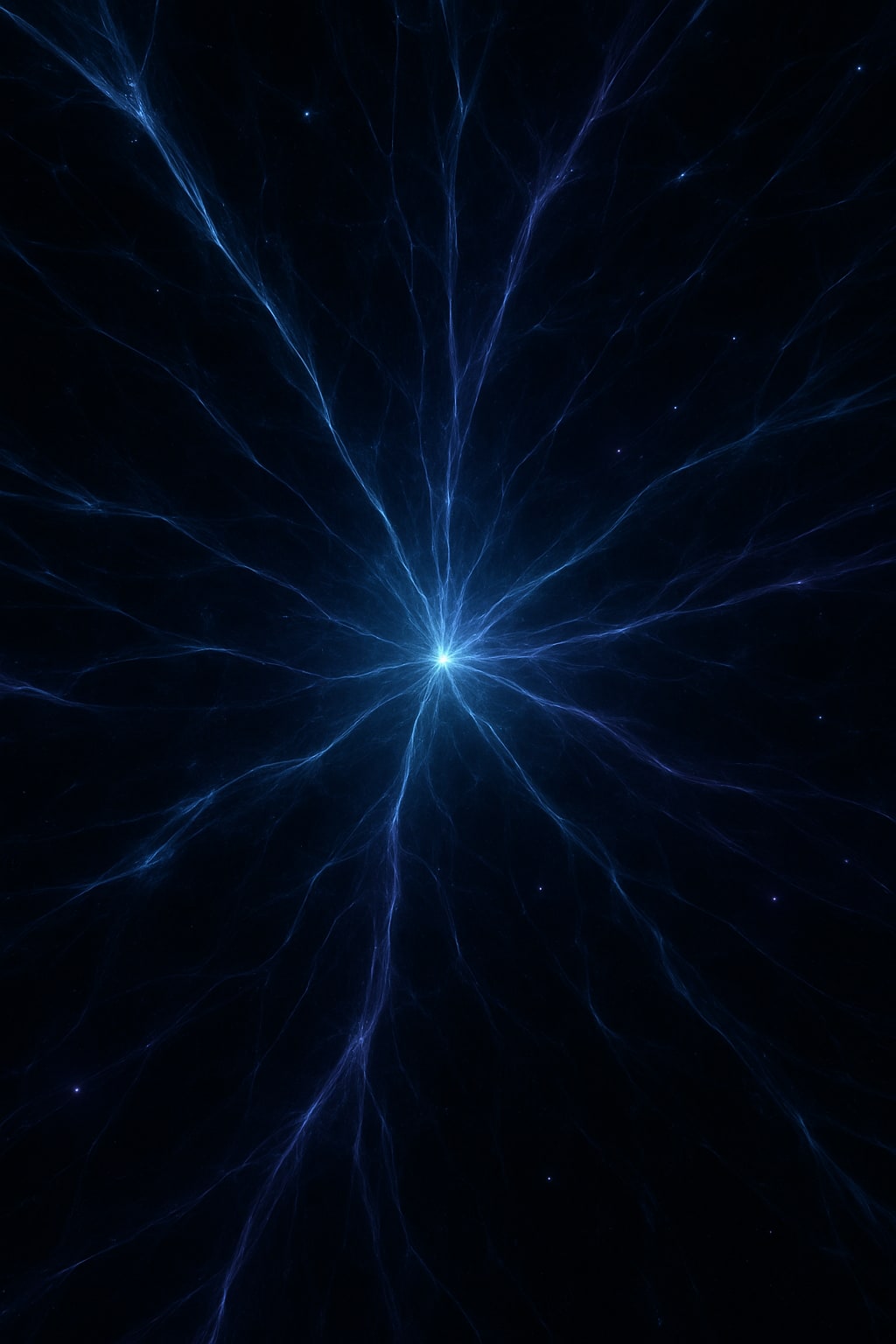
For decades, cosmologists have suspected that the Universe is woven together by an enormous and invisible scaffold: a vast network of filaments, bridges, knots, and voids known collectively as the cosmic web. This web is not a poetic metaphor. It is the real, physical structure of the cosmos on the largest scales—hundreds of millions of light-years across—shaped by dark matter, threaded by hot gas, and lit here and there by strings of galaxies.
Until recently, however, most of this structure remained theoretical. Computer simulations predicted it. Gravity demanded its existence. Observations hinted at it. But direct, large-scale detection of the faint filaments proved nearly impossible. They were simply too diffuse, too cold, or too overshadowed by the bright galaxies near them.
All of that is now changing.
With the launch of the Euclid Space Telescope, a European Space Agency mission designed to map dark matter and dark energy across the sky, astronomers are finally beginning to see the cosmic web not as a theory, but as a real, measurable landscape. And the first discoveries are already shaking up our assumptions about how the Universe formed and evolved.
What the Cosmic Web Really Is
Cosmological simulations dating back to the late twentieth century predicted that, on large scales, matter in the Universe would not be evenly distributed. Instead, under the influence of gravity and dark matter, it would collapse into a network of dense nodes—the galaxy clusters—connected by long, thin filaments that stretch for tens of millions of light-years. Between them lie enormous empty regions called voids.
If you could zoom out far enough, the Milky Way, Andromeda, and even the entire Local Group would look like a single drop of dew clinging to one of these strands.
Scientists have long believed that these filaments hold much of the Universe’s “missing matter”—the baryonic (normal) matter that models predict but telescopes rarely find. But without the ability to observe these threads directly, many questions remained open: How massive are the filaments? How much gas do they contain? Do they influence how galaxies form and grow?
Euclid is now supplying the first concrete answers.
Euclid’s Early Triumphs
In its initial data releases, Euclid has already imaged tens of millions of galaxies, each one serving as a marker that reveals how matter is distributed across the cosmos. Using gravitational lensing—where mass bends the light of background galaxies—scientists can create a 3D map as if the Universe were illuminated by backlights.
One particularly striking early discovery involves a giant filament of hot gas connecting four galaxy clusters within the Shapley Supercluster. This filament spans roughly 23 million light-years and contains more mass than ten Milky Way galaxies combined. It is among the clearest observational proofs that the cosmic web’s largest threads are not merely mathematical predictions but tangible, measurable structures.
Another breakthrough comes from Euclid’s shape-analysis data. Researchers found that galaxies tend to align their axes along the direction of nearby filaments. Heavier, earlier-type galaxies show this trend most strongly. This suggests that a galaxy’s environment—whether it lives in a filament, a node, or a void—plays a crucial role in determining its shape, rotation, growth rate, and even how its stars form.
Why These Discoveries Matter
These findings do far more than simply confirm a long-standing theory. They force a re-examination of several foundational cosmological assumptions.
The Case of the “Missing Matter”
If large quantities of normal matter hide within intergalactic filaments, our previous census of the Universe’s baryonic content must be revised. Models that once assumed a shortfall in observable matter are being recalibrated as astronomers measure how much gas is truly present between galaxies.
Rethinking Galaxy Evolution
Traditional galaxy-formation theories often treat galaxies as relatively isolated systems or focus primarily on interactions within clusters. The new Euclid results demonstrate that galactic properties are strongly tied to their position inside the cosmic web, meaning large-scale topology matters as much as local dynamics.
Testing Dark Matter and Dark Energy Models
The shape of the cosmic web is a direct outcome of the interplay between dark matter and the expansion of the Universe. By mapping billions of galaxies, Euclid provides a powerful test of the standard cosmological model (ΛCDM) and could reveal where the model succeeds—or fails—to describe the structure of the Universe accurately.
What Comes Next
Euclid is only at the beginning of its mission. Over the next several years, it will map over a billion galaxies, charting not just where matter is now, but how its distribution has changed over cosmic time. Combined with data from X-ray, infrared, and radio telescopes, Euclid will help produce the most detailed model of the cosmic web ever constructed.
We may soon understand how and when these colossal filaments formed, how they funnel gas into galaxies, and how they shaped the evolution of the cosmos itself.
A Universe Revealed by Its Skeleton
The emerging picture is stunning: the Universe is not an expanse of isolated islands, but a connected and dynamic architecture. Euclid has begun to reveal this hidden skeleton—a delicate but immense network of matter that underlies everything we see.
And as more data arrives, one thing becomes clear: the cosmic web is not just a structure we are discovering. It is a profound challenge to our understanding of how the Universe works.
In this sense, Euclid is not merely mapping the cosmos—it is rewriting it.
About the Creator
Keep reading
More stories from Holianyk Ihor and writers in Futurism and other communities.
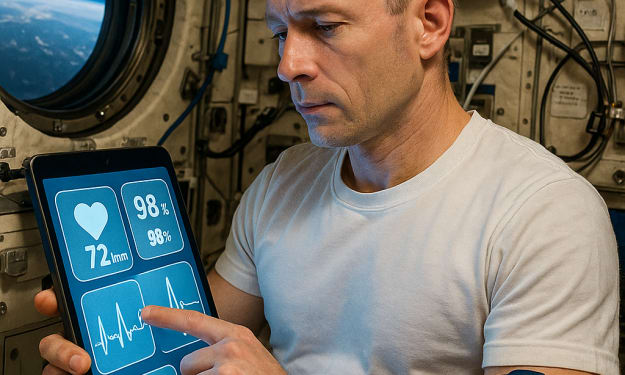
Space Medicine Aboard the Station: How Astronauts Stay Healthy Beyond Earth
Life on an orbital space station is far more than breathtaking views and scientific breakthroughs. For astronauts, living in microgravity is a full-body experiment—one that never stops. Every minute spent in orbit reshapes the human body, changes how organs function, and challenges the limits of our biology. That’s why space medicine has become one of the most crucial, innovative, and fascinating branches of modern science.
By Holianyk Ihorabout a month ago in Futurism
About Binding Prometheus
I want to start actively advocating on behalf of my own work, and the most valuable part of my canon is, without a doubt, Binding Prometheus, the play I have been working on since 2019 and only finished in 2023 as part of my MA. The play itself is an amalgamation of a million different inspirations. On one end, it evokes the Ancient Greek myth-play, deriving its own title from the earliest extant work of Western drama we have, Aeschylus’s Prometheus Bound. On the other end, it borrows significantly from the sci-fi bulwarks from over the years, namely Mary Shelley’s Frankenstein and Karel Capek’s Rossum’s Universal Robots. The play could be an episode of Black Mirror, I fear. I don’t know. I’ve only ever seen one episode of Black Mirror.
By Steven Christopher McKnight11 days ago in Futurism
Telemedicine Market: Remote Healthcare Delivery & Market Momentum
According to IMARC Group's latest research publication, The global telemedicine market size was valued at USD 111.4 Billion in 2025. Looking forward, IMARC Group estimates the market to reach USD 602.1 Billion by 2034, exhibiting a CAGR of 20.62% from 2026-2034
By James Whitman4 days ago in Futurism
Where's the Glory?
In breaking news, rehabilitated Republican Senator Johnnie Johnson (Pronouns: HE, HIM, HIS) called a press conference from the Men’s room of the New Orleans Louis Armstrong International Airport, Concourse B, across from the Ignatius Reilly’s Lucky Dog stand. The Senator had just returned from a sexual reorientation rehabilitation program in Memphis, TN after being publically disgraced at a Buckee’s Truckstop restroom soliciting sex from an undercover cop three months ago. He is a founding member of the Reformed Christians for Christ, a conservative, pro-family and ex-gay advocacy group. In the spirit of being reborn, Senator Johnson invited reporters to marvel at his plans for a major remodeling of airport bathrooms.
By Cathy Schieffelin4 days ago in Humor


Comments
There are no comments for this story
Be the first to respond and start the conversation.