
The Crescent Planet: A World with a Permanent Terminator Line
Space

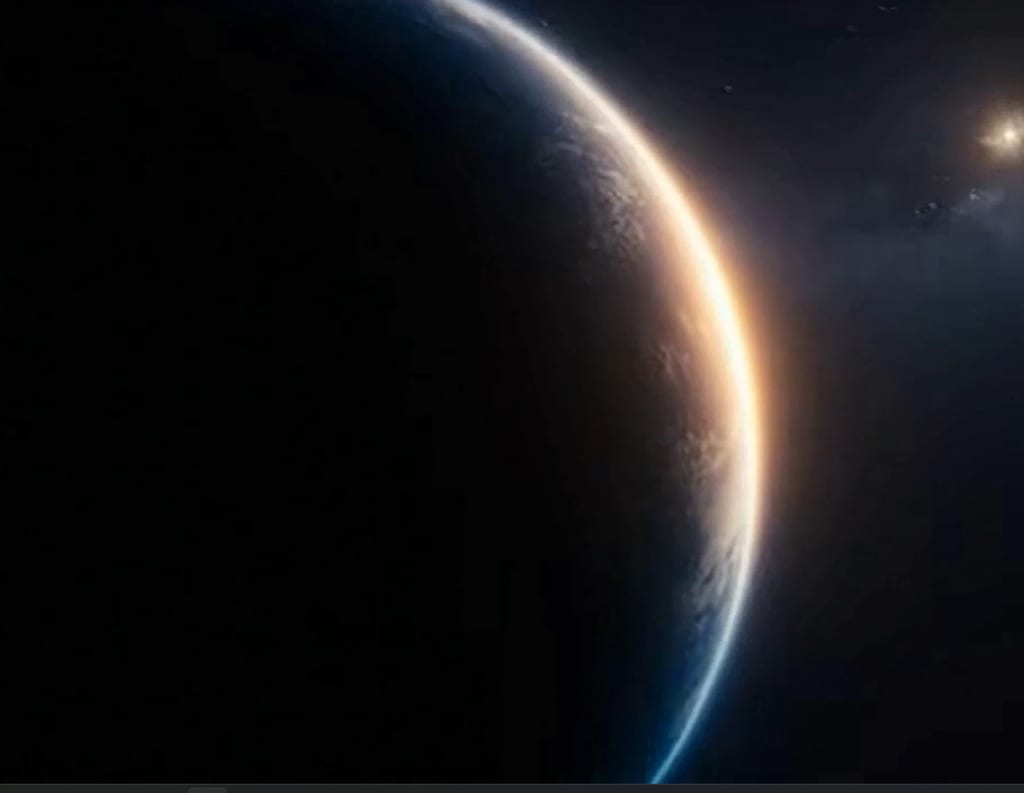
Imagine a world where the sun never rises and never sets. A world where one hemisphere burns beneath an unmoving star while the other drowns in eternal night. Between them lies a narrow ring of twilight—an endless borderland where day and night touch but never mingle.
This is the crescent planet: a tidally locked world whose terminator line never shifts. From space, it is forever a glowing crescent, a thin arc of reflected light etched into a sphere of darkness. Its face never changes. Its day never becomes night. Its night never remembers the sun.
In recent years, astrophysicists have begun to suspect that such planets may be far more common than we once imagined—perhaps even the most typical environments for life around red dwarf stars.
How a planet becomes a permanent crescent
The phenomenon is rooted in tidal locking, a natural process caused by gravitational interaction. It’s the same reason the Moon always shows the same face to Earth. When a planet orbits very close to its star, tidal forces slow its rotation until one side becomes permanently turned toward the star.
From that moment:
- The dayside is stuck in endless daylight.
- The nightside is trapped in perpetual darkness.
- The terminator line—the boundary between light and shadow—stays perfectly still.
- From afar, the world looks like a permanent crescent, its thin sliver of brightness never waxing or waning.
- To an astronomer, it’s like observing a photograph that never changes, no matter how many decades pass.
Three worlds in one
A tidally locked planet is not uniform; it is a triptych of radically different environments.
1. The Dayside: A land beneath a frozen sun
On the dayside, the star hovers motionless in the sky, a blinding white disc that never shifts by a single degree.
Temperatures can reach extremes capable of boiling oceans:
- The ground may turn into glassy deserts of melted rock.
- Winds can whip up colossal storms as superheated air rises continuously beneath the fixed star.
- Water, if it exists, may only survive underground or in sheltered basins protected by geography.
- Imagine living in a place where shadows never move, where noon lasts a thousand years, where the sky is a white-hot furnace dome.
2. The Nightside: A world carved from darkness
Cross into the nightside, and the opposite extreme takes hold. Temperatures plummet until the air itself may freeze out of the atmosphere.
This realm experiences:
- Oceans locked beneath miles of ice
- Landscapes so cold that mountains glitter with atmospheric frost
- Silence so complete that even the wind seems reluctant to enter
If the dayside is a global desert of fire, the nightside is an abyss of ice—quiet, deadly, and beautiful in its stillness.
3. The Terminator Zone: The twilight ring of possibility
Then there is the terminator zone—the narrow band where day and night collide. Here, the temperature may stabilize into something Earth-like. Water could exist as liquid. Clouds may drift in the dim light of an eternal sunset.
Some climate models even suggest this region could be the most habitable part of the planet, as thermal winds constantly redistribute heat between hemispheres. Life, if it emerges here, would evolve under skies painted with permanent twilight.
Imagine a world where the star forever clings to the horizon, glowing like an orange ember. Shadows stretch endlessly. Nothing ever changes position in the sky—not the constellations, not the sun, not even the glow of the dayside storms far in the distance.
A planet that looks the same for centuries
To us, watching from our solar system, a tidally locked exoplanet would appear as a crescent that never shifts its phase. Venus, for example, changes from a crescent to a gibbous as it orbits the Sun. But a tidally locked planet around another star would show the same thin shape year after year.
Telescopes would observe:
- The same illuminated arc
- The same dark hemisphere
- The same atmosphere shimmering at the edges
Even over a human lifetime, it would look eerily unchanging—like a cosmic sculpture rather than a living world.
Could life exist on a crescent planet?
Possibly—and perhaps even more easily than we might expect.
Astrobiologists propose two main habitats:
- Life in the Terminator Ring
The terminator zone could host Earth-like conditions:
- Liquid water
- Moderate temperatures
- Stable climate
Organisms might evolve under dim light, relying on biochemistry optimized for perpetual dusk. Plants or plant-like organisms might develop dark pigments to catch faint rays from the low-hanging star.
Life Underground on the Dayside
Even the scorched dayside could hide life below the surface, protected from harsh radiation and temperature extremes. Subsurface aquifers warmed by geothermal energy might support microbial ecosystems—much like extremophile communities on Earth.
Life in the Nightside Oceans
If geothermal heat keeps parts of the nightside ocean liquid beneath the ice, entire ecosystems could thrive in the darkness, similar to Earth’s deep-sea vent communities.
A crescent planet could therefore host three entirely different biospheres, each adapted to its region’s unique challenge.
Why these worlds matter
Most potentially habitable exoplanets discovered around red dwarf stars are expected to be tidally locked. This means crescent worlds may not be rare oddities—they may be among the most common abodes of life in the universe.
Understanding them helps scientists:
- Model alien climates
- Predict atmospheric signatures
- Interpret telescope data
- Infer where life could realistically form
And it expands our imagination beyond Earth’s familiar day–night cycle.
A universe of twilight worlds
The crescent planet represents one of the most hauntingly beautiful possibilities in planetary science: a world where extremes of light and dark meet at a thin line of everlasting dusk.
To live there would be to stand on a cosmic border forever balanced between fire and ice. To observe it would be to witness a celestial crescent frozen in time.
In the vastness of space, such twilight worlds may be far more common than we once believed—silent crescents orbiting distant suns, waiting for us to find them.
About the Creator
Keep reading
More stories from Holianyk Ihor and writers in Futurism and other communities.
How Planetary Defense Works: The Modern Methods Behind Tracking Asteroids
When we look up at the night sky, it often appears calm, steady, and predictable. But beyond that serene view lies a dynamic neighborhood of drifting rocks, icy remnants, and fast-moving objects. Among them are asteroids—cosmic leftovers from the early Solar System that occasionally wander a little too close to Earth.
By Holianyk Ihor2 months ago in Futurism
About Binding Prometheus
I want to start actively advocating on behalf of my own work, and the most valuable part of my canon is, without a doubt, Binding Prometheus, the play I have been working on since 2019 and only finished in 2023 as part of my MA. The play itself is an amalgamation of a million different inspirations. On one end, it evokes the Ancient Greek myth-play, deriving its own title from the earliest extant work of Western drama we have, Aeschylus’s Prometheus Bound. On the other end, it borrows significantly from the sci-fi bulwarks from over the years, namely Mary Shelley’s Frankenstein and Karel Capek’s Rossum’s Universal Robots. The play could be an episode of Black Mirror, I fear. I don’t know. I’ve only ever seen one episode of Black Mirror.
By Steven Christopher McKnight10 days ago in Futurism
Australia Industrial Drying Equipment Market: Smart Manufacturing, Energy Efficiency & Future-Ready Processing
In 2024, Australia industrial drying equipment market reached USD 48.80 Million. Looking ahead, the market is expected to expand steadily to USD 85.07 Million by 2033, exhibiting a compound annual growth rate (CAGR) of 6.37% during 2025–2033.
By Kevin Cooper3 days ago in Futurism


Comments
There are no comments for this story
Be the first to respond and start the conversation.