
A New Candidate for a Dark-Matter-Free Galaxy — and Why It Challenges Modern Cosmology
Space

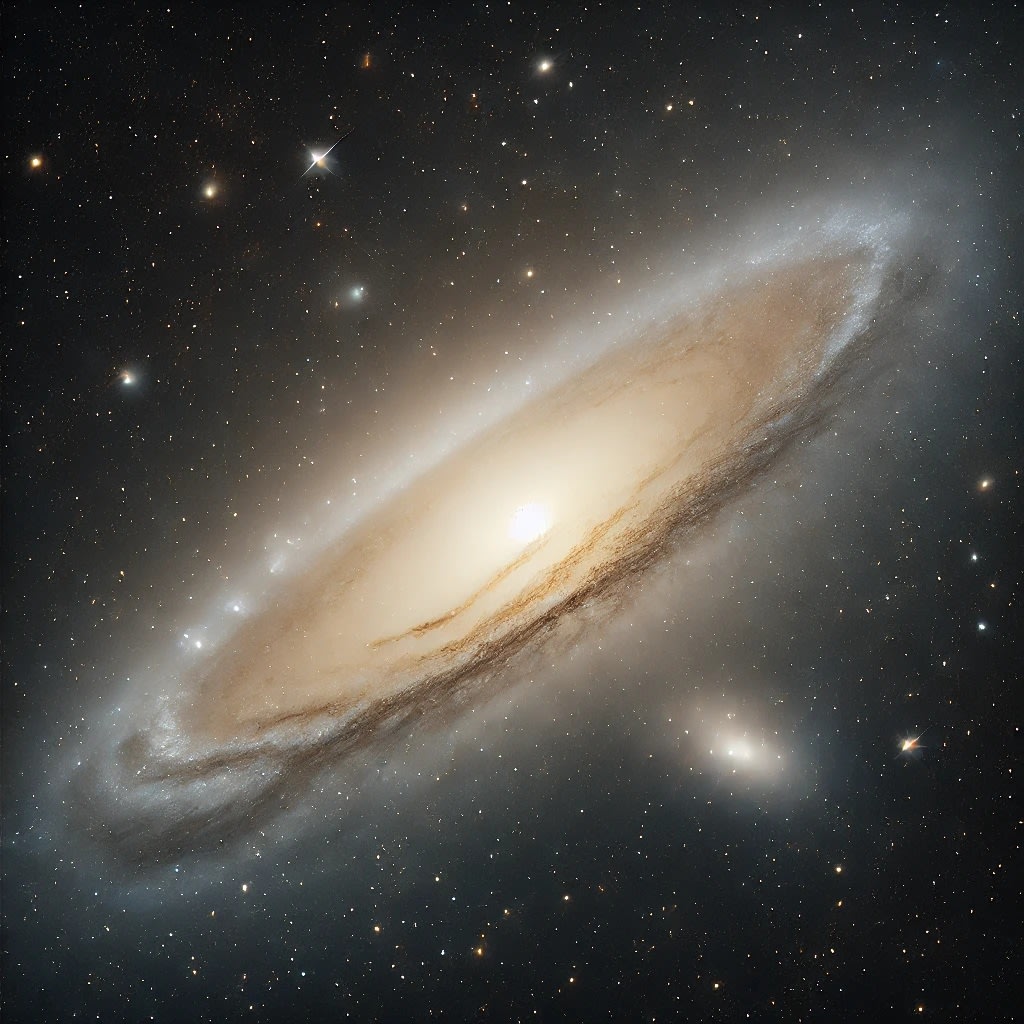
For decades, dark matter has been treated as one of the fundamental building blocks of the Universe. According to the dominant ΛCDM (Lambda Cold Dark Matter) model, every galaxy—large or small—should be embedded in a massive halo of invisible, non-luminous matter. This dark halo is not a minor detail; it is a core element of the structure of the cosmos. It dictates how galaxies form, how they rotate, how they merge, and how their stars and clusters behave over billions of years.
But every so often, the Universe surprises us. Recently, a new object, FCC 224, has emerged as a striking candidate for a galaxy that appears to lack dark matter almost entirely. If confirmed, this discovery would be more than a scientific curiosity. It would pose significant questions about how galaxies actually form—and whether our understanding of gravity and the dark cosmos is as robust as we believe.
FCC 224: A Silent Rebel in a Dark-Dominated Universe
FCC 224 is not a tiny dwarf galaxy or a loosely bound cloud of stars; it is a legitimate massive galaxy, one that should, by all conventional models, require a large reservoir of dark matter to hold itself together. Yet its behavior tells a different story.
Researchers analyzed the motion of its globular clusters—ancient, compact spheres of stars that orbit their host galaxy much like moons orbit a planet. These clusters act as excellent dynamical test particles. Their speeds, orbital distributions, and overall kinematics can reveal the gravitational landscape of the galaxy they inhabit.
In the case of FCC 224, the clusters move far more slowly and predictably than they should if an extensive dark matter halo were present. When scientists calculate the galaxy’s mass based on this orbital data, the result is startlingly low. Essentially, the visible matter—its stars—accounts for nearly all of its gravitational pull.
Even more intriguing, the galaxy shows no signs of having been violently stripped of its dark matter. Normally, if a galaxy passes through a larger neighbor or undergoes a major tidal interaction, gravitational forces can tear away part of its dark halo. However, analysts saw no evidence for such disruption. FCC 224 appears calm, stable, and structurally intact.
That leaves two possibilities:
- It formed without a substantial dark matter halo, or
- It underwent some type of evolution that current models cannot explain.
Neither conclusion fits comfortably within the standard cosmological framework.
Why a Galaxy Without Dark Matter Is a Big Problem
Dark matter is not an optional ingredient in ΛCDM. It is the scaffolding of the cosmos. Without it, simulations of galaxy formation fail to produce objects that look like the galaxies we observe today. Spiral galaxies would fly apart under their own rotation. Galaxy clusters would disperse. Even the large-scale structure of the Universe—the cosmic web of filaments and nodes stretching billions of light-years—depends on dark matter to take shape.
So when astronomers find a galaxy that apparently lacks dark matter, the implications cascade through several levels of theory.
1. It challenges models of galaxy formation
Galaxies are thought to form inside dark matter “wells,” where gas cools and collapses into stars. Without that initial well, how do you get a stable galaxy of this size? What mechanism could gather enough baryonic matter without the gravitational assistance of a massive invisible halo?
2. It raises questions about the behavior of dark matter itself
Is dark matter distributed more heterogeneously than we assumed? Could certain galactic environments suppress its presence? Or could dark matter interact in ways that allow it to be displaced more easily than current theory predicts?
3. It forces reconsideration of alternative physics
For decades, a minority of theorists have argued that perhaps dark matter does not exist at all, and that the anomalies we attribute to it are signs of modified gravitational laws. These models—ranging from MOND-like frameworks to new proposals involving evolving fundamental forces—usually struggle to match the full suite of cosmological observations. But dark-matter-free galaxies give these alternatives new ammunition.
Not the First Case—But the Most Compelling?
FCC 224 is not the first galaxy suspected of being dark-matter-poor. NGC 1052-DF2, NGC 1277, and several other candidates have made headlines over the past decade. But each had complications: disputed distances, uncertain mass estimates, or signs of gravitational stripping.
FCC 224 stands out because the evidence comes not from its stars but from its globular clusters—objects whose dynamics are typically more reliable and easier to model. If future observations confirm the lack of a dark halo, FCC 224 may become the clearest example yet of a galaxy that seems to defy the ΛCDM blueprint.
The Road Ahead
Astronomers will need deeper measurements and more independent analyses before declaring the case closed. Additional data on its stellar motions, high-resolution mapping of its structure, and gravitational-lensing studies could all help answer the central question: Is FCC 224 a rare anomaly, or a sign that our understanding of the Universe needs revision?
If more galaxies like this emerge, the implications could reshape cosmology. Whether that means modifying ΛCDM, rethinking galaxy formation, or even changing our understanding of gravity, one thing is certain: FCC 224 has already begun to provoke one of the most intriguing scientific debates of the decade.
About the Creator
Keep reading
More stories from Holianyk Ihor and writers in Futurism and other communities.
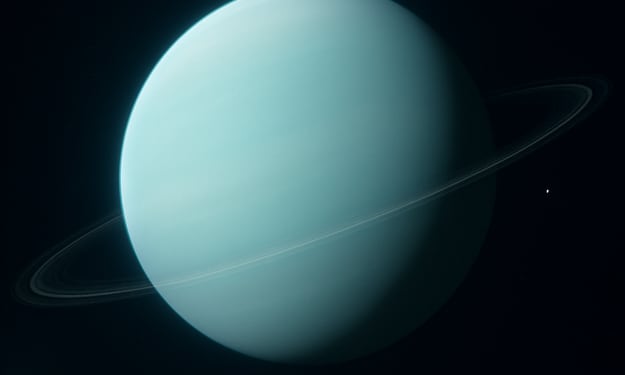
A New World in the Shadows: Uranus Gains a Newly Discovered Moon, S/2025 U1
For decades, Uranus seemed like one of the quietest and least explored giants in our Solar System. Its pale-blue disk, distant and dim, concealed only a modest collection of known moons—until now. In 2025, astronomers announced a remarkable discovery: a previously unseen miniature satellite orbiting Uranus. The moon, currently designated S/2025 U1, is tiny, elusive, and scientifically promising. Despite its minuscule size—no more than 8 to 10 kilometers across—it adds an important new piece to the complex and dynamic architecture of Uranus’s moon system.
By Holianyk Ihorabout a month ago in Futurism
About Binding Prometheus
I want to start actively advocating on behalf of my own work, and the most valuable part of my canon is, without a doubt, Binding Prometheus, the play I have been working on since 2019 and only finished in 2023 as part of my MA. The play itself is an amalgamation of a million different inspirations. On one end, it evokes the Ancient Greek myth-play, deriving its own title from the earliest extant work of Western drama we have, Aeschylus’s Prometheus Bound. On the other end, it borrows significantly from the sci-fi bulwarks from over the years, namely Mary Shelley’s Frankenstein and Karel Capek’s Rossum’s Universal Robots. The play could be an episode of Black Mirror, I fear. I don’t know. I’ve only ever seen one episode of Black Mirror.
By Steven Christopher McKnight11 days ago in Futurism
Carbon Black Market: Tire Manufacturing Demand, Capacity Expansion & Market Outlook
According to IMARC Group's latest research publication, global carbon black market size was valued at USD 17.9 Billion in 2024. Looking forward, IMARC Group expects the market to reach USD 25.4 Billion by 2033, exhibiting a growth rate of 3.57% during 2025-2033.
By Suhaira Yusuf4 days ago in Futurism
Let's Don't Do This
"I just can't do this anymore..." "Do what?" What can't you do? Put gas in your own car? I swear to God you make me take care of everything, don't you? You know I'm on my way to work right now but that never stops you from bothering me, does it?"
By Shirley Belk6 days ago in Fiction



Comments (1)
Modern Cosmology is wrong about galaxy evolution. All the stars in all the spiral galaxies are not orbiting their centers, they are all spiraling INTO their centers. This is why all the Milky Way stars travel at the same speed, not because of Dark Matter. There was no Big Bang. The centers of galaxies are eternal, only the matter spiraling inward is less than 14 billion years old. The centers feed on the inbound material, and eject elementary particles back into space; a perpetual cycle of creation and destruction. Unfortunately, we are at the destruction end of the cycle. Global Warming is not anthropogenic, it's a direct result of increasing proximity to the center of the Milky Way. Sea level rising isn't the problem - the entire ocean is rising up. Once the polar ice caps disappear, the oceans will quickly become too warm to remain liquid. Modern Cosmology is making their observations fit their theory. That's poor science. One hundred years of Science trying to prove Einstein correct is going to cost Mankind it's very existence.