
A New Image of Black Hole Magnetic Fields Reveals a Stunning, Ultra-Detailed Structure
Space

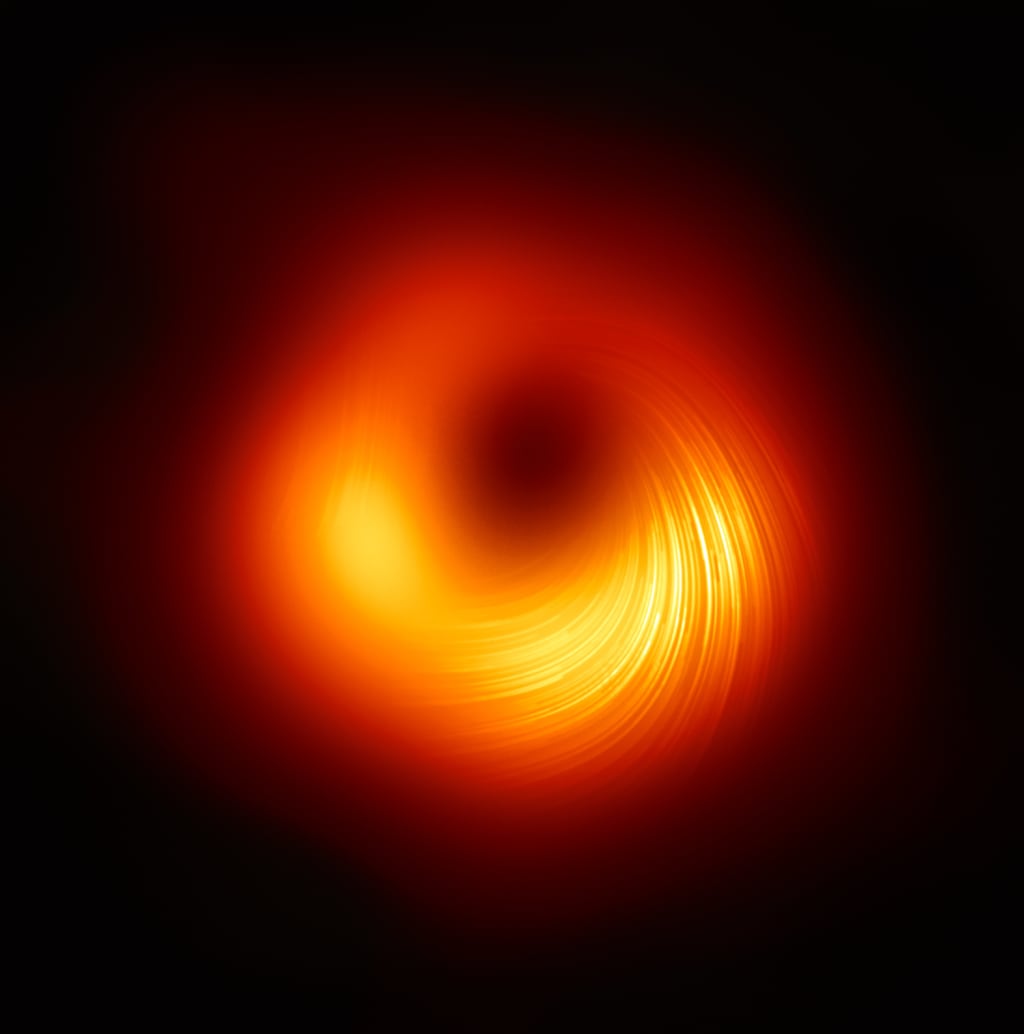
For decades, black holes have represented the ultimate frontier of observational astronomy: regions so extreme that even light cannot escape, where physics bends into unfamiliar shapes and our best theories are pushed to their absolute limits. Yet each year, astronomers take one step closer to transforming the unseeable into the observable. The latest achievement is nothing short of astonishing: scientists have produced the most detailed image ever made of the magnetic fields swirling around a supermassive black hole.
Captured with the Event Horizon Telescope (EHT), a global array of synchronized radio observatories, this new view reveals a surprisingly ordered and intricate structure—an almost sculptural pattern of twisting loops, spiraling filaments, and luminous ribbons of polarized light. Far from the chaotic maelstrom once imagined, the magnetic environment near the event horizon appears organized, dynamic, and critically important to the physics that governs black hole behavior.
How Astronomers Imaged Something Invisible
Magnetic fields themselves cannot be photographed. They do not emit light, and they do not reflect it. But the plasma surrounding a black hole—gas heated to billions of degrees and accelerated to nearly the speed of light—does emit a type of radiation astronomers can decode. As electrons spiral along magnetic field lines, they produce polarized synchrotron radiation. The orientation of that polarization acts like a tracer, revealing the structure of the underlying magnetic fields.
The EHT works by linking telescopes across Earth into a single, planet-sized interferometer. This configuration achieves an angular resolution so fine that it could theoretically read a newspaper on the Moon from Earth. For the new magnetic-field image, researchers combined improved algorithms, new observatory stations, and far more sensitive polarization calibration than in earlier EHT releases. The result is a coherent map of magnetic patterns—on the exact scale of the black hole’s event horizon.
What the New Image Shows
Far more than a “pretty picture,” the visualization reveals several key structures:
- A Toroidal Magnetic Skeleton
The dominant component of the field wraps around the black hole in a broad, circular pattern. This toroidal structure suggests an accretion flow that is comparatively stable, with magnetic pressure acting as a framework that shapes how plasma moves inward.
- Spiral and Vertical Filaments
Superimposed upon the torus are delicate spiral strands—like magnetic braids—and vertical streaks that point toward the rotation axis. These features are signatures of energy transport and may help regulate how angular momentum is removed from the accretion disk.
- The Likely Launch Zone of the Black Hole Jet
Near the axis of rotation, the fields become straighter and more focused, like stretched wires. This configuration aligns perfectly with theoretical models of the Blandford–Znajek mechanism, in which a spinning black hole transfers energy into a tightly collimated, relativistic jet. This is the first time we have observed structures consistent with this mechanism at such proximity to the event horizon.
- Unexpected Order
Perhaps the most striking discovery is the degree of organization. Instead of turbulence dominating the picture, the magnetic fields appear coherent and stable over vast scales relative to the black hole itself. High magnetic field strength may play a much greater role in shaping the accretion flow than previously believed.
Why This Discovery Matters
- Testing General Relativity in Extremes
Every new observation of a black hole is an opportunity to test Einstein’s theory under the most extreme conditions known. The new polarization data offer additional, independent parameters—such as field geometry and plasma behavior—that researchers can compare directly with simulations of general-relativistic magnetohydrodynamics (GRMHD). These comparisons refine our understanding of how spacetime behaves when gravity becomes overwhelming.
- Understanding Why Some Black Holes Launch Jets
Astrophysicists have long struggled to explain why some supermassive black holes produce powerful jets that stretch thousands of light-years, while others remain comparatively quiet. The new magnetic-field map reveals where and how jets may be initiated, providing crucial constraints for jet-formation theories. If magnetic fields act as the “wiring” that channels rotational energy out of the black hole, then imaging those fields is the equivalent of watching a cosmic engine in motion.
- A Better Picture of Accretion Physics
Accretion disks evolve based on how efficiently they shed angular momentum. Magnetic fields are central to that process. With improved observations, scientists can estimate the degree of magnetization, the nature of turbulence, and the stability of plasma circulation. These are essential ingredients for any model that seeks to explain how galaxies grow, evolve, and sometimes ignite into quasars.
- A Technological Breakthrough
The EHT has proven not only that black holes can be imaged, but that their internal structures—light, plasma, and magnetic fields—can be mapped with unprecedented detail. This represents a new observational regime. If the current image resembles a still frame, the upcoming upgrades to the next-generation EHT (ngEHT) aim to produce something closer to a real-time movie of matter spiraling into a black hole.
What Comes Next
The future is extraordinarily promising. With additional telescopes, broader frequency coverage, and dramatically improved sensitivity, the ngEHT will allow researchers to track how magnetic fields, brightness, and plasma morphology change over hours or even minutes. This means that, for the first time in history, humanity will be able to watch how a black hole feeds, evolves, and possibly launches a jet in real time.
Astronomy is entering an era in which the invisible is no longer out of reach. Magnetic fields, once abstract mathematical constructs, now reveal themselves as vibrant structures on the edge of the ultimate abyss. And with each new breakthrough, the darkest regions of the universe become just a little brighter.
About the Creator
Keep reading
More stories from Holianyk Ihor and writers in Futurism and other communities.
The First Evidence of “Pulsating” Emission from a Black Hole’s Accretion Disk
For decades, astronomers have observed mysterious flickers, flares, and quasi-periodic oscillations coming from black hole systems. These rhythmic bursts of radiation—especially in X-rays—have inspired hundreds of theories but offered few firm answers. Were they turbulence? Magnetic reconnection? Random instabilities? Or something deeper, tied to the very structure of spacetime near a black hole?
By Holianyk Ihorabout a month ago in Futurism
About Binding Prometheus
I want to start actively advocating on behalf of my own work, and the most valuable part of my canon is, without a doubt, Binding Prometheus, the play I have been working on since 2019 and only finished in 2023 as part of my MA. The play itself is an amalgamation of a million different inspirations. On one end, it evokes the Ancient Greek myth-play, deriving its own title from the earliest extant work of Western drama we have, Aeschylus’s Prometheus Bound. On the other end, it borrows significantly from the sci-fi bulwarks from over the years, namely Mary Shelley’s Frankenstein and Karel Capek’s Rossum’s Universal Robots. The play could be an episode of Black Mirror, I fear. I don’t know. I’ve only ever seen one episode of Black Mirror.
By Steven Christopher McKnight11 days ago in Futurism
The steps to losing a child
Step One: Lose a child. Not what anyone wants to happen and nothing you can do to change it, but you can go through steps to becoming happy again. You can go through steps to loving again. You can go through steps to become a new you because after losing a child you will never be the same person you once were.
By Tabitha Hinkley3 days ago in Fiction


Comments
There are no comments for this story
Be the first to respond and start the conversation.