space
Space: The Final Frontier. Exploring space developments and theorizing about how humans fit into the universe.
Titan’s Strange “Wandering Dunes”: A Discovery That Redraws the Map of This Alien World
When the Cassini spacecraft first mapped the surface of Titan with radar, researchers realized they were looking at one of the most Earth-like worlds in the Solar System—but in a dark, chemically exotic form. Titan, Saturn’s largest moon, is a place of methane rains, hydrocarbon lakes, seasonal storms, and dense orange haze. Its valleys, channels, and sedimentary plains resemble terrestrial landscapes carved by water and wind, only here the fluids are liquid hydrocarbons and the “sediment” is organic dust.
By Holianyk Ihorabout a month ago in Futurism
A TRIPLE BLACK HOLE SYSTEM IS SPIRALING INWARD — AND ASTRONOMERS HAVE FINALLY CAUGHT IT IN ACTION
For the first time in observational astronomy, researchers have witnessed something once considered so rare that it bordered on theoretical speculation: a system of three black holes simultaneously spiraling toward one another. This extraordinary discovery offers a new window into the evolution of galactic cores, the mechanisms that accelerate black hole mergers, and the origins of some of the most powerful gravitational-wave events ever detected.
By Holianyk Ihorabout a month ago in Futurism
How Accurate Interstellar Really Is?
When Interstellar hit theaters in 2014, it didn’t just entertain audiences , it rewired our brains. Christopher Nolan didn’t want another sci-fi fantasy. He wanted a film where space looked like space, where gravity behaved like gravity, and where black holes appeared the way the universe actually paints them. And standing behind him was Nobel Prize winning physicist Kip Thorne, whose job was to keep the movie grounded in real physics…at least, as real as physics allows when you’re folding spacetime like origami.
By Sakuni Bandaraabout a month ago in Futurism
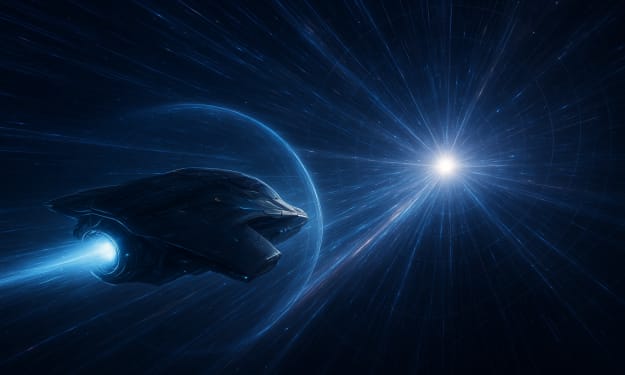
What if we travel at the speed of light?
Imagine strapping yourself into a spaceship, its engines thrumming with power, and leaving Earth behind. You accelerate, faster and faster, slicing through the void of space. What would the universe look like if you approached the speed of light? How would reality warp before your eyes?
By Sakuni Bandaraabout a month ago in Futurism
The day the Sun dies...
Control Tower: “Horizon, this is Mission Control. Final systems check complete. Countdown begins in “10…” The cabin thrummed beneath our boots. My heart matched the rhythm of the engines, deep and steady, like a giant taking long breaths.
By Sakuni Bandaraabout a month ago in Futurism
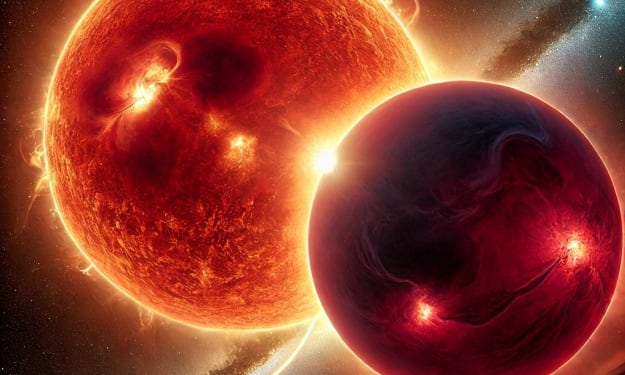
Astronomers Discover an Ultra-Rare Binary: Two Red Giant Stars on the Brink of Collision
Astronomers have announced a discovery that is already being called one of the most extraordinary stellar findings of the decade: a binary system made of two enormous red giant stars so close to each other that their bloated atmospheres are practically brushing together. Systems like this are so rare that many astrophysicists doubted they could survive long enough to be observed at all. Yet this newly identified pair is not only real—it is entering a catastrophic final phase that could end in a spectacular merger.
By Holianyk Ihorabout a month ago in Futurism
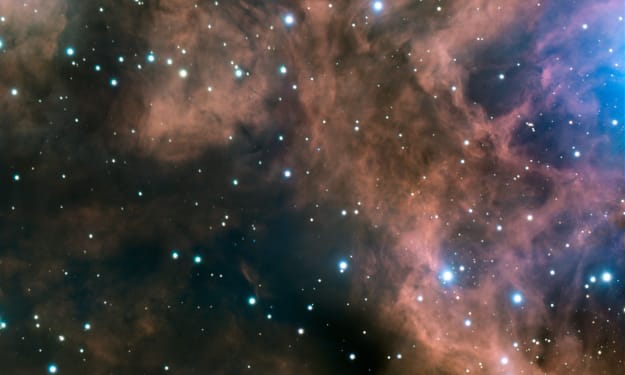
New Interstellar Molecules Discovered — A Breakthrough in the Chemistry of Life
Across the vast darkness between the stars, where temperatures drop to just a few degrees above absolute zero, an unexpected kind of cosmic creativity is unfolding. Astronomers have announced the discovery of several previously unknown interstellar molecules hiding inside dense molecular clouds — the very regions where new stars and planets are born. What makes this discovery particularly compelling is that these molecules play a crucial role in prebiotic chemistry, the set of chemical processes that precede the emergence of life.
By Holianyk Ihorabout a month ago in Futurism
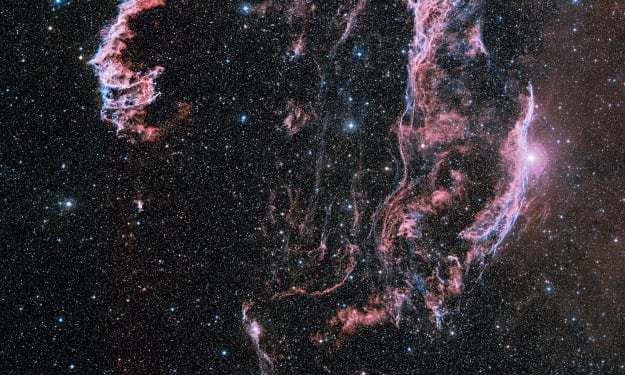
A New Class of Supernovae Discovered: Explosions That Do Not Destroy Their Stars
Astronomers have just announced a discovery that reshapes one of the most fundamental ideas in stellar astrophysics. For decades, a “supernova” meant one thing: the violent death of a star. It was the final, catastrophic event in a massive star’s life cycle—a colossal explosion so intense that, for a few weeks, it can outshine an entire galaxy. Afterward, the star is gone forever, replaced by a neutron star, a black hole, or a rapidly expanding cloud of debris.
By Holianyk Ihorabout a month ago in Futurism
Scientists Spot a “Falling Star” for the First Time — A Stellar Body Collapsing Under Its Own Gravity
Every so often, astronomy delivers a discovery that forces us to rethink what we know about stellar evolution. This time, researchers have identified an extraordinary object they refer to as a “falling star.” It is not falling through space, nor plunging toward another body. Instead, it is collapsing inward — pulled relentlessly by its own gravity. For the first time in history, astronomers have managed to observe a star in the rare, almost impossible-to-catch stage of self-destruction.
By Holianyk Ihorabout a month ago in Futurism
A New Image of Black Hole Magnetic Fields Reveals a Stunning, Ultra-Detailed Structure
For decades, black holes have represented the ultimate frontier of observational astronomy: regions so extreme that even light cannot escape, where physics bends into unfamiliar shapes and our best theories are pushed to their absolute limits. Yet each year, astronomers take one step closer to transforming the unseeable into the observable. The latest achievement is nothing short of astonishing: scientists have produced the most detailed image ever made of the magnetic fields swirling around a supermassive black hole.
By Holianyk Ihorabout a month ago in Futurism
The First Evidence of “Pulsating” Emission from a Black Hole’s Accretion Disk
For decades, astronomers have observed mysterious flickers, flares, and quasi-periodic oscillations coming from black hole systems. These rhythmic bursts of radiation—especially in X-rays—have inspired hundreds of theories but offered few firm answers. Were they turbulence? Magnetic reconnection? Random instabilities? Or something deeper, tied to the very structure of spacetime near a black hole?
By Holianyk Ihorabout a month ago in Futurism