space
Space: The Final Frontier. Exploring space developments and theorizing about how humans fit into the universe.
Part Three: The Final Revelation, And The True Face of the Divine
The True Face of the Divine In the first part, we explored an age when gods walked among men, an era when humanity's relationship with the divine was direct and tangible. In the second part, we entered the Golden Age, a period characterized by unity, wisdom, and balance. However, we soon witnessed its slow unraveling as corruption, ambition, and the burden of human forgetfulness took hold. This descent into chaos was not merely a loss of knowledge; it was a deliberate concealment orchestrated by those who feared humanity's awakening, as well as by the cycles of time itself, which safeguard sacred truths until the appropriate moment for their reemergence.
By The Secret History Of The World5 months ago in Futurism
Atomic Atomic Saturation
Atomic Atomic Saturation I have always been fascinated by the moments in science when nature seems to quietly whisper: “This is as far as I will go.” One of these whispers emerges in the world of atomic physics, in a phenomenon known as atomic saturation. It is an elegant yet stubborn limit in the interaction between light and matter, a point beyond which the rules we expect no longer apply in a simple way.
By Mohamed hgazy5 months ago in Futurism
How the Universe Can “Regenerate” Galaxies
When we think about galaxies, we imagine grand, seemingly eternal structures made up of billions of stars, planets, gas clouds, and dark matter. They appear timeless cosmic cities that simply age until their stars burn out, leaving only cold, silent darkness.
By Holianyk Ihor6 months ago in Futurism
What Would Happen If You Broke the Speed of Light?
Science, sci-fi, and a dash of time paradoxes The speed of light in a vacuum about 299,792 kilometers per second (or roughly 186,282 miles per second) isn’t just a big number. It’s the ultimate cosmic speed limit, built into the very fabric of the universe. Albert Einstein’s special theory of relativity proved more than a century ago that nothing with mass can travel faster than light.
By Holianyk Ihor6 months ago in Futurism
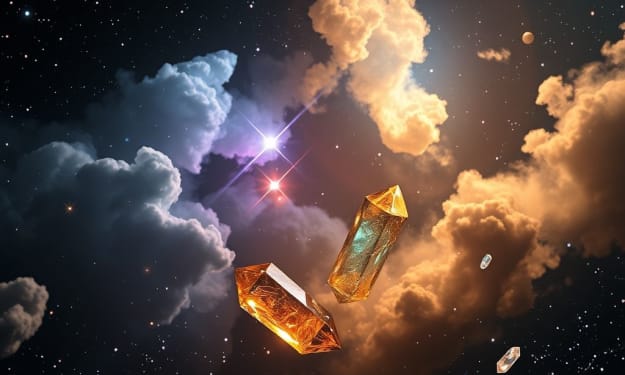
How Space Creates Crystals: Jewels from the Depths of the Universe
When most people think of crystals, they imagine a sparkling piece of quartz on display in a mineral shop or a perfectly cut diamond set in a ring. But few realize that some of the most unusual and flawless crystals are not born deep within Earth’s crust they are forged in the cold, airless reaches of space.
By Holianyk Ihor6 months ago in Futurism
Hot Jupiters — The Planets That Shouldn’t Exist
In astronomy, there’s a strange breed of worlds that seem to defy common sense. They’re enormous, like Jupiter, yet they orbit so close to their stars that a “year” on them lasts only a few Earth days. Their scorching atmospheres can reach temperatures hot enough to melt metal. Astronomers call them Hot Jupiters and, by all known laws of planetary science, they shouldn’t exist at all.
By Holianyk Ihor6 months ago in Futurism
The South Atlantic Anomaly: A Mysterious Weak Spot in Earth's Magnetic Field
The South Atlantic Anomaly: A Mysterious Weak Spot in Earth's Magnetic Field High above our planet, where satellites orbit and astronauts glide through space, there's a strange region unlike any other. It's not a hole in the ozone layer, nor a gap in the atmosphere—but a disturbance in Earth’s magnetic field itself. Scientists call it the South Atlantic Anomaly (SAA), and it’s been puzzling geophysicists for decades.
By Mohamed hgazy6 months ago in Futurism
Super-Dense Worlds: Where a Kilogram Weighs Tons
When we think about weight, we usually picture familiar things: a kilogram of apples, a ton of bricks, a liter of water. Our measurements feel intuitive because we live on Earth, with Earth’s gravity. But step beyond our planet, and the entire system begins to break down. Imagine a world where a simple kilogram feels as heavy as a small car. Welcome to the realm of super-dense objects places where gravity bends reality, from neutron stars and exotic exoplanets to hypothetical "hell worlds" that challenge our understanding of physics.
By Holianyk Ihor6 months ago in Futurism
Why Do Some Stars Spin Close to the Speed of Light?
When we think about stars, we usually picture brilliant glowing spheres, massive in size and unimaginably hot. But among these cosmic giants, there exists a rare class of stars that defy even our wildest expectations they spin so fast that parts of them move at speeds approaching that of light. It sounds like science fiction, but it's a very real phenomenon. So how can a star spin that fast without tearing itself apart? Let’s dive into the physics of these stellar speedsters.
By Holianyk Ihor6 months ago in Futurism
Part Two: The Science of the Soul, the Afterlife & the Rise of the New Human
The Science of the Soul, the Afterlife & the Rise of the New Human In Part One, we embarked on a journey of awe and inspiration as we witnessed how science is gradually bridging the gap between spirituality and material reality. We marveled at discoveries such as the Higgs boson, often referred to as the "God particle", which unlocks a universe balanced on a razor's edge of mathematical precision. This universe, so finely tuned that life could not exist if even a single constant were slightly altered, is a testament to the coexisting, inspiring nature of our existence. We also explored how quantum mechanics suggests that consciousness plays a fundamental role in shaping reality, and how controlled studies on prayer, meditation, and healing demonstrate measurable benefits that challenge materialist explanations. Most importantly, we came to understand that science is not disproving God; instead, it is beginning to decode the divine matrix that underlies everything, leaving us in a state of awe and wonder.
By The Secret History Of The World6 months ago in Futurism
From Chaos to Cosmos: How Order Emerged After the Big Bang
When we hear the word chaos, we imagine disorder swirling motion, noise, confusion. Now imagine that our entire universe began in exactly such a state: incredibly hot, unimaginably dense, and bursting with energy. That wild beginning is what we call the Big Bang. And yet, billions of years later, from this primordial chaos emerged galaxies, stars, planets even life itself. How did something so ordered come from such a turbulent start?
By Holianyk Ihor6 months ago in Futurism