

When we think about galaxies, we imagine grand, seemingly eternal structures made up of billions of stars, planets, gas clouds, and dark matter. They appear timeless cosmic cities that simply age until their stars burn out, leaving only cold, silent darkness.
But the Universe is not merely a destroyer. Increasingly, astronomers are discovering evidence that it can also repair, renew, and even regenerate galaxies. And this cosmic restoration might happen far more often than we once believed.
The Galactic Cycle of Matter
At the heart of this concept lies a fascinating truth: galaxies are not static. They’re constantly losing and reclaiming material.
Stars expel gas during their life cycles sometimes gently, in the form of stellar winds, and sometimes violently, through the titanic explosions of supernovae. Supermassive black holes in galactic centers blast jets of plasma into intergalactic space. Powerful galactic winds can carry away entire clouds of gas and dust.
But here’s the twist much of that matter eventually comes back. Under the pull of gravity, the expelled gases cool, condense, and fall back toward the galaxy, much like rain returning to the ground after evaporating. Astronomers call this process the galactic fountain.
This constant recycling is vital. It replenishes a galaxy’s reservoirs of gas, providing the raw material needed to form new stars. Without it, a galaxy would age into silence, but with it, it can effectively “refresh” itself.
Collisions and Cosmic Rebirth
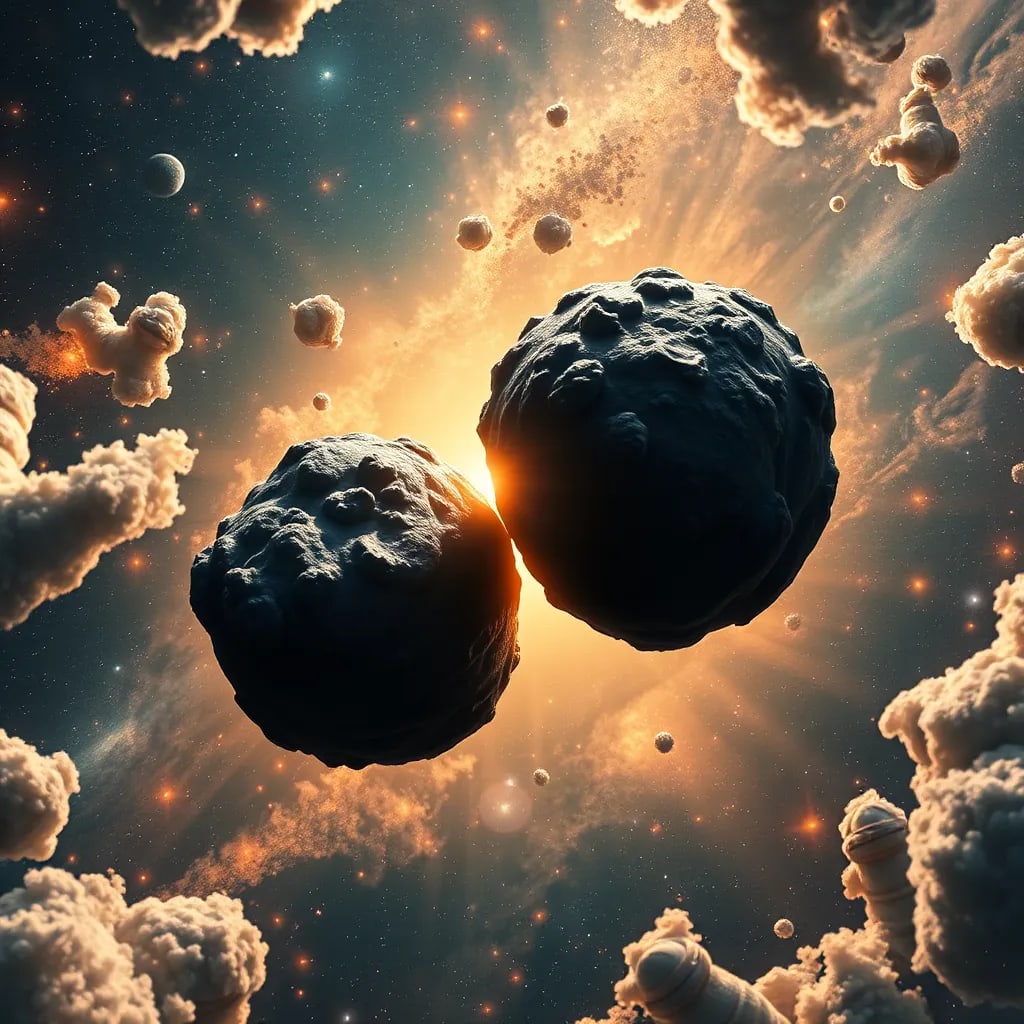
Sometimes, galactic regeneration takes a more dramatic form. When two galaxies collide, the gravitational chaos compresses their gas clouds, sparking an explosive burst of star formation.
In other words, a collision can breathe new life into a galaxy that was otherwise winding down. Even “retired” galaxies, where star formation has nearly ceased, can suddenly erupt with the glow of billions of newborn stars.
A stunning example is the Antennae Galaxies a pair of spiral galaxies that began colliding millions of years ago. Once relatively calm, they are now in the midst of a stellar baby boom, with vast regions glittering from fresh star clusters. While the collision will ultimately merge them into a single galaxy, the process ensures they burn brightly for millions of years to come.
Fed by the Cosmic Web
On an even grander scale, galaxies are not isolated islands. They are strung like beads along the cosmic web an immense network of filaments made primarily of cold hydrogen gas.
These filaments act like invisible highways, channeling fresh material into galaxies. Over billions of years, this slow but steady inflow can feed even older galaxies with enough gas to restart the process of star formation.
Computer simulations suggest that in the early Universe, this cosmic gas flow was particularly active, keeping young galaxies bursting with energy and color. Without it, the Universe’s early years might have looked far dimmer.
Black Holes: Destroyers or Architects?
Central black holes often get a bad reputation for “quenching” galaxies. Their powerful outflows and radiation can blow away star-forming gas, effectively shutting down the galaxy’s stellar production.
But that’s not the whole story. In certain conditions, these same forces can compress surrounding gas, triggering waves of new star formation. This means a supermassive black hole isn’t always a cosmic villain sometimes it acts as an unlikely architect, building the next generation of stars.
Why This Matters
The idea of galactic regeneration reshapes how we view the Universe. It tells us that cosmic structures aren’t simply born, grow old, and die. Instead, they undergo complex life cycles, where periods of decline can be followed by dramatic renewal.
In a way, galaxies behave a lot like living organisms: they lose energy, recover, adapt, and sometimes transform into something entirely new.
And here’s a thought worth holding onto our own Milky Way may have experienced such a rebirth billions of years ago. Without it, the Sun might never have formed, and Earth’s story our story could have been entirely different.
The Universe, it seems, is not just a silent witness to the passage of time. It’s an active participant in the grand cycle of creation, destruction, and rebirth. Galaxies are not doomed to fade quietly into the void they can be reborn, and in that rebirth, they may light up the cosmos all over again.
About the Creator
Keep reading
More stories from Holianyk Ihor and writers in Futurism and other communities.
What Would Happen If You Broke the Speed of Light?
Science, sci-fi, and a dash of time paradoxes The speed of light in a vacuum about 299,792 kilometers per second (or roughly 186,282 miles per second) isn’t just a big number. It’s the ultimate cosmic speed limit, built into the very fabric of the universe. Albert Einstein’s special theory of relativity proved more than a century ago that nothing with mass can travel faster than light.
By Holianyk Ihor5 months ago in Futurism
About Binding Prometheus
I want to start actively advocating on behalf of my own work, and the most valuable part of my canon is, without a doubt, Binding Prometheus, the play I have been working on since 2019 and only finished in 2023 as part of my MA. The play itself is an amalgamation of a million different inspirations. On one end, it evokes the Ancient Greek myth-play, deriving its own title from the earliest extant work of Western drama we have, Aeschylus’s Prometheus Bound. On the other end, it borrows significantly from the sci-fi bulwarks from over the years, namely Mary Shelley’s Frankenstein and Karel Capek’s Rossum’s Universal Robots. The play could be an episode of Black Mirror, I fear. I don’t know. I’ve only ever seen one episode of Black Mirror.
By Steven Christopher McKnight15 days ago in Futurism
Top-12 AI Agents Development Services in the 2026
AI agents are no longer experimental tools. In 2026, they sit at the core of how modern companies automate workflows, support customers, analyze data, and make decisions at scale. Autonomous customer support agents and multi-agent enterprise systems coordinate complex operations. Businesses actively seek partners capable of designing, building, deploying, and maintaining production-ready AI agents.
By CEO A&S Developers4 days ago in Futurism



Comments
There are no comments for this story
Be the first to respond and start the conversation.