
What Would Happen If You Broke the Speed of Light?
Space

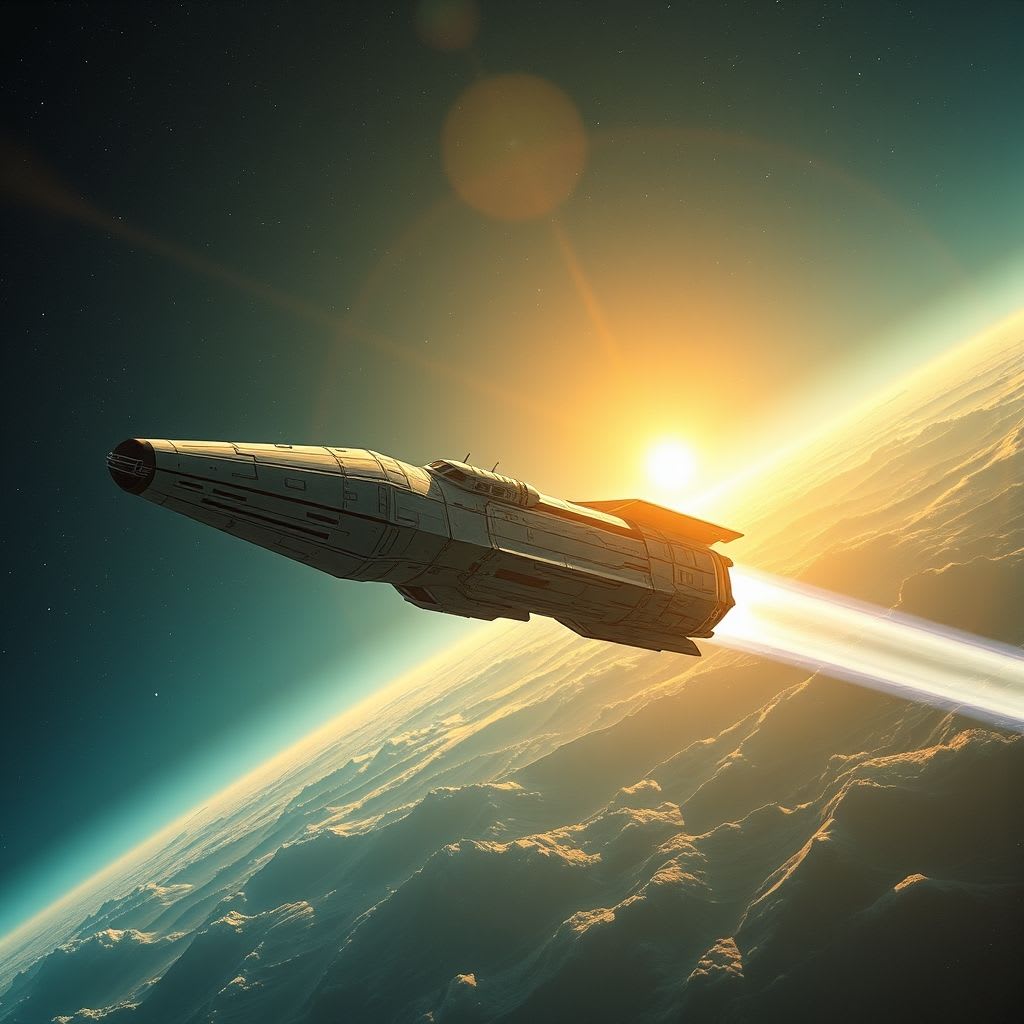
Science, sci-fi, and a dash of time paradoxes
The speed of light in a vacuum about 299,792 kilometers per second (or roughly 186,282 miles per second) isn’t just a big number. It’s the ultimate cosmic speed limit, built into the very fabric of the universe. Albert Einstein’s special theory of relativity proved more than a century ago that nothing with mass can travel faster than light.
But let’s indulge in a thought experiment. What if, somehow, we could shatter that limit? What would really happen if you pushed past light speed?
1. Physics Throws Up a Stop Sign
Accelerating an object with mass to the speed of light is like trying to push a mountain uphill forever the closer you get, the harder it becomes. According to Einstein’s famous equation 𝐸=𝑚𝑐2, as you accelerate toward light speed, your effective mass increases. That means the faster you go, the more energy you need to keep accelerating.
At 99.999% of the speed of light, your spacecraft would appear enormously “heavier” to an outside observer. To push it that last fraction of a percent to exactly light speed would require infinite energy something that simply can’t happen with our current understanding of physics.
2. Time Starts to Get Weird
Even if, through some miracle, you bypassed the energy problem, there’s another issue: time stops playing by the usual rules.
Near light speed, time slows down for the traveler. This isn’t science fiction it’s been confirmed in experiments with high-speed particles and ultra-precise atomic clocks. For example, astronauts on the International Space Station age just a tiny bit slower than people on Earth because they’re moving faster.
But if you somehow went faster than light, relativity suggests you could slip into backward time travel. That’s where the infamous grandfather paradox comes in: if you go back and prevent your grandparents from meeting, how could you have existed to travel back in the first place? Such paradoxes are one reason many physicists suspect that faster-than-light travel is impossible or at least very different from how we imagine it.
3. Theoretical Loopholes
Just because breaking light speed seems impossible doesn’t stop scientists and science fiction writers from dreaming up ways around it.
Here are a few ideas that pop up in theory and fiction:
- Tachyons — Hypothetical particles that always travel faster than light. They’d have imaginary mass and could never slow down below the light barrier. Sadly, no one’s ever detected one.
- Alcubierre Warp Drive — A speculative concept where you compress space in front of your ship and stretch it behind, creating a “wave” you ride. Technically, you’re not moving through space faster than light — you’re moving space itself.
- Wormholes — Shortcuts through spacetime, like tunnels connecting distant points in the universe. Traveling through a wormhole might make it look like you broke light speed, even if you didn’t.
4. What Would It Feel Like?
Let’s ignore the engineering nightmare for a moment. Imagine you’ve somehow jumped to superluminal speed.
The stars ahead might vanish their light wouldn’t have time to reach you. Meanwhile, the universe behind you could shift into strange blues and violets due to extreme Doppler shifts. Space around you could warp and twist into surreal patterns. In sci-fi films, it’s often shown as a glowing tunnel of light, but in reality, the view might be stranger or maybe completely dark.
5. Why We’re Stuck (for Now)
The universe enforces the light-speed limit with ruthless precision. Even the fastest known particles, cosmic rays, come close but never quite touch it. Every time we’ve tested the laws of relativity, they’ve held firm.
That said, human history is full of “impossible” things becoming possible: heavier-than-air flight, space travel, nuclear power. For now, breaking the speed of light remains in the realm of imagination but it’s exactly these “what if” questions that push science forward.
Final Thoughts
Going faster than light isn’t just hitting the gas — it’s challenging the very structure of space and time. In theory, it could open the door to time travel, instant journeys between stars, and entire new realms of physics. In practice, the laws of the universe say: not today.
Still, one day, far in the future, when humanity looks back on our early spacefaring days, maybe we’ll think of our slow, sub-light-speed rockets the way we now think of ancient sailing ships: quaint, courageous, and just the beginning of the journey.
About the Creator
Keep reading
More stories from Holianyk Ihor and writers in Futurism and other communities.
How Space Creates Crystals: Jewels from the Depths of the Universe
When most people think of crystals, they imagine a sparkling piece of quartz on display in a mineral shop or a perfectly cut diamond set in a ring. But few realize that some of the most unusual and flawless crystals are not born deep within Earth’s crust they are forged in the cold, airless reaches of space.
By Holianyk Ihor5 months ago in Futurism
About Binding Prometheus
I want to start actively advocating on behalf of my own work, and the most valuable part of my canon is, without a doubt, Binding Prometheus, the play I have been working on since 2019 and only finished in 2023 as part of my MA. The play itself is an amalgamation of a million different inspirations. On one end, it evokes the Ancient Greek myth-play, deriving its own title from the earliest extant work of Western drama we have, Aeschylus’s Prometheus Bound. On the other end, it borrows significantly from the sci-fi bulwarks from over the years, namely Mary Shelley’s Frankenstein and Karel Capek’s Rossum’s Universal Robots. The play could be an episode of Black Mirror, I fear. I don’t know. I’ve only ever seen one episode of Black Mirror.
By Steven Christopher McKnight17 days ago in Futurism


Comments
There are no comments for this story
Be the first to respond and start the conversation.