Advocacy
The Silent Power of Everyday Choices
Every morning, Mia stood at the same crossroads — not a dramatic life-or-death decision, but a simple one: walk to work or drive. Like most people, her life was full of these tiny, seemingly insignificant choices. But over time, Mia began to realize something profound: the little decisions we make each day don’t just shape our routines — they shape our world. It started with a reusable water bottle. Mia had been reading about plastic pollution and was stunned to learn that over a million plastic bottles are bought every minute worldwide. She didn’t consider herself an environmentalist, but something about that number stuck with her. So, one day, she skipped her usual bottled water and bought a sturdy reusable bottle. It was a small change, almost laughably minor. But the next day, she used it again. And again. That one decision soon led to others. She began walking to work on days when the weather was nice. It added 15 minutes to her commute, but she found the fresh air invigorating. She noticed the color of the trees, the sound of birds, and the way the city quietly came to life in the early morning. Walking made her feel better physically, too. Her energy levels improved, and her mood stabilized. Without meaning to, she had started a habit — one that benefited both her and the environment. Curious about how far she could take this mindset, Mia began to examine other parts of her life. Grocery shopping became an adventure in conscious consumption. She started choosing more fresh produce and fewer packaged foods. She tried new plant-based recipes, not because she was giving up meat entirely, but because it felt right to reduce her consumption. These choices weren’t driven by guilt, but by a growing sense of alignment — with her values, her health, and the planet. But Mia’s story isn’t unique. What she discovered is part of a broader truth: small, consistent actions add up. Researchers call this the “compound effect” — the idea that tiny decisions, repeated over time, create significant change. Just as saving a few dollars a day can lead to financial stability, choosing sustainable habits can ripple outwards into meaningful impact. Take, for example, energy consumption. By simply switching off unused lights and electronics, households can save hundreds of kilowatt-hours each year. On a national level, that kind of savings reduces strain on the power grid and cuts down on greenhouse gas emissions. One family might not notice the difference — but millions making similar changes create a wave of transformation. And there’s a psychological benefit, too. Making positive choices fosters a sense of agency. In a world that often feels overwhelming — with climate change, political uncertainty, and mental health challenges — realizing that you do have control over your own actions is empowering. Studies show that people who feel they can make a difference are more likely to take action, and more likely to be optimistic about the future. Mia’s story also had a ripple effect beyond herself. Her coworkers noticed her morning walks and began joining her occasionally. Her roommate, inspired by Mia’s plant-based dinners, started cooking more at home. Her small choices sparked curiosity, conversation, and eventually change in those around her. None of it was perfect. Mia still had days where she drove instead of walked, ordered takeout in plastic containers, or forgot to bring her reusable bag. But perfection was never the goal — progress was. The silent power of her everyday choices wasn’t in grand gestures, but in the quiet consistency of trying. By the end of the year, Mia looked back and barely recognized the version of herself from twelve months earlier. Not because she had transformed into someone completely different, but because she had tuned into her values and lived them, one small act at a time. The truth is, the future isn’t shaped by a few heroic actions. It’s built by the quiet, daily decisions made by people like Mia — and people like you. Every time we choose to walk instead of drive, cook instead of order, repair instead of replace, we’re casting a vote for the kind of world we want to live in. And that world? It starts now — not with noise, but with the silent power of everyday choices.
By Muhammad Saad 6 months ago in Earth
Beneath the Surface: The Hidden Forces Shaping Our World
Beneath the Surface: The Hidden Forces Shaping Our World An Exploration of the Unseen Influences Behind Global Events, Technologies, and Everyday Choices When 16-year-old Amina posted a photo of her handmade jewelry on social media, she didn’t think much of it. Within hours, the image had spread beyond her small town in Kenya, landing her unexpected orders from Canada, Germany, and Japan. It seemed like magic. But beneath the surface, powerful, invisible systems had shaped her moment of digital success. In today's hyperconnected world, the surface — what we see, hear, and experience — often feels spontaneous and natural. But behind each moment lies a dense web of hidden forces: algorithms steering attention, psychological nudges guiding behavior, political frameworks shaping narratives, and economic structures controlling access. Take Amina's story. Her post gained traction not by chance, but because an algorithm on the platform recognized the image as “high engagement potential.” The AI had been trained on millions of similar posts — analyzing colors, faces, lighting, and hashtags — to decide what content should be shown to more users. Without realizing it, Amina had aligned with the invisible preferences of a machine-learning system designed to maximize ad revenue. This phenomenon isn’t confined to social media. Consider how global events reach us through the news. While we imagine journalists reporting freely, editorial decisions are often influenced by political pressure, corporate interests, or audience algorithms. Certain topics are amplified; others are buried. What feels like a balanced view of the world is often just a carefully curated slice — a product of commercial logic and public sentiment. Even our most personal choices — what we eat, where we shop, how we vote — are subtly shaped by unseen forces. Behind the food in your fridge is a global supply chain run by a handful of multinational corporations. These companies use climate data, labor analytics, and trade agreements to maximize profit, not sustainability. Your decision to buy strawberries in January isn't really a choice — it’s the endpoint of a system that made them available in the first place, at a cost that hides its environmental toll. In the digital economy, personal data has become currency. Every click, scroll, and pause feeds into vast databases that power behavioral prediction models. Advertisers and political strategists use this data to craft hyper-targeted messages designed to persuade or manipulate. What appears to be free will — our choices — are increasingly the result of behavioral engineering. But perhaps the most powerful hidden force is psychological: the set of cognitive biases and social instincts that have evolved over thousands of years. We’re drawn to stories that confirm our beliefs (confirmation bias), we follow the behavior of crowds (herd mentality), and we tend to avoid uncomfortable truths (cognitive dissonance). These instincts, once useful for survival, are now exploited in the digital age. The result? A world where outrage spreads faster than facts, where convenience trumps critical thought, and where truth is often buried beneath emotionally charged misinformation. Yet, understanding these forces offers power — the power to push back. Amina, after her unexpected viral moment, decided to learn more about the system that had amplified her work. She discovered that by tweaking her descriptions and using specific hashtags, she could navigate the algorithm more intentionally. More importantly, she began using her platform to educate her followers about fair trade, sustainability, and local craftsmanship. Likewise, media literacy programs in schools are teaching students how to question sources, identify bias, and think critically. Organizations around the world are advocating for greater transparency in algorithms and better regulation of data usage. Peering beneath the surface can feel overwhelming — even unsettling. It reveals how much of our world is shaped by forces beyond our control. But it also opens the door to greater awareness, agency, and resilience. The systems shaping our reality are not inherently evil; they are tools created by people. And like all tools, they can be reformed, reimagined, and redirected. As Amina tells her growing online community, “We can’t change what we don’t see. But once we see it, we can start to choose differently.” The hidden layers of influence — technology, psychology, politics, economics — aren’t going away. But the more we understand them, the better equipped we are to live with purpose, make conscious decisions, and perhaps, reshape the very systems that once shaped us.
By Muhammad Saad 6 months ago in Earth
The Hidden Town Where No One Ages
The Hidden Town Where No One Ages A Twilight Zone-style Mystery by ChatGPT I first heard of Everspring from a traveler at a dusty roadside diner in northern Oregon. He was old, grizzled, and talked in riddles like he belonged in an old folktale. As I sat nursing a coffee, he leaned over and muttered, “If you ever get lost on Route 9, and take the wrong turn at the burnt elm tree, don’t be surprised if you end up in Everspring. People say no one ever grows old there. They say time forgets them.”
By Huzaifa Dzine6 months ago in Earth
Beneath the Surface: The Hidden Systems That Shape Our World
Every morning, as the sun stretches over the skyline and the city hums to life, Maya steps outside with her coffee in hand, barely thinking about the world beneath her feet. To her, the day begins with traffic lights, notification sounds, and digital calendars. But unbeknownst to her—and most people—the real machinery of modern life operates beneath the surface. Maya is a systems analyst for a tech firm, someone who understands digital frameworks and backend processes. Yet one morning, while stuck in a subway delay, she began to wonder: What else am I missing? That moment sparked a journey of curiosity. What are the invisible forces that make our world function? Her first stop was her own domain: the digital world. Behind every online purchase, GPS ping, or video stream lies an intricate ballet of signals bouncing between cell towers, data centers, and undersea cables. For instance, when Maya texts her sister in another country, the message doesn’t float magically through the air—it’s routed through thousands of miles of fiber-optic cables on the ocean floor. These global data highways, invisible to the naked eye, form the backbone of the internet. “People think the cloud is this mysterious place in the sky,” one network engineer told her. “But really, it’s warehouses full of blinking servers powered by electricity, cooled by complex HVAC systems, and monitored 24/7.” Even electricity itself is a hidden marvel. Power grids stretch like nervous systems across continents. Electricity travels from wind turbines and power plants to substations and transformers, eventually lighting up Maya’s apartment with a simple flick of a switch. She realized how rarely she thought about these grids—until they went down. But not all invisible systems are man-made. Nature, too, operates vast hidden networks. Intrigued, Maya visited an environmental research center, where a biologist introduced her to the “wood wide web.” Beneath forests, tree roots are linked by vast fungal networks—mycorrhizae—that transport nutrients, share chemical signals, and even warn neighboring trees of danger. “In a way,” the biologist said, “trees talk to each other underground. An old tree might share sugars with a sapling. A diseased tree might be quarantined by the network. It’s cooperation, not just competition.” Maya was fascinated. Beneath the soil she walked on every day, entire communication systems were silently at work—natural versions of the internet, formed long before humans built their own. Even urban life rests on unseen natural processes. Storm drains and aquifers redirect rainwater. Pollinators like bees, largely unnoticed, enable a third of the global food supply. Microbes in the human gut—trillions of them—help digest food, fight disease, and even influence mood and behavior. The more Maya learned, the more she realized: The world isn’t just built above ground or on screens—it’s powered by ecosystems, machines, and networks we rarely see or appreciate. One day, Maya took a walk through a local park. As she sat on a bench, she watched people scroll their phones, jog past trees, and chat on benches. She began to reflect on society’s hidden systems—those built not of metal or mycelium, but of behavior, trust, and connection. Take language, for example. It’s an invisible code humans use to pass knowledge, express emotion, and preserve culture. Or consider the financial system—money moves between banks in digital pulses, governed by trust, agreements, and regulations. Even democracy itself is a system: reliant on participation, belief in fairness, and shared values. Perhaps the most powerful hidden system is human connection. Every time a neighbor helps another, when people vote, when communities organize or when ideas are shared—it’s part of a vast social network. Much like the forest, societies thrive when connected, and falter when those connections break down. By the end of her exploration, Maya’s view of the world had changed. She now saw the layers that lay beneath the surface—technological, biological, and social. She began to ask more questions. What systems do we depend on without realizing it? How do these systems adapt—or collapse—under pressure? She realized that progress didn’t just mean faster phones or taller buildings. True progress meant understanding the systems that sustain us, and ensuring they remain strong, equitable, and resilient. That night, as she looked out her window at the glowing skyline, she felt awe. Not just at the beauty of the city lights, but at everything that made them possible—from the silent currents of electricity, to the fungi in the soil, to the people who keep things running, often unseen and unthanked. Because beneath the surface, the real world is always at work. And to truly understand our future, we must learn to see what’s hidden.
By Muhammad Saad 6 months ago in Earth
Earth Spinning Faster.The Shortest Day Recorded on 10 July.
How Fast Does the Earth Spin? Normally, the Earth takes 24 hours to complete one full rotation on its axis. This is what gives us day and night. In reality, the Earth takes slightly more than 86,400 seconds (the exact number of seconds in 24 hours) to rotate once. Scientists have been measuring the length of the day very precisely for decades using atomic clocks, which are incredibly accurate.
By Hamd Ullah7 months ago in Earth
"Earth Speaks: The Untold Story Beneath Our Feet"
We walk on it, build on it, and live because of it — yet we rarely listen to it. Earth, our only home, isn’t silent. It speaks in tremors, whispers through winds, sighs with the melting of glaciers, and groans under the weight of human industry. If we pay close attention, Earth tells a story — ancient, urgent, and unfolding in real time beneath our feet. The Living Planet Earth is not just a rock floating in space; it’s a dynamic, living system. The concept of Gaia Theory, introduced by scientist James Lovelock, suggests Earth functions like a self-regulating organism. Its oceans, forests, atmosphere, and even the soil interact like organs in a body, working together to sustain life. Soil alone is more alive than most people imagine. Just one tablespoon contains more microorganisms than there are people on Earth — fungi, bacteria, and other tiny creatures that make life above ground possible. They decompose organic matter, fix nitrogen, and help grow the food we eat. Yet much of this underground world remains a mystery, a silent story still being uncovered. Earthquakes and Fire: The Planet’s Pulse Sometimes, Earth speaks more forcefully. Every day, there are thousands of small earthquakes around the globe. Most go unnoticed, but they are signs of the planet’s internal motion. These tremors happen as tectonic plates — massive slabs of Earth’s crust — shift and grind against each other. This process has shaped continents, created mountains, and caused devastating events. Volcanoes are another voice of Earth — sometimes violent, sometimes subtle. While eruptions can destroy, they also give life. Volcanic soil is among the most fertile on the planet, and eruptions have played a key role in shaping our atmosphere and ocean chemistry over millions of years. The Climate Conversation In more recent decades, Earth has been speaking louder and more urgently. Temperatures are rising, glaciers are retreating, oceans are warming, and extreme weather is becoming more common. These are not random occurrences — they’re symptoms. Imagine Earth with a fever. Carbon dioxide and methane — greenhouse gases from burning fossil fuels, deforestation, and agriculture — act like a blanket, trapping heat in the atmosphere. The more we burn, the thicker the blanket becomes. Earth is responding. In the Arctic, sea ice once as old as ancient civilizations is melting at record speeds. Coral reefs, often called the “rainforests of the sea,” are bleaching and dying as ocean temperatures rise. Droughts, floods, and wildfires are becoming part of a new normal. The Hidden Layers: What Lies Beneath Beneath the crust lies a realm of heat and pressure that powers the engine of plate tectonics. Deeper still is the Earth’s core — a swirling sea of molten metal that generates our magnetic field, shielding life from deadly solar radiation. These deep systems may seem distant, but they affect our daily lives. Without the magnetic field, GPS satellites wouldn’t work, power grids would be vulnerable, and our atmosphere could be stripped away by solar winds. Even deeper, scientists are now exploring the possibility of a “deep biosphere” — a hidden world of microbial life miles beneath the surface. Some of these microbes live in environments so extreme they challenge what we thought life needed to survive. What we learn from them may help us understand life on other planets, and our own origins. Are We Listening? The truth is, Earth has always spoken. But have we been listening? Indigenous cultures have long viewed the planet as a living entity, something to respect and live in balance with. Modern science is now catching up to this wisdom, revealing how interconnected everything is — from the roots of a forest to the clouds in the sky. We are part of this system. Our actions ripple through Earth’s systems in ways both visible and hidden. But here’s the good news: we also have the power to heal. Regenerating soil, restoring forests, reducing emissions, and shifting how we interact with nature can all help rewrite the next chapter. The Next Chapter Earth’s story is still being written — and we’re not just readers; we’re authors. The question is, what kind of story do we want to tell? One of collapse and silence, or one of listening, healing, and coexisting? If we pay attention to the signs — the language of wind, water, stone, and soil — perhaps we’ll hear not just warnings, but guidance. Earth is speaking. And the time to listen is now.
By Muhammad Saad 7 months ago in Earth
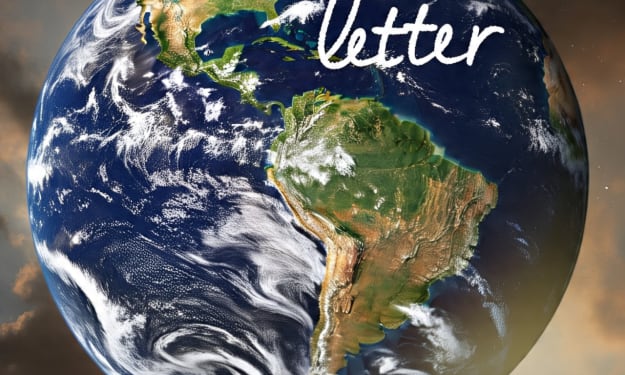
Dear Humans: A Letter from Planet Earth
Dear Humans: A Letter from Planet Earth What Our Home Has Been Trying to Tell Us—And Why Now Is the Time to Listen Dear Humans, I’ve been meaning to write to you for some time. I suppose I’ve been trying to reach you in my own ways—through the wind that carries whispers across your mountains, through the oceans that ebb and roar with forgotten songs, through the trees that creak in the silence after the storms. But lately, you’ve been too distracted to hear me. So I’m writing this letter instead, in the hope that you might finally listen. You’ve called me many names—Gaia, Mother Earth, Terra. To you, I’ve been a provider, a canvas for your dreams, a place to call home. I’ve never asked much in return. I gave you forests for shelter and firewood, rivers for water, soil to grow your food. I cradled you through the centuries, even when you stumbled through wars and famine and greed. But lately, I’ve been hurting. Perhaps you’ve noticed. The air is heavier now—thicker with the fumes of your factories and cars. The ice at my poles weeps quietly into rising seas. The coral reefs, once so vivid with life, lie pale and brittle, as if mourning something they can no longer name. Even the animals, my oldest companions, are falling silent. So many of them have vanished, as if they slipped off the page of a story you stopped telling. I tried to speak louder. I sent you stronger storms, longer droughts, more erratic seasons. I thought maybe then you’d pause. That you’d ask yourselves: Why is this happening? What are we doing wrong? Some of you did. You marched, you protested, you planted trees and picked up trash. You created documentaries and built solar panels and whispered to your children that there might still be time. But too many of you did not listen. You kept drilling, digging, building, burning. You wrapped yourself in comfort and consumption, convincing yourselves that progress must always come at a cost. That someone else would fix it. That the Earth would endure. And I will—endure, that is. With or without you. You see, I’ve lived through worse. I’ve survived the fire of forming, the ice of extinction, the long silence after the dinosaurs fell. I’m not afraid of change. I am change. But you—you are fragile. Your cities, your families, your music, your dreams—they are precious, and they are new. You’ve been here barely a blink, yet in that time, you’ve created beauty and chaos in equal measure. You’ve written poems to the moon and sent rovers to Mars. You’ve healed diseases, painted sunsets, and crafted stories that stir the soul. And yet, you are burning the ground beneath your own feet. Please, hear this not as a scolding, but as a plea. I do not want your guilt. I want your attention. Your care. Your action. Because now is the time. The window is narrowing, but it has not yet closed. You can still choose to change. You can reimagine your cities as green spaces that breathe, power your homes with the sun that smiles down every day, and protect the forests that still remember how to hold carbon in their roots. You can slow down. You can listen. You often ask yourselves: What kind of world will we leave behind for our children? But I ask you this: What kind of children will you raise for this world? Raise them to respect the soil under their feet and the sky above their heads. Teach them to wonder, to restore, to protect. Let them know that nature is not a resource—it is a relationship. Dear humans, I still love you. Even now, through the smog and sorrow, I see the sparks of your kindness. I feel it when a child plants their first seed, when a fisherman releases a bycatch back into the water, when a scientist whispers hope into data, when a community rebuilds with green in mind. I am not asking you to be perfect. I’m only asking you to remember that you belong to me—not as owners, but as stewards. Listen now, while you still can. With hope, Earth
By Muhammad Saad 7 months ago in Earth
The Use of Mobile Phones
It was 7:00 a.m. when Maya’s alarm rang—an upbeat tune playing from her smartphone. She groaned, reached for it, and hit snooze. Five minutes later, the alarm blared again, and this time, she sat up. She had a full day ahead: classes, errands, and a group presentation to prepare for. Before getting out of bed, she scrolled through her notifications—messages from friends, a reminder from her calendar, and a news update. This wasn’t unusual. In fact, Maya’s entire day revolved around her phone. As she got dressed for college, she opened a language-learning app to revise vocabulary. On the way to the bus stop, she called her mother, who lived in another city, and they spoke for a few minutes—a quick check-in. Once on the bus, Maya plugged in her earphones and caught up on a podcast discussing global issues. She felt connected, informed, and somehow, in control. Across town, Ramesh, a delivery driver in his mid-thirties, checked his route for the day on his phone. Without it, his work wouldn’t be possible. His employer sent customer addresses, and digital payments came through a mobile app. Ramesh often wondered how people managed before smartphones. He used it not just for work, but to talk to his wife during breaks, check cricket scores, and watch short videos to relax. Meanwhile, in a quiet village 300 kilometers away, twelve-year-old Anjali sat under a tree with her classmates. They crowded around a single smartphone, watching a science lesson downloaded by their teacher the previous evening. The school lacked a computer lab and internet access, but the teacher used his phone to bring in the world outside—a place where rockets launched into space and underwater creatures swam through coral reefs. For Maya, Ramesh, Anjali, and millions like them, the mobile phone had become more than a gadget—it was a bridge. A bridge between people, opportunities, knowledge, and services. Later that afternoon, Maya met with her groupmates at the library. They sat together, not with papers and pens, but with phones and laptops. One person gathered research articles, another created slides, and Maya coordinated with a classmate who was joining remotely. The project came together seamlessly. Yet, not all moments with mobile phones were positive. That evening, Maya and her friends went out for dinner. They sat around a table, each with a phone either in their hand or next to their plate. The conversation was sporadic—someone paused to reply to a text, another scrolled through social media while waiting for the food. Maya noticed the silence between them. It felt... odd. They were together, but not truly present. Across the city, Ramesh sat with his son, trying to help him with homework. But his phone buzzed with delivery updates and messages. Each time he looked down at the screen, his son’s frustration grew. “You’re not listening,” the boy finally said. Ramesh sighed, turned the phone over, and promised himself he’d switch it off after dinner. In the village, Anjali’s teacher held a community session, explaining the benefits—and dangers—of mobile phones. He spoke about how children could be distracted or misled by content online. “It’s a tool,” he said, “and like any tool, it depends on how we use it.” The next morning, Maya left her phone in her bag during her morning lecture. She found she listened better and took more detailed notes. After class, she sat on a bench outside and watched the campus come to life—students laughing, birds chirping, the soft wind rustling through the trees. She smiled. It felt refreshing. The world had changed, and so had people. The mobile phone had brought families closer, improved education in remote areas, supported livelihoods, and offered entertainment at one’s fingertips. But it had also blurred the line between personal and digital life, raised concerns about privacy, and at times, replaced real conversations with screen time. In the end, Maya realized, it wasn’t about using mobile phones less—it was about using them wisely. About knowing when to connect with the world, and when to disconnect and just be. As she walked to her next class, her phone buzzed. She paused, looked at the notification—and then slid it back into her pocket. Some moments, she knew, were better lived than captured.
By Muhammad Saad 7 months ago in Earth
Whispers of the Wild: A Journey Through the Natural Forest Park
In a world increasingly dominated by concrete jungles and digital distractions, the gentle embrace of nature feels like a lost language — one that whispers, rather than shouts. "Whispers of the Wild: A Journey Through the Natural Forest Park" invites you to reconnect with this language, to listen to the soft stories told by the rustling leaves, the babbling brooks, and the quiet footfalls of creatures unseen.
By Noor Hussain7 months ago in Earth