
"Earth Speaks: The Untold Story Beneath Our Feet"
Discover how our living planet communicates through climate, quakes, and ecosystems—and what it’s urgently trying to tell us.
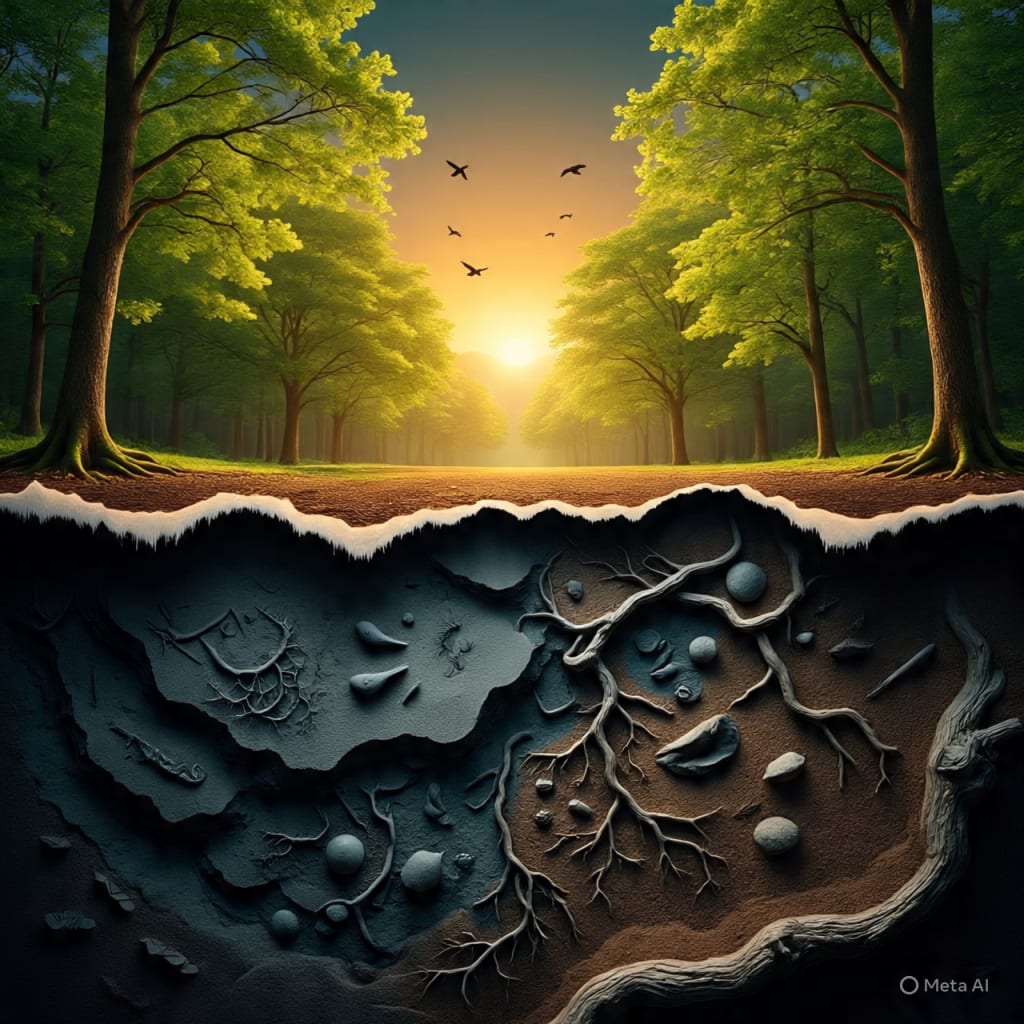
We walk on it, build on it, and live because of it — yet we rarely listen to it. Earth, our only home, isn’t silent. It speaks in tremors, whispers through winds, sighs with the melting of glaciers, and groans under the weight of human industry. If we pay close attention, Earth tells a story — ancient, urgent, and unfolding in real time beneath our feet.
The Living Planet
Earth is not just a rock floating in space; it’s a dynamic, living system. The concept of Gaia Theory, introduced by scientist James Lovelock, suggests Earth functions like a self-regulating organism. Its oceans, forests, atmosphere, and even the soil interact like organs in a body, working together to sustain life.
Soil alone is more alive than most people imagine. Just one tablespoon contains more microorganisms than there are people on Earth — fungi, bacteria, and other tiny creatures that make life above ground possible. They decompose organic matter, fix nitrogen, and help grow the food we eat. Yet much of this underground world remains a mystery, a silent story still being uncovered.
Earthquakes and Fire: The Planet’s Pulse
Sometimes, Earth speaks more forcefully.
Every day, there are thousands of small earthquakes around the globe. Most go unnoticed, but they are signs of the planet’s internal motion. These tremors happen as tectonic plates — massive slabs of Earth’s crust — shift and grind against each other. This process has shaped continents, created mountains, and caused devastating events.
Volcanoes are another voice of Earth — sometimes violent, sometimes subtle. While eruptions can destroy, they also give life. Volcanic soil is among the most fertile on the planet, and eruptions have played a key role in shaping our atmosphere and ocean chemistry over millions of years.
The Climate Conversation
In more recent decades, Earth has been speaking louder and more urgently. Temperatures are rising, glaciers are retreating, oceans are warming, and extreme weather is becoming more common. These are not random occurrences — they’re symptoms.
Imagine Earth with a fever. Carbon dioxide and methane — greenhouse gases from burning fossil fuels, deforestation, and agriculture — act like a blanket, trapping heat in the atmosphere. The more we burn, the thicker the blanket becomes.
Earth is responding. In the Arctic, sea ice once as old as ancient civilizations is melting at record speeds. Coral reefs, often called the “rainforests of the sea,” are bleaching and dying as ocean temperatures rise. Droughts, floods, and wildfires are becoming part of a new normal.
The Hidden Layers: What Lies Beneath
Beneath the crust lies a realm of heat and pressure that powers the engine of plate tectonics. Deeper still is the Earth’s core — a swirling sea of molten metal that generates our magnetic field, shielding life from deadly solar radiation.
These deep systems may seem distant, but they affect our daily lives. Without the magnetic field, GPS satellites wouldn’t work, power grids would be vulnerable, and our atmosphere could be stripped away by solar winds.
Even deeper, scientists are now exploring the possibility of a “deep biosphere” — a hidden world of microbial life miles beneath the surface. Some of these microbes live in environments so extreme they challenge what we thought life needed to survive. What we learn from them may help us understand life on other planets, and our own origins.
Are We Listening?
The truth is, Earth has always spoken. But have we been listening?
Indigenous cultures have long viewed the planet as a living entity, something to respect and live in balance with. Modern science is now catching up to this wisdom, revealing how interconnected everything is — from the roots of a forest to the clouds in the sky.
We are part of this system. Our actions ripple through Earth’s systems in ways both visible and hidden. But here’s the good news: we also have the power to heal. Regenerating soil, restoring forests, reducing emissions, and shifting how we interact with nature can all help rewrite the next chapter.
The Next Chapter
Earth’s story is still being written — and we’re not just readers; we’re authors.
The question is, what kind of story do we want to tell? One of collapse and silence, or one of listening, healing, and coexisting? If we pay attention to the signs — the language of wind, water, stone, and soil — perhaps we’ll hear not just warnings, but guidance.
Earth is speaking. And the time to listen is now.
About the Creator
Keep reading
More stories from Muhammad Saad and writers in Earth and other communities.
Dear Humans: A Letter from Planet Earth
Dear Humans: A Letter from Planet Earth What Our Home Has Been Trying to Tell Us—And Why Now Is the Time to Listen Dear Humans, I’ve been meaning to write to you for some time. I suppose I’ve been trying to reach you in my own ways—through the wind that carries whispers across your mountains, through the oceans that ebb and roar with forgotten songs, through the trees that creak in the silence after the storms. But lately, you’ve been too distracted to hear me. So I’m writing this letter instead, in the hope that you might finally listen. You’ve called me many names—Gaia, Mother Earth, Terra. To you, I’ve been a provider, a canvas for your dreams, a place to call home. I’ve never asked much in return. I gave you forests for shelter and firewood, rivers for water, soil to grow your food. I cradled you through the centuries, even when you stumbled through wars and famine and greed. But lately, I’ve been hurting. Perhaps you’ve noticed. The air is heavier now—thicker with the fumes of your factories and cars. The ice at my poles weeps quietly into rising seas. The coral reefs, once so vivid with life, lie pale and brittle, as if mourning something they can no longer name. Even the animals, my oldest companions, are falling silent. So many of them have vanished, as if they slipped off the page of a story you stopped telling. I tried to speak louder. I sent you stronger storms, longer droughts, more erratic seasons. I thought maybe then you’d pause. That you’d ask yourselves: Why is this happening? What are we doing wrong? Some of you did. You marched, you protested, you planted trees and picked up trash. You created documentaries and built solar panels and whispered to your children that there might still be time. But too many of you did not listen. You kept drilling, digging, building, burning. You wrapped yourself in comfort and consumption, convincing yourselves that progress must always come at a cost. That someone else would fix it. That the Earth would endure. And I will—endure, that is. With or without you. You see, I’ve lived through worse. I’ve survived the fire of forming, the ice of extinction, the long silence after the dinosaurs fell. I’m not afraid of change. I am change. But you—you are fragile. Your cities, your families, your music, your dreams—they are precious, and they are new. You’ve been here barely a blink, yet in that time, you’ve created beauty and chaos in equal measure. You’ve written poems to the moon and sent rovers to Mars. You’ve healed diseases, painted sunsets, and crafted stories that stir the soul. And yet, you are burning the ground beneath your own feet. Please, hear this not as a scolding, but as a plea. I do not want your guilt. I want your attention. Your care. Your action. Because now is the time. The window is narrowing, but it has not yet closed. You can still choose to change. You can reimagine your cities as green spaces that breathe, power your homes with the sun that smiles down every day, and protect the forests that still remember how to hold carbon in their roots. You can slow down. You can listen. You often ask yourselves: What kind of world will we leave behind for our children? But I ask you this: What kind of children will you raise for this world? Raise them to respect the soil under their feet and the sky above their heads. Teach them to wonder, to restore, to protect. Let them know that nature is not a resource—it is a relationship. Dear humans, I still love you. Even now, through the smog and sorrow, I see the sparks of your kindness. I feel it when a child plants their first seed, when a fisherman releases a bycatch back into the water, when a scientist whispers hope into data, when a community rebuilds with green in mind. I am not asking you to be perfect. I’m only asking you to remember that you belong to me—not as owners, but as stewards. Listen now, while you still can. With hope, Earth
By Muhammad Saad 8 months ago in Earth


Comments
There are no comments for this story
Be the first to respond and start the conversation.