
Earth Spinning Faster.The Shortest Day Recorded on 10 July.
On 10 July 2022, scientists recorded one of the shortest days ever measured on Earth. This was because our planet completed a full rotation faster than usual, making the day slightly shorter. Although humans cannot feel this change in the Earth’s spin, it is a fascinating and important discovery for scientists, as it may signal something about the inner and outer workings of our planet.

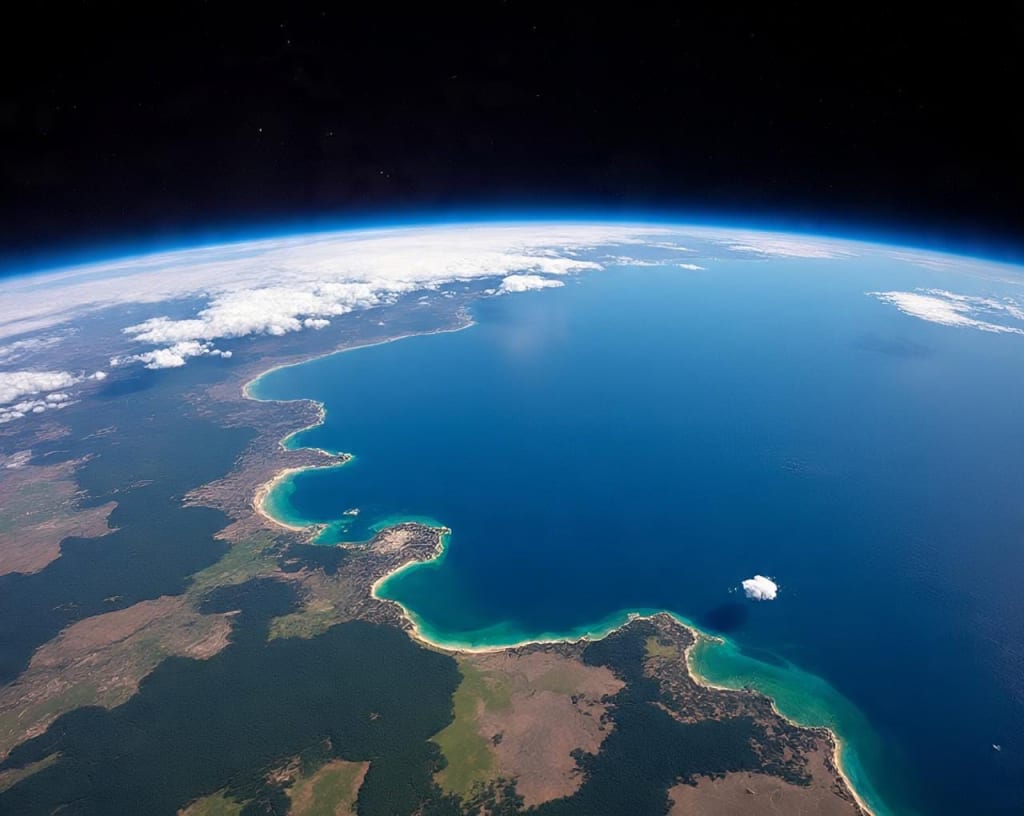
How Fast Does the Earth Spin?
Normally, the Earth takes 24 hours to complete one full rotation on its axis. This is what gives us day and night. In reality, the Earth takes slightly more than 86,400 seconds (the exact number of seconds in 24 hours) to rotate once. Scientists have been measuring the length of the day very precisely for decades using atomic clocks, which are incredibly accurate.
However, the Earth does not spin at a perfectly constant rate. Several factors influence its speed, including the moon’s gravitational pull, the Earth’s molten core, ocean tides, and even winds in the atmosphere. Over millions of years, the Earth has been gradually slowing down because of tidal friction caused by the moon. That means days have slowly been getting longer — but recently, scientists noticed something surprising.
The Surprising Shortest Day
On 10 July 2022, the Earth completed its rotation 1.59 milliseconds faster than usual. This made the day slightly shorter than the standard 24 hours. It was the shortest day ever recorded since precise measurements began in the 1960s.
This is not the only time something like this has happened. In fact, scientists noticed that since 2020, the Earth has been spinning a little faster overall, leading to shorter days than expected. The 10 July event was simply the most extreme example so far.
Although 1.59 milliseconds may not seem like much, it is significant in terms of how precisely time is measured today. Technologies like GPS, the internet, and financial networks all rely on exact timing. Even tiny differences in time can affect these systems.
Why Is the Earth Spinning Faster?
Scientists are still studying the exact reasons why the Earth is spinning faster. There are a few possible explanations:
Changes in the Earth’s core: The liquid outer core of the Earth moves around the solid inner core. This can change how mass is distributed inside the planet and can speed up or slow down the spin.
Glacial melting: As ice from glaciers melts due to global warming, water flows into the oceans and redistributes the mass of the Earth. This can also affect the spin slightly.
Chandler wobble: The Earth does not spin perfectly straight; it wobbles slightly on its axis, something called the Chandler wobble. Changes in this wobble may also influence the speed of rotation.
What Does It Mean for Us?
For ordinary people, a day being 1.59 milliseconds shorter makes no noticeable difference. We cannot feel the Earth spinning faster, and it does not change how we live our lives day to day. However, scientists and engineers who work with high-precision systems have to adjust their calculations to keep everything in sync.
For example, timekeepers sometimes use something called a leap second, which is either added or subtracted to keep atomic clocks in line with the Earth’s rotation. If the Earth keeps spinning faster, scientists may one day have to introduce a negative leap second, something that has never been done before.
A Window into Our Planet’s Behavior
The fact that the Earth is spinning faster is not dangerous, but it is an interesting reminder that our planet is a dynamic, living system. The movements of the core, the oceans, the atmosphere, and even ice melting at the poles all interact to affect the spin.
By studying these small changes, scientists can learn more about the Earth’s interior and climate system. It also shows how connected everything on Earth is — from the deep core to the winds in the sky.
Conclusion
The shortest day recorded on 10 July 2022 was an exciting milestone in Earth science. It showed that the Earth can sometimes spin faster than expected, making the day just a little shorter. Although we cannot feel these changes, they are important for understanding how our planet works and keeping our modern technology running smoothly.
As we continue to monitor the Earth’s spin, we may discover even more surprising facts about our incredible planet. The shortest day may just be the start of a fascinating new chapter in the study of Earth’s behavior.
About the Creator
Hamd Ullah
Sharing real stories and positive message to inspire heart and mind.
Keep reading
More stories from Hamd Ullah and writers in Earth and other communities.
A building's lifetime climate impact is mostly determined by its daily energy use.
The majority of a building's climate impact is not caused by its construction. As the heating, lighting, and ventilation systems continue to function year after year, it gradually accumulates.
By Francis Dami4 days ago in Earth
Workers Recover 15,000 Crabs After Lorry Crashes Into Field
An extraordinary scene unfolded when a lorry carrying an estimated 15,000 live crabs crashed into a field, spilling its cargo across farmland and prompting a large-scale recovery effort. The unusual accident quickly drew attention from local residents, emergency services, and animal welfare groups, as workers scrambled to rescue as many crabs as possible before they succumbed to exposure.
By Aarif Lashari5 days ago in Earth
Ludacris and Nelly draw backlash over bookings at MAGA-coded music festival
Ludacris and Nelly headlining a mostly right-wing event is good for them. It’s also great for the genre of hip hop. The two rap veterans have showcased their talents on other stages. Why can’t they perform for mostly MAGA folks and grab that bag?
By Skyler Saunders4 days ago in Beat




Comments
There are no comments for this story
Be the first to respond and start the conversation.