
Beneath the Surface: The Hidden Systems That Shape Our World
An Exploration of the Invisible Forces Behind Technology, Nature, and Society
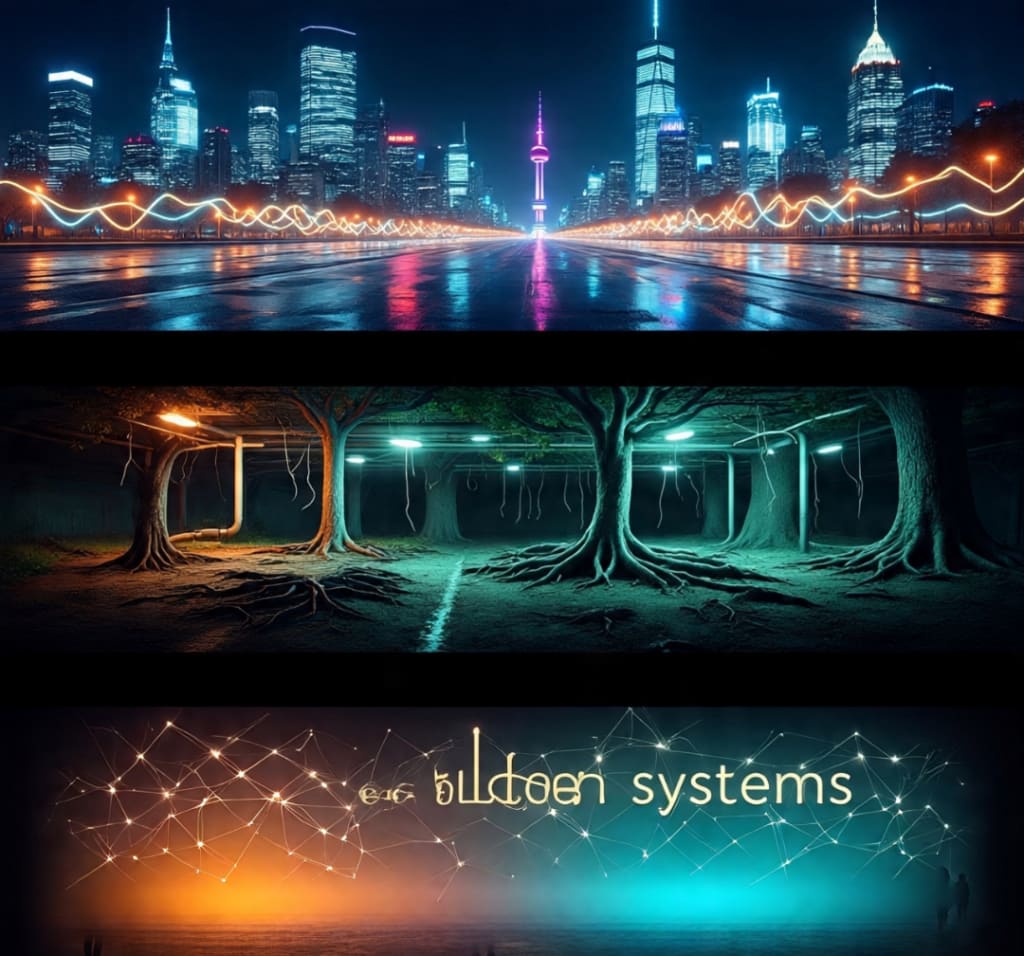
Every morning, as the sun stretches over the skyline and the city hums to life, Maya steps outside with her coffee in hand, barely thinking about the world beneath her feet. To her, the day begins with traffic lights, notification sounds, and digital calendars. But unbeknownst to her—and most people—the real machinery of modern life operates beneath the surface.
Maya is a systems analyst for a tech firm, someone who understands digital frameworks and backend processes. Yet one morning, while stuck in a subway delay, she began to wonder: What else am I missing? That moment sparked a journey of curiosity. What are the invisible forces that make our world function?
Her first stop was her own domain: the digital world.
Behind every online purchase, GPS ping, or video stream lies an intricate ballet of signals bouncing between cell towers, data centers, and undersea cables. For instance, when Maya texts her sister in another country, the message doesn’t float magically through the air—it’s routed through thousands of miles of fiber-optic cables on the ocean floor. These global data highways, invisible to the naked eye, form the backbone of the internet.
“People think the cloud is this mysterious place in the sky,” one network engineer told her. “But really, it’s warehouses full of blinking servers powered by electricity, cooled by complex HVAC systems, and monitored 24/7.”
Even electricity itself is a hidden marvel. Power grids stretch like nervous systems across continents. Electricity travels from wind turbines and power plants to substations and transformers, eventually lighting up Maya’s apartment with a simple flick of a switch. She realized how rarely she thought about these grids—until they went down.
But not all invisible systems are man-made. Nature, too, operates vast hidden networks.
Intrigued, Maya visited an environmental research center, where a biologist introduced her to the “wood wide web.” Beneath forests, tree roots are linked by vast fungal networks—mycorrhizae—that transport nutrients, share chemical signals, and even warn neighboring trees of danger.
“In a way,” the biologist said, “trees talk to each other underground. An old tree might share sugars with a sapling. A diseased tree might be quarantined by the network. It’s cooperation, not just competition.”
Maya was fascinated. Beneath the soil she walked on every day, entire communication systems were silently at work—natural versions of the internet, formed long before humans built their own.
Even urban life rests on unseen natural processes. Storm drains and aquifers redirect rainwater. Pollinators like bees, largely unnoticed, enable a third of the global food supply. Microbes in the human gut—trillions of them—help digest food, fight disease, and even influence mood and behavior.
The more Maya learned, the more she realized: The world isn’t just built above ground or on screens—it’s powered by ecosystems, machines, and networks we rarely see or appreciate.
One day, Maya took a walk through a local park. As she sat on a bench, she watched people scroll their phones, jog past trees, and chat on benches. She began to reflect on society’s hidden systems—those built not of metal or mycelium, but of behavior, trust, and connection.
Take language, for example. It’s an invisible code humans use to pass knowledge, express emotion, and preserve culture. Or consider the financial system—money moves between banks in digital pulses, governed by trust, agreements, and regulations. Even democracy itself is a system: reliant on participation, belief in fairness, and shared values.
Perhaps the most powerful hidden system is human connection.
Every time a neighbor helps another, when people vote, when communities organize or when ideas are shared—it’s part of a vast social network. Much like the forest, societies thrive when connected, and falter when those connections break down.
By the end of her exploration, Maya’s view of the world had changed. She now saw the layers that lay beneath the surface—technological, biological, and social. She began to ask more questions. What systems do we depend on without realizing it? How do these systems adapt—or collapse—under pressure?
She realized that progress didn’t just mean faster phones or taller buildings. True progress meant understanding the systems that sustain us, and ensuring they remain strong, equitable, and resilient.
That night, as she looked out her window at the glowing skyline, she felt awe. Not just at the beauty of the city lights, but at everything that made them possible—from the silent currents of electricity, to the fungi in the soil, to the people who keep things running, often unseen and unthanked.
Because beneath the surface, the real world is always at work.
And to truly understand our future, we must learn to see what’s hidden.
About the Creator
Keep reading
More stories from Muhammad Saad and writers in Earth and other communities.
"Earth Speaks: The Untold Story Beneath Our Feet"
We walk on it, build on it, and live because of it — yet we rarely listen to it. Earth, our only home, isn’t silent. It speaks in tremors, whispers through winds, sighs with the melting of glaciers, and groans under the weight of human industry. If we pay close attention, Earth tells a story — ancient, urgent, and unfolding in real time beneath our feet. The Living Planet Earth is not just a rock floating in space; it’s a dynamic, living system. The concept of Gaia Theory, introduced by scientist James Lovelock, suggests Earth functions like a self-regulating organism. Its oceans, forests, atmosphere, and even the soil interact like organs in a body, working together to sustain life. Soil alone is more alive than most people imagine. Just one tablespoon contains more microorganisms than there are people on Earth — fungi, bacteria, and other tiny creatures that make life above ground possible. They decompose organic matter, fix nitrogen, and help grow the food we eat. Yet much of this underground world remains a mystery, a silent story still being uncovered. Earthquakes and Fire: The Planet’s Pulse Sometimes, Earth speaks more forcefully. Every day, there are thousands of small earthquakes around the globe. Most go unnoticed, but they are signs of the planet’s internal motion. These tremors happen as tectonic plates — massive slabs of Earth’s crust — shift and grind against each other. This process has shaped continents, created mountains, and caused devastating events. Volcanoes are another voice of Earth — sometimes violent, sometimes subtle. While eruptions can destroy, they also give life. Volcanic soil is among the most fertile on the planet, and eruptions have played a key role in shaping our atmosphere and ocean chemistry over millions of years. The Climate Conversation In more recent decades, Earth has been speaking louder and more urgently. Temperatures are rising, glaciers are retreating, oceans are warming, and extreme weather is becoming more common. These are not random occurrences — they’re symptoms. Imagine Earth with a fever. Carbon dioxide and methane — greenhouse gases from burning fossil fuels, deforestation, and agriculture — act like a blanket, trapping heat in the atmosphere. The more we burn, the thicker the blanket becomes. Earth is responding. In the Arctic, sea ice once as old as ancient civilizations is melting at record speeds. Coral reefs, often called the “rainforests of the sea,” are bleaching and dying as ocean temperatures rise. Droughts, floods, and wildfires are becoming part of a new normal. The Hidden Layers: What Lies Beneath Beneath the crust lies a realm of heat and pressure that powers the engine of plate tectonics. Deeper still is the Earth’s core — a swirling sea of molten metal that generates our magnetic field, shielding life from deadly solar radiation. These deep systems may seem distant, but they affect our daily lives. Without the magnetic field, GPS satellites wouldn’t work, power grids would be vulnerable, and our atmosphere could be stripped away by solar winds. Even deeper, scientists are now exploring the possibility of a “deep biosphere” — a hidden world of microbial life miles beneath the surface. Some of these microbes live in environments so extreme they challenge what we thought life needed to survive. What we learn from them may help us understand life on other planets, and our own origins. Are We Listening? The truth is, Earth has always spoken. But have we been listening? Indigenous cultures have long viewed the planet as a living entity, something to respect and live in balance with. Modern science is now catching up to this wisdom, revealing how interconnected everything is — from the roots of a forest to the clouds in the sky. We are part of this system. Our actions ripple through Earth’s systems in ways both visible and hidden. But here’s the good news: we also have the power to heal. Regenerating soil, restoring forests, reducing emissions, and shifting how we interact with nature can all help rewrite the next chapter. The Next Chapter Earth’s story is still being written — and we’re not just readers; we’re authors. The question is, what kind of story do we want to tell? One of collapse and silence, or one of listening, healing, and coexisting? If we pay attention to the signs — the language of wind, water, stone, and soil — perhaps we’ll hear not just warnings, but guidance. Earth is speaking. And the time to listen is now.
By Muhammad Saad 8 months ago in Earth



Comments
There are no comments for this story
Be the first to respond and start the conversation.